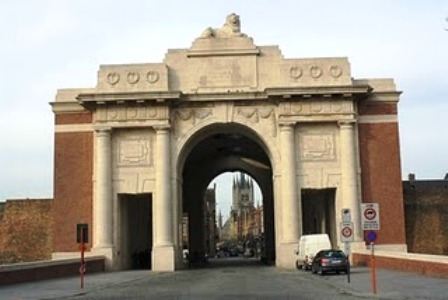
Click thephoto of Menin Gatesabove to
see an album of photos,then close the window to return to our website.
Click here to read
Part 1:
Vimy Ridge France
Thursday 25 March 2010
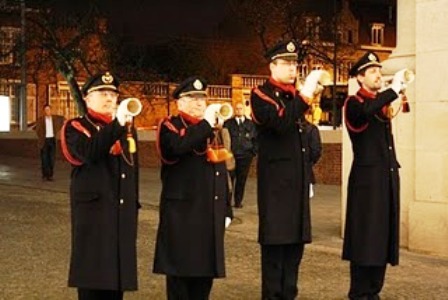
Playing the Last Post
We have come to the medieval city of Ieper (Ypres) in Belgium to
explore the WWI sites nearby. We have checked in our Bed and Breakfast
and have walked to the Menin Gate to join dozens of others waiting for
the Last Post ceremony that has started promptly at 8 PM each evening
since 1928. Every evening is different, depending on who is in
attendance. Tonight there is a small contingent of local service people,
school groups from Scotland and Britain and many tourists. The traffic
has been stopped and we have a front row view of the proceedings. Five
buglers from volunteer fire brigades form a row at the eastern end of
the gate, accompanied by a woman from the Scottish school group with her
bagpipes. The buglers play the Last Post, followed by a recitation of
the exhortation from Laurence Binyon’s “for the Fallen”:
They shall not grow old, as we who are left grow old,
Age shall not
weary them, nor the years condemn.
At the going down of the sun and
in the morning,
We shall remember them.
There is a minute of
silence followed by the laying of wreaths by local officials and two
school groups. The ceremony ends with the Reveille played on the
bagpipes. It is incredibly moving, so much so that we return the next
night to witness the ceremony again.
The
British Government built the gate, finished in 1927, on the road that
marks the starting point for one of the main roads out of the town that
led Allied soldiers to the front line to the east of the city. It
commemorates the more than 250,000 British Commonwealth forces who were
killed in four battles around Ieper defending the Ypres Salient, the
main battle line. The gate is more than a simple archway. It forms a 20
M long and 14.5 M high Hall of Memory arching over the road. More than
100,000 soldiers have no known grave, of whom the names of 54,896 killed before 16 August 1917 are inscribed on the walls of the monument.
Ieper (Ypres) itself was a lovely city to visit. Completely destroyed
in 1914 by German artillery attacks, the citizens were evacuated and the
city was later retaken by British and became a British military center.
At the end of WWI, Winston Churchill wanted to preserve the city as a
memorial to the horrors of war. The Belgians disagreed. The Belgian
Government subsidized all citizens who wanted to return and rebuild,
which they did, magnificently. Rebuilding was also financed by payments
from Germany as reparation.
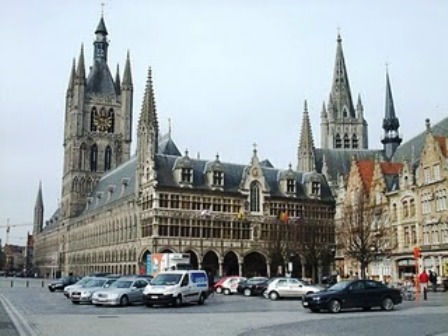 There
There
is an excellent walking trail on the rebuilt ramparts of the old city
walls next to a moat. Flemish style buildings abound. Medieval churches
and the Cloth Hall, with its 49 bell belfry have been restored. The
Cloth Hall, once the trading center for the local weaving industry and
the repository of the City treasury, now houses the excellent In
Flanders Field Museum. We spent one morning in the museum experiencing
the displays with an excellent explanation of WWI origins and
experiences in the trenches. It certainly answered many of our questions
about the WWI experiences in the area.
Ieper bills itself as the City of Peace, but it is also known as Cat
City. In medieval times, live cats were thrown from Cloth hall belfry to
ensure good luck. Now a jester throws toy cats from the belfry and there
is a Cat Parade every third year on second Sunday in May with everyone
in cat costumes.
John Stephens had included a suggested circle tour of Canadian
cemetaries and memorials on his website, which we used as a base for an
afternoon tour. We managed to visit several important sites near Ieper.
Our first stop was the Hill 62 Memorial and Sanctuary Wood cemetary. The
memorial commemorates battles between April to August 1916, the first
time Canadian forces were in a planned offensive. The memorial site gave
a good view of the southern stretch of the Salient line.
Our next stop was the Passendale (Passcendaele) memorial. If you
haven’t see the film by Paul Gross, produced in 2008, it is worth while
renting. It depicts a battle of Oct/Nov 1917, ultimately won by
Canadian and British forces, but at a horrific loss of life. The
Canadian General Currie, Commander of the Canadian Corps, who had
excelled at Vimy Ridge, warned of huge loss of life and tried to disuade
the British from their plans but was overuled. Record rains had created
a sea of mud in which soldiers who slipped off wooden walkways were
drowned. The battle was won but at the cost of 15,654 Canadian soldiers
and about 500,000 Commonwealth lives were lost for a gain of a mere 2 sq
miles.We had missed the turnoff to the Tyne Cot British cemetary on our way
to Passendale, so we backtracked and visited this impressive site. It
was the British tradition to bury soldiers killed in battle at the site
of their death. Tyne Cot greatly expanded an original battlefield
cemetary of 353 graves to include include those follen in the
battlefields and those buried in smaller cemetaries nearby. It is now
the biggest Commonwealth cemetary and the most visited. A very good
visitor’s center was opened by Queen Elizabeth and Prince Philip in 2007
and is well worth visiting. Included in the cemetary is a Memorial to
the Missing. The back wall is inscribed with the names of 35,000 British
and Commonwealth soldiers who died after 17 August 1917 and whose graves
are unknown.
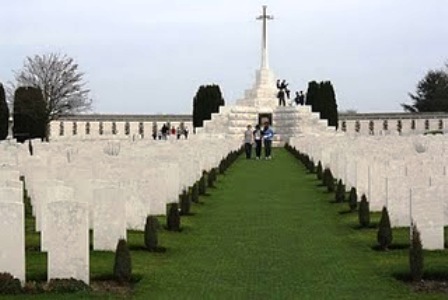
Tyne Cot British cemetary
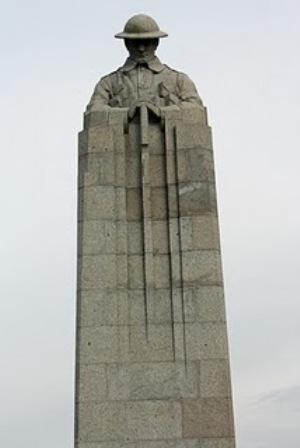
Brooding Soldier
Frederick
Clemens was the second place winner of the contest to design the Vimy
Ridge Memorial. His design was originally intended to be the built
for the remaining Canadian memorials. It was so impressive that the
sculpture of the Brooding Soldier, was built near St Julien and not
repeated elsewhere. It is a beautiful, evocative monument that stands
beside well-tended gardens at a cross roads as a monument to the
futility of war. The site commemorates 2,000 Canadian soldiers who were
victims of the first German gas attacks between 22-24 April 1915.
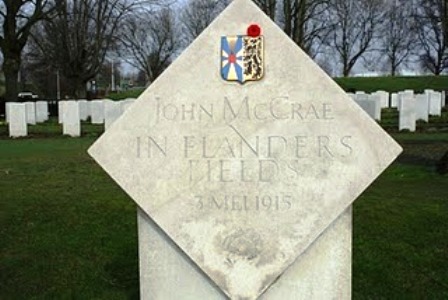 Our
Our
last stop of the day was not to be missed. John MacRae, a medical doctor
from Guelph Ontario, volunteered early in WWI. He was stationed at a
field station on the site of the John MacRae Memorial and Essex Farm
Cemetary where he composed his famous poem “In Flanders Fields” in
bunkers used as medical stations. The poem, memorized by generations of
Canadian school children, is inscribed on a plaque on the site. It is
also included in the In Flanders Field museum in Ieper and recited
ecovatively as part of the displays.
We visited only a portion of the cemetaries and
memorials to WWI in France and Belgium. We met several people who were
on repeat trips to the area. Many had become students of the history of
this period, learning more each time they came back. We would return as
well, even exploring the area by bicyle as there are 1,000 Km of bike
paths criss-crossing the countryside. It was an unforgetable visit.
Click here to read
Part 1: Vimy Ridge France
Return to
France Intro
Page
Return to
Travels
Return to
Introduction