Episode 8: Ooty to Varkala continued
Page 2
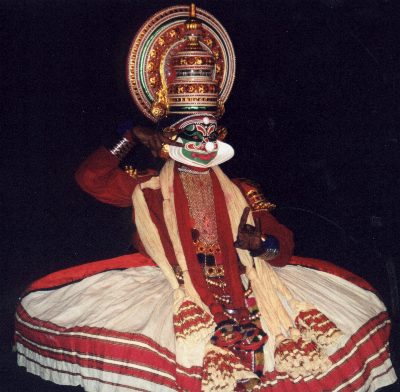
Villain in Kathakali play
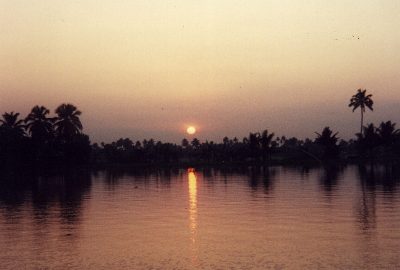
Sunset over the Kerala canals
Read Previous Episode:
Hampi to Madikeri
February 10, 2001, Varkala Beach
continued
from
Episode 8: Page 1
Madurai is famous for its colourful temples, and our
hotel was right next to Kudalagar Temple, a smaller
version of the Sree Meenakshi Temple. Kudalagar, with a
central tower dedicated to Vishnu and two smaller towers
(gopurams) for Vishnu’s two wives, had a resident
elephant. Once or twice a day the handlers would walk the
elephant next door to the yard in front of our hotel,
much to the delight of the guests. We toured Kudalagar
with the help of a guide. He led us around the dark
corridors surrounding the ground floor temple to proudly
show us the resident family of bats. We hoped they would
stay asleep. For Rs 1 each, our guide got the keys to the
tower stairs so that we could view the Vishnus on the
upper two floors and go out on the roof to admire the
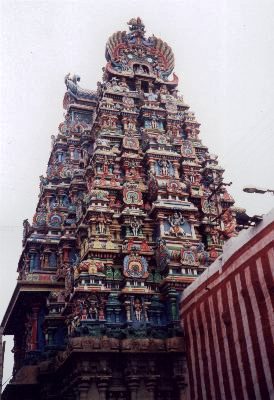
gopurams up close. The exterior of all three gopurams was
covered in stone sculptures, painted in the favourite
rainbow sherbet colours, and depicting the life of Vishnu.
The temples themselves are centuries old, but the
painting of the sculptures started only about 100 years
ago.
 The
The
next day we walked to the Sree Meenakshi Temple complex,
where we had to remove our shoes and leave them for
safekeeping across the street from the entrance gate. The
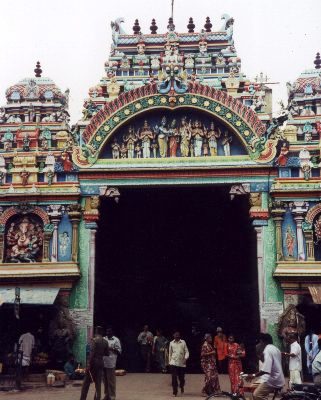
Sree Meenakshi complex, encompassing 12 towers (gopurams),
covers several hectares and is surrounded on all four
sides by high walls. Entrance is through gates, crowned
with the tallest towers, in the center of each side. Like
the Kudalagar, the towers are covered in gaudily painted
sculptures, this time depicting the life of Siva and his
consort Meenakshi. Each of the two tallest towers has
over 1,400 figures carved on its sides. There has been at
least one temple on the Sree Meenakshi site for at least
2000 years, but the complex as it currently stands was
built in the 15th and 16th C. The sculptures and all the
many interior decorations get repainted every 5 or 6
years, employing 400 artists for 4 months. We toured the
complex with a guide, who told us that Hindus consider a
pilgrimage to Sree Meenakshi as important a life event as
Muslims do a trip to Medina. The most popular time of
year for the faithful to come is in April, when over 10,000
people per day come to watch the ceremonies marking the
marriage of Siva. We watched the current worshippers wash
their feet and hands in the huge tank near the North
entrance before proceeding to pray at one or more of the
many interior temples.
 After finishing
our temple tour, we wandered through the market complex
across from the East gate. Madurai is known for its
cotton and silk materials and we couldn’t resist the
sales pitch of one of the merchants. Tailors, working
steadily at lines of machines in the market, sewmade to
measure clothing in a matter of hours. We returned before
supper that evening to try on and take home our purchases.
The last day of January we woke up to our second day
of rain in India. We were on our way again. This time we
took a long, 10-hour bus trip back to the western coast
of India and the town of Ernakalum. The steady drizzle
continued for almost half of our trip, including our
ascent of the Western Ghats. Fortunately, the clouds
lifted near the top and we were treated to a beautiful
trip down the western side of the hills.
It was dark by the time we reached Ernakalum, so we
found a hotel and asked the manager for a restaurant
suggestion. He directed us to a local hotel and told us
to be sure to stop at the temple across the street from
the restaurant after dinner to participate in the
festival in progress. We followed his recommendation and
arrived at the temple just in time to hear the end of a
performance by a traditional Indian orchestra. As they
were finishing, mahoots readied seven elephants for their
part in the proceedings. Large golden headdresses,
stretching down their trunks, were placed on their heads.
As soon as three were ready, their mahoot climbed on top
and unfurled a fringed parasol. One priest, carrying a
huge gold icon, climbed onto the center elephant, and the
line of three elephants, followed by more temple priests
with drums, cymbals and flutes and ending with a small
crowd of worshipers, started to circle the main temple. A
line of seven priests playing large circular trumpets
greeted their return. All seven elephants were lined up
behind the trumpeters, each now carrying three priests.
We watched and listened until the whole procession
started off around the temple again, then we went back to
the hotel. It had been a long day.
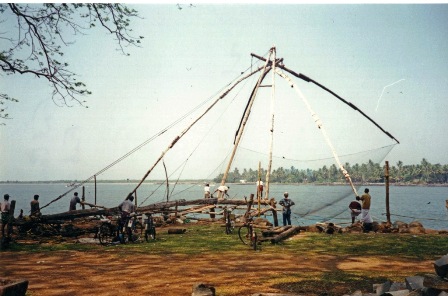 The next morning we took a short, 15-minute ferry ride
across the bay to Fort Cochin.
This is a sleepy
fishing and tourist town on a peninsula pointing north
from the mainland. We hadn’t decided how long we were
going to stay, so we did all the tourist things the first
day. The fisherman of Fort Cochin catch their fish using
permanently mounted Chinese fishing nets. These look like
giant Praying Mantises hanging over the water. Long
bamboo poles, lashed together near the shore, secure each
of the corners and the center of the net. At high tide,
the poles are tilted to lower the net into the water.
After a short time a group of up to seven men grab ropes
attached to the poles and pull in unison to raise the net
and inspect their catch. Their catch looked pretty meager
to us. Next to the Chinese nets is a line of fish stalls,
where you can choose your meal from the catch of the day.
The fish is taken to one of the several outside
restaurants facing the fish stalls, to be cooked to order.
The choice is not limited by what comes from the Chinese
Fishing Nets and the result is delicious.
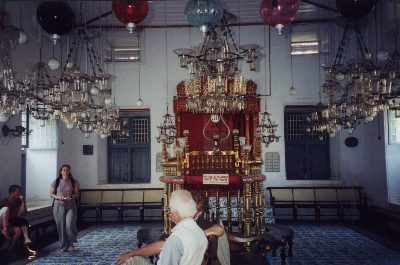 After lunch, we
took a rickshaw to the adjoining town of Mattancherry to
visit Jew Town. Jewish people came to this area 1200
years ago and established a reputation as spice traders.
There are only about 50 Jewish people left in the area,
but the Synagogue, which we visited, is still active.
Our first visit was to a spice shop where we bought
packages of masala mixtures and other spices. The owner
told us to look out for the Pepper Exchange, around the
corner. We followed a small group consisting of a Western
couple and two Indians through the front door of an
ordinary looking office building. A sign inside informed
us that we needed special permission to view the trading.
We got lucky. Just then one of the Indians with the group
in front of us came out of the office saying that they
were to go upstairs. Ray asked if we could come along,
and the man said sure. We went up to an open room on the
second floor, lined with open booths. The official group
were introduced to two traders, father and son, who
explained the operation to us. This is a commodity
trading operation, dealing in futures of black pepper.
The younger trader stopped to answer a telephone ringing
in his booth and immediately all hell seemed to break
loose. There were loud, demonstrative shouts between
several of the other traders in the room while the deal
was completed. It was quite exciting and reminded me of
the TSE before the departure of the floor traders. We
left the Western couple, who turned out to work for a
spice company in the USA, thanked our hosts and went out
to explore more shops in the area.
The streets are filled with interesting looking
antique stores, but we decided it would be impossible to
transport a large wooden chest or an entire wooden door
back to Ottawa. We walked a short distance to see the
Dutch Palace, now a museum. The Portuguese built the
original building and presented it to the local Raj in
the 16th C in return for trading concessions. The current
name came into common usage after the Dutch took it over
and made many renovations. The most interesting feature
of the building are the murals, depicting Ramayama
stories, painted on the walls of many of the rooms. In a
downstairs ladies bedroom is a rather erotic scene of
Krisha groping eight uncomplaining ladies, using all
eight of his arms and two feet.
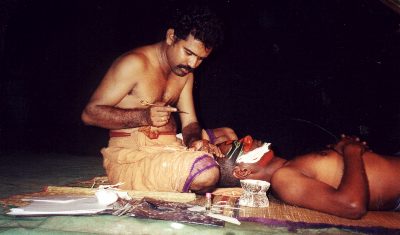
Applying makeup for show
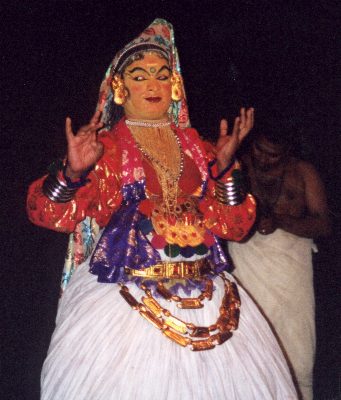
Heroine in Kathakali play
That evening we went to a performance of Kathakali
theatre.
We
went shortly after 5 PM to watch makeup being applied to
the actors. The main character, the bad guy, has an
elaborate green, red and black mask painted on his face
by an artist. The mask was completed with the application
of white paper wattles on his cheeks.
The other two
men, one taking the part of a heroine and the other the
hero, applied their own makeup. The performance, done in
mime, traditionally goes on for five or six hours, but we
watched a small portion that lasted an hour. It began
with an explanation of the elaborate eye and facial
expressions and the hand and arm movements used to convey
emotion and action. We were given an English precis of
the plot, so it was easy to follow the story. The whole
performance seemed to be similar to what I have read and
seen about Chinese traditional theatre.
We decided we liked the slow pace of Fort Cochin, so
we stayed another day just wandering about town and
relaxing. Saturday morning we took the local bus down the
coast to Appaluzha (Allepey).
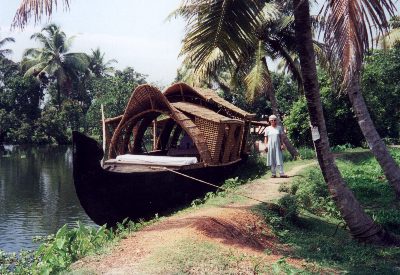
Kerala reed houseboat
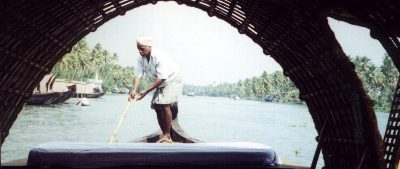
Houseboat poler
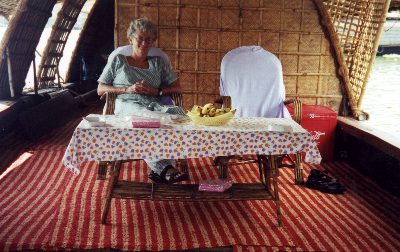
Lunch inside the boat
Our plan was to hire a houseboat to take us
through the
canals down the coast to Kollam. We found out our choices
were to take the regular tourist boat that takes eight
hours to reach Kollam or hire a private houseboat for a
tour of Lake Vembanad, returning to Allepey in 24 hours.
In fact, we could get on a houseboat right then, so
instead of staying overnight in Allepey, we agreed to
stay two nights on the houseboat. We took a rickshaw to
the houseboat jetty and boarded our home for the next two
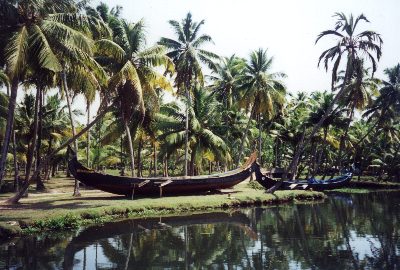
days. The base of the boat is a traditional oversized
wooden canoe.
The roof is
constructed of arched panels of woven bamboo covering a
seating area in the front and one bedroom and bathroom.
There was no motor on the boat. Instead a man at each end
used a long bamboo pole to propel the boat. Sibi, the
cook, who spent his time preparing large and delicious
meals for us, completed our crew. Our
days were spent sitting, reading and
playing cards, while we drifted past lines of small
houses built on narrow strips of reclaimed land between
the lake waters and rice fields on the other side. At
night, we moored off shore, near water lily fields that
were home to many kinds of waterfowl.
 Monday morning, we woke to
discover
we had moored for the night just off the houseboat jetty,
so it was an easy process to complete our journey and to
return to Allepey in time to catch the Tourist boat to
Kollam. I was a little concerned that three days on the
canals would be too much, but we are in gear down mode,
and it was fun. The canals on the way to Kollam were
similar to the lake, but wider and progressively more
populated as we neared Kollam.
We stopped for a quick Thali lunch en route, then made
a drop off and pick up stop at the Matha Amrithanandamayi
Ashram. A woman guru, known world wide as the Hugging
Mother is the guru. Miri, whom we had met previously in Ooty, rejoined
our boat. She told us that they had been part of special
festivities the day before. More than a thousand people
arrived to be greeted personally and hugged by Amma. All
kinds of special powers have been attributed to the Amma.
Miri, who is not a stereotypical Israeli, was impressed
that even without being told, the Amma greeted her with
‘mazel tov’. People claimed their lives are changed after
meeting the Amma, but Miri wouldn’t go that far.
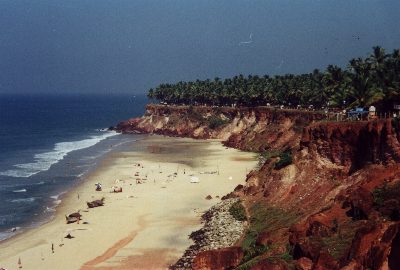 We spent the night in the forgettable town of Kollam
and took the local bus the next morning to Varkala beach.
This is where we are spending the rest of our time in
India.
The beach at Varkala doesn’t
compare to Goa, but the water is nice and warm and the
waves are fun to ride. We have a nice room on the cliffs
overlooking the most popular section of the beach. To
reach the beach you have to walk very carefully down 100
meters of steps cut into the side of the red sandstone
cliffs. Vigilant lifeguards, who blow their whistles to
warn swimmers when they have strayed beyond the safe
area, patrol Varkala beach. Apparently several people are
drowned each year, but the tides were not overly strong
while we were there and we are strong swimmers, so we
chose to ignore any whistles that might have been
directed at us.
Varkala is still an active fishing community and we
liked to watch the fishermen launch their boats. They use
two different kinds of boats. The most common is what I
call a Kerala Kayak. It is simply three logs, tapered at
one end and curved like a banana. The boat is self-bailing
as the logs are simply lashed together at both ends. One
or two fisherman paddle their craft like a kayak, using a
bamboo length split in two as a two-ended paddle and cast
a small net from the boat.
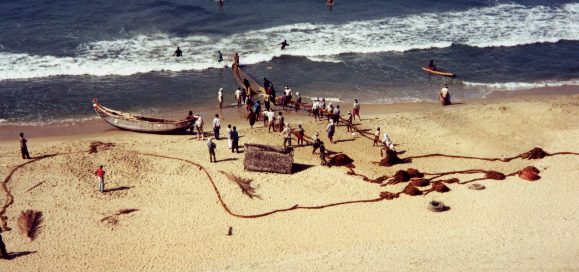 We watched a large cooperative effort several mornings.
One of
the large fishing boats, similar to the base of the
houseboat we were on, and about five meters long and
about than two meters wide, went out early to set a large
net. The net was really a large purse attached to two
long ropes, strung with floats to keep it on the surface.
Both rope ends were anchored on the beach and the purse
end floated about 200 meters from the shore. When the net
was ready to be brought in, a crew of about 20 fisherman
at each end of the net pulled from the shore. Other
fishermen stayed in their small boats at the far end of
the net to prevent any fish loss. A few other fishermen
waded into the water to make sure the net was hauled in
straight. The catch, when it was finally hauled in, was
many small, silver fish that are used in fish masala. It
looked like a lot of effort for a relatively small catch.
One day, word must have been passed that bigger fish
were in the area. The large fishing boat set out again to
set the net and there was great excitement when the
second catch was hauled in. They had netted a large
school of Butterfish, which are fat silver fish between
two and four feet long. All the local people, including
the restaurant owners, were haggling over the price and
carrying their purchases home for dinner.
One afternoon we walked north from the main beach
along a path along the top of the cliffs to explore some
of the other, more private beaches that dot the coast.
The first one we came to already had several sunbathers
and swimmers, so we continued on. We watched a western
couple get on one of the Kerala Kayaks with a fisherman
and paddle in our direction. Suddenly, I noticed a fin
come out of the water just ahead of the boat. It was a
dolphin, come to greet them. There were at least two of
them and they stayed quite close for a short while. The
fellow on the boat jumped off a few times to try to swim
nearer the dolphins, but they kept their distance. We
stopped at a lovely, deserted beach, about 1/2 K long.
The water was great and there were no beach hawkers to
disturb the atmosphere.
 Yesterday morning we walked along the cliffs to the
south of the main beach. The cliffs are even higher at
that end, so the beaches are more difficult to reach. We
stopped at one of the few guesthouses along the cliff and
took their path down the cliffs to the beach. The drop
was twice the height of the main beach and I decided the
paths at our end of the beach were a piece of cake in
comparison. We walked back along the beach, wading into
the water in places and scrambling over rocks in others.
It is no wonder that these beaches are not very popular.
We plan to stay
at the beach until Sunday afternoon, when we will take
the bus to Thrivuvananthapuram (Trivandrum). From there
we catch a flight Monday morning, via Bahrain and London,
arriving back in Ottawa Tuesday, Feb 13. In the meantime
we are enjoying the swimming and trying to avoid a last
minute sunburn.
See you back in the Great White North.
Return to
The India Chronicles Intro
or
Travels
or Introduction