Episode 7: Hampi to Madikeri
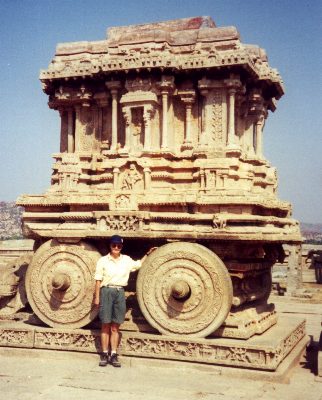
Stone Chariot at Hampi
Read Previous Episode:
Ajanta to Benaulim, Goa or Next
Episode: Ooty to Varkala
Wednesday January 24, 2001, Madikeri
Well,
the overnight bus ride to Hampi was an experience,
probably one time only. The bus was one of the newest we
have traveled on in India, but that doesn’t mean it was
comfortable. The bus has about six rows of regular
upright seats in the front and then six sets of two
tiered bunks. I was expecting single bunks, like the
trains, but they are all double. If you are not traveling
with a close friend, you certainly get very close to a
new friend on this trip. Ray & I shared an upper bunk
and it’s a good thing neither of us is very tall as there
was room for me to stretch out, but anyone over 5 ft 9
inches would have problems. This wouldn’t have been too
bad, except the road was extremely bumpy and the bus was
missing a few of its gears. The driver had to keep
shifting, very noisily, and each time the bus would loose
power. We left at 8:30 PM from Margao, Goa and limped
into Hampi about 9 AM, having managed little sleep. It
could have been worse. Two couples arrived at our
guesthouse two days later rather the worse for wear. It
seems the bus finally broke down in the middle of the
night and they all had to disembark and wait for a
replacement to continue the trip.
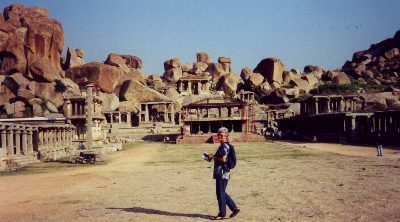 Anyway, Hampi was worth the trip.
We stayed in a very
simple but friendly Guesthouse and spent four days
exploring the area. Hampi, or Vijayanagar, was the
capital of one of the largest Hindu empires in India,
rivaling Delhi, until it sacked and ruined by Mogul
invaders in 1565. In its hay day, the city covered 33 sq
Km and had a population of half a million. This whole
city is in a semi-desert area strewn with large, smooth
boulders, much like I would image the badlands, or Fred
Flintstone’s home in Cactus Rock to look like. Apparently
it had volcanic origins that were
later covered by an ocean, which washed the many boulders
smooth. Excavations of the area started in 1976, with the
majority done after 1985. The ruins include seven very
large bazaar areas, one for each day of the week, the
foundations of numerable houses, temples and other public
areas.
We arrived in Hampi on the day of one of the major
religious festivals in the area, celebrating the change
in the angle of the sun, so instead of a sleepy town, we
were surrounded by thousands of Indian Pilgrims coming to
pay homage in the still operating Virupaksha temple and
bathing in the Tungabhadra River, next to the town. The
majority of people left that first Sunday and the
remainder were gone by the end of Monday, when the town
re verted to its usual quiet self.
 We spent the first two days exploring the area on our
own, using a not very good guidebook. I got frustrated
getting lost and not knowing what I was looking at, so we
hired a local guide for the day and really saw the sights.
One of the highlights for us included the Virupaksha
temple complex, complete with a resident elephant, the
symbol of royalty, right in the village. Numerology
played a big part in the design of the temple. The temple
consists of seven main towers of varying heights,
arranged so that worshipers say their prayers at specific
locations where all 7, 5, 3 or just one tower is visible.
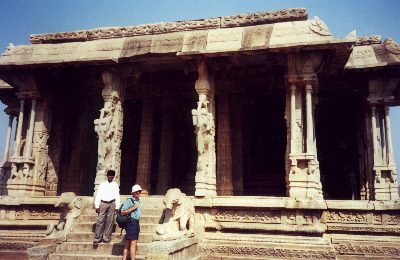
There was also a side pavilion with a roof held up by
many stone pillars, many of which consist of one main
pillar and three side pillars. The stone contains quite a
bit
of iron, so that when the side pillars
are tapped with the hand or a baton, they emit a musical
note. The diameter of the pillars varies so that each
group when played together makes a chord. This same m
usical pillars are also a feature of the Vittala temple,
about 1 Km away. During major festivals, up to 80
musicians would strike the pillars to provide the music
to accompany dancers.
Some of the temples in the Vittala temple complex had
been designed with a complicated system of channels to
funnel off the monsoon rains and with built in stone
loops to attach curtains around the open sides to shield
the worshipers from the rains. In the courtyard of the
Vittala complex stands a huge, heavily carved, stone
chariot whose wheels used to turn. It was used to
transport priests from one temple to another as part of
their ceremonies.
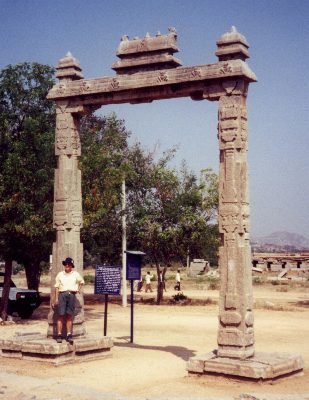
King’s Balance Gateway
Outside the
Vittala complex is a large stone gateway, called the
King’s Balance. A few times a year the King and his
noblemen would gather for a unique form of taxation. A
large scale was suspended from the center of the gateway
and the King sat on one side. The noblemen were then
required to contribute enough gold and jewels to balance
the King’s weight. The fatter the King was, the more he
collected.
To get to the Royal enclosure
area, about 2 Km away from the town, you walk through
banana plantations irrigated by ancient canal systems. In
this area there are the ruins of foundations for many of
the nobelmen’s houses, several watchtowers, a Royal
viewing platform, an audience hall with a secret
underground room next to it where private arrangements
could be made without fear of being overheard. There was
also the women’s compound, the heavily walled Zanana,
with temples and the lovely Lotus Pavilion to sit in and
enjoy the views.
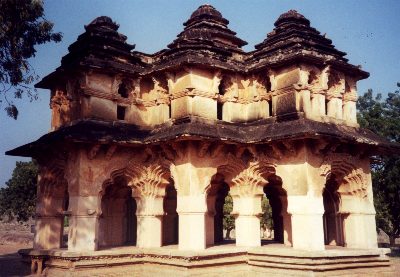
Lotus Mahal
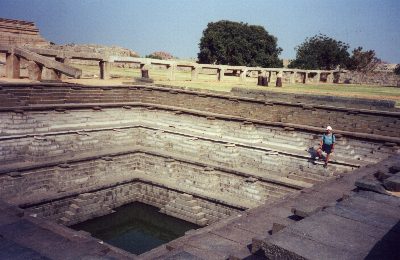
Step Tank
Bathing must have been an
important part of their lives as this is where we saw an
advanced aqueduct construction that provided water to
three major baths. The most elaborate was the Queen’s
bath, an eight-foot deep pool, filled and emptied every
day with fresh water. The pool was surrounded on four
sides by rooms on two stories. The bottom floor rooms
were open to the pool and designed to let in the maximum
light and air while the upper rooms were fronted by large
stone bay windows. Nearby was an interesting bathing tank
for the noblemen, called the Step Tank. The four sides
descend from the ground to the bottom of the pool in a
series of steps, arranged artistically from each corner
and in the middle of each side.
This allows
access to the water no matter how deep the water was.
Even the public bath was impressive, as it was easily as
big as two Olympic sized pools.
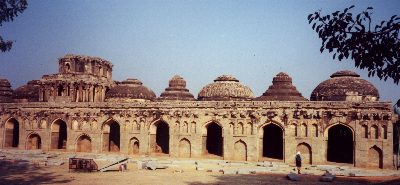
The Royal elephants were
obviously prized as there was a large, elaborate home for
11 elephants with individually decorated rooms and a
large building next door for the Mahoots, their handlers.
Our last day in Hampi, we walked to the temple at the
top of Matunga Hill, just outside of town. From the
rooftop of the temple you can get a great 360 view of the
surrounding countryside. For lunch we walked alongside
the river to a restaurant called Under the Mango Tree.
You sit on straw mats on a series of concrete terraces
built on the hillside overlooking the river. It was a
very relaxing and popular spot to spend a few hours.
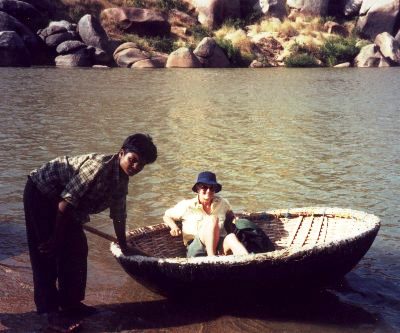 In the afternoon,
we crossed the river in a coracle, a small boat made of
woven bamboo strips, the size and shape of a satellite
dish, and waterproofed on the outside with tar. We
arrived at a busy time, so we were two of about 12
people, at Rs 5 each, squished into the bottom of the
craft and propelled across by one man using a single
paddle. We walked around the guesthouse area favoured by
the longer term travelers who like to pay about Rs 50 for
a crude straw or mud shack with a mattress on the floor.
We followed a road that turned into a dirt path through
rice fields and along the bottom of the rocky hills. Our
objective was to reach the river further upstream, where
I had seen another landing spot for the local boats. By
clambering over the rocks, we finally came to the river
where we could see some boats and owners on the other
side. I hailed one of the men on the other side, who did
cross over to pick us up. I think he was having a boring
afternoon, as part way across he stopped to demonstrate
how the boat could transform into a merry-go-round. We
made the other side safely.
Wednesday night we took the overnight train to
Bangalore, and then transferred to another train to
Mysore, arriving by 10:30 AM. This was the easiest trip
yet. The 2nd class sleeper was relatively comfortable and
the trains were even on time. My only problem was that
Hampi was very hot when we left and Bangalore was
considerably cooler. Consequently, we were soon putting
on additional clothes to keep warm in the train.
Mysore
is known for its silks, sandalwood oil and sandalwood
carvings, so we took a rickshaw ride to visit several
operations. In one
small shop we sniffed several different oils that are an
important part of Ayurvedic medicine, reputed to ease
pains and cure various ailments. I bought some water Lily
oil to keep mosquitoes
away and sandalwood oil for
massages. In a silk shop we placed an order for a new
nightshirt for Ray and new travel pants and top for me.
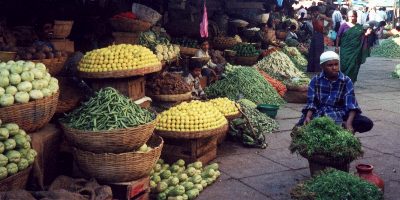
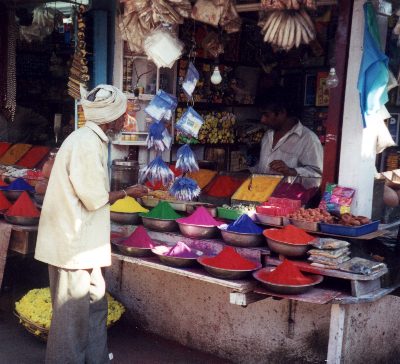
We also paid a visit to the huge Deveraja market, where
besides the displays of fruits and vegetables, there is a
large wholesale section selling flower garlands bought by
people to bring as gifts for the temples or to festoon
their homes and vehicles as good luck charms.
I took
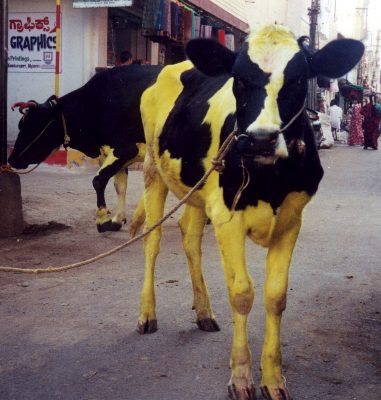
a double take at the cows wandering the streets of Mysore.
Instead of their usual white, or black and white colour,
these animals had their horns painted green, orange or
red and their whole bodies were covered in yellow or
chartreuse coloured chalk. I was told that their owners
did this during a special Puja, or prayer ceremony the
day before we arrived.
 Most of Mysore is a rather dirty, garbage strewn
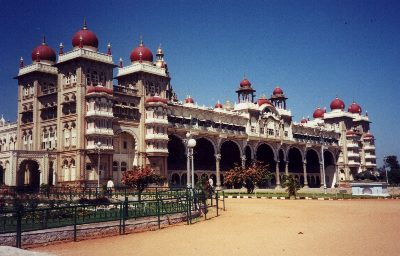
commercial area, but the Mysore Palace is a welcome
change. It was designed by an English architect for the
local Maharaja and built in 1912 for the sum of Rs 4.2
million.
Opulent even for those times,
decorated with stained glass, mirrors and gaudy colours,
the current Maharaja still lives in the rear portion of
the palace and opens the palace and grounds to the public.
When we finished our tour of the house and grounds, we
tried to find a doorway out to the street at the north
end of the complex, instead of returning to the far south
end. The gates were locked, but we saw locals climb over
the fence, so we just followed suit. I expected to hear
whistles blown any minute, but all was quiet.
Saturday we boarded a bus to Madikeri, a market town
built on the side of several ridges in the mountainous
region west of Mysore. The three-hour trip wound through
coffee plantations and citrus groves that cover the sides
of the steep mountains. This certainly was the most
scenic section of India we have been in to date. It
reminds me of the foothills in Nepal, only more heavily
forested.
We came to Madikeri to go on a trek up some of the
surrounding peaks, a popular activity in this mainly
undiscovered area. We had phoned ahead, intending to do a
three-day trek starting on Sunday, but I ended up with
another bout of Delhi Belly, so we delayed one day.
Instead, when I felt better later in the day, we walked
to a garden with a small pavilion, the Raja’s seat, on
one of the ridges in the town to enjoy the view and
explore the area.
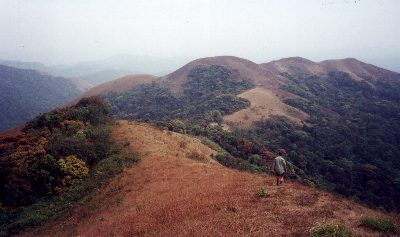 Monday we were driven just out of town where we joined
up with our guide, Bharath, and two young Israelis, who
had slept in a hut nearby overnight. The mountains with
the best trails are quite spread apart, so we hopped a
rickety local bus for a 45-minute ride over bumpy,
winding roads to a small village where we were to start
hiking.
We
left our overnight bags and blankets to be used that
night in a local house and started out through a coffee
plantation and through the jungle. There were no
civilized stairs to climb on this route. Instead we
followed a dirt path that became increasingly steep, but
not overly difficult, as we came nearer the top at 1,300
M after about two hours. The hill must have been logged
at one time, as it was covered only with grass and scrub
bushes. The view of the mountains all around was
spectacular, reminiscent of the Adirondacks, although
visibility was limited as it was a partially cloudy day
and the more distant hills were shrouded in mist.
After eating our pack lunches, Ray wandered a little
way towards the next ridge. He called back that he had
heard an elephant trumpeting in the forest below him, and
sure enough we all heard it several times again. Bharath
was quite worried that it might be a lone wild elephant,
considered dangerous, but he finally concluded it was a
herd of wild elephants and not quite so threatening. Try
as we might, we could not see them under the heavy cover
of the forest, we just heard them trumpeting and breaking
off tree limbs.
Finally, we gave up and descended to the road, picked
up our bags and boarded another bus to the tiny village
of Bhagamandala, 15 minutes away. We went to find our
assigned rooms in the local temple and to meet another
couple waiting for us. Paul, from Australia, and Eleanor,
from Sweden, had been stranded in the village by a bus
strike the previous day. Their guide had to return to
Madikeri to pick up more trekkers, so they had spent a
lazy day in the village and now joined in with us.
The temple consisted of an inner and an outer
courtyard. The outer walls were lined with guest rooms
and there was a temple dedicated to Ganesh in this
courtyard. Inside the inner courtyard were three other
small temples dedicated to Rama, Shiva and another God (there
are 3,000,000 gods to choose from). Our room was
certainly basic and the public toilet and bath facilities
were 100 M down the road. The room was just a concrete
cell with a simple wooden door and one electric light, so
we folded some of the many blankets we had brought to
make a mattress for ourselves.
At 7:45 that evening we all assembled to watch the
resident priests perform their Puja ceremony. We had
witnessed several versions of these prayer ceremonies,
but this was quite elaborate. I think that one of the
requirements for becoming a priest is the ability to play
the drums or a flute as these instruments accompany many
of the ceremonies. While the head priest did his thing in
each temple, some of the local people gathered rang bells
to wake the gods. After the head priest finished his
duties in the three inner temples, he emerged suitably
garbed in a red headdress and sash over his white robes
and carrying a large, gold icon. All the resident priests
then formed a procession and circled the inner temples
three times and then went through the doorway to the
outer courtyard, which they circled five times. Much drum
playing, symbol banging, flute playing and bell ringing
accompanied all of this.
We ate a simple, but good meal that night in a local
restaurant and retired to our rooms. Unfortunately, we
did not sleep as well as we had hoped. I had a hard time
adjusting to the lack of padding on our bed, but Ray was
soon asleep, only to be wakened after 1 AM by loud voices
in the room next door. There was an extended family of
six adults and two small children crowded in there, and
they decided to have a very loud discussion lasting
several hours in the middle of the night. Even our
earplugs were only marginally effective. Then at 5:00 AM,
the drums starting morning prayers began, followed by
loud, recorded Hindu music for 1/2 hour, to make sure
everyone was awake. This of course woke up the family,
who continued an even more angry discussion. Our wake up
call at 6:45 wasn’t really necessary.
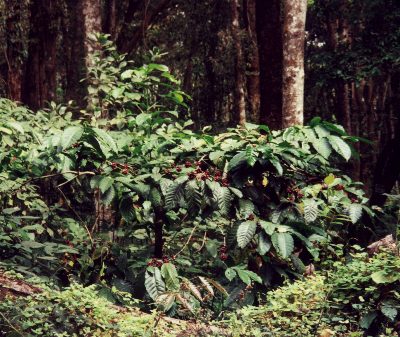 We got up, packed, ate breakfast in the
local restaurant and were on the bus at 8:00 heading to
the next hill. Fortunately, we got on at the beginning of
the bus route and had seats, for the bus traveled for the
next hour crowding more and more school children and
other people inside. Of course, this is the norm for
Indian buses, and everyone manages to keep their good
humours. We got off the bus and a few minutes later,
boarded a second bus for another fifteen minutes. We
walked to a local store where we stored everything we
didn’t need for the day and started up the road to
Taidyendamol, a 1,745 M peak. About 1/2 hour up the road
we took a break at an interesting looking lodge, the
Palace Estate Guesthouse. The original two bungalows,
probably built by the British as summer homes, are set
amongst lovely gardens amidst coffee and cardamom
plantations. The owners built a row of five rooms opening
onto a balcony, about two years ago, behind the bungalow,
for trekkers who wanted to stay longer in the area. The
rooms are simple, but the beds had mattresses. There were
no ensuite toilets but the row of facilities across from
the rooms had western style toilets that flushed by
pouring a bucket of water down them. It looked like a
peaceful place to spend a couple of days.
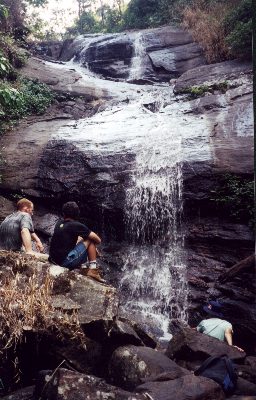 We continued our walk through the jungle and out into
the open to the top. It took us less than three hours,
counting rest stops, to cover the 1000 M distance from
the bus stop.
The
last section was quite steep again, but no one had any
difficulty. No elephants in the vicinity this time, but
the views of the mountains were just a good as the
previous day. After lunch at the top, we made it to the
Palace Estate in less than two hours, with a small side
trip to rest and cool our feet in a pool at the bottom of
a waterfall. Finally, we returned to the road, collected
our belongings and hopped on the bus for the return trip
to Madikeri, a 1/2 hour ride through small villages and
joining up with the main road from Mysore.
We were looking forward to going out again today for
another trek, but I am not over Delhi Belly, so we just
stayed put in Madikeri and I got a chance to write this
episode. Tomorrow we take a long bus ride through the
mountains to Udhagamandalam (Ooty), another British
summer residence in the nearby Nilgiri hills. I hope I
will be better by then and that we can explore a little
of that area on foot.
We are starting our countdown to the end of our trip
and trying to fit in all the other places we want to
visit. We anticipate a busy time on our return visiting
all our friends and family again. We trust you are all
well and enjoying the winter. We plan to come back with
good tans to make you all jealous.
Return to
The India Chronicles Intro
or
Travels
or Introduction