Episode 6: Ajanta to Benaulim,
Goa
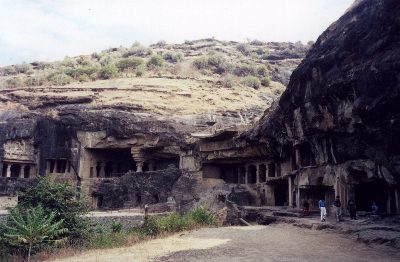
Ellora caves
Read Previous Episode:
Gujarat or Next Episode:
Hampi to Madikeri
Friday January 12, 2001 Benaulim, Goa
Hi
once again from the land of sun and surf. Hope everyone
is enjoying those crisp, clear winter days. We are now at
the beach in Goa, but continuing on from the last episode…
 We took the train from
Ahmedabad to Jalgaon, a sizable town that is probably not
on many maps, but is just an hour’s ride from the cave
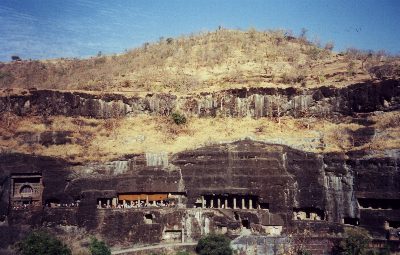
temples of Ajanta. Imagine the horseshoe shaped Niagara
gorge, all dried up, with 30 caves carved into the steep
sides just below t he rim. That is what Ajanta looks
like, except the caves were intended as Buddhist
monasteries and temples and date from around 200 BC to
650 AD. We took one of the local guides up on his
suggestion to get an overview of the caves and followed
him across the dry riverbed and up a path to the other
side from the caves. From there we had a good view of the
whole gorge. We continued on, crossing over to the cliffs
above the caves and walked along the periphery, looking
down into some of them.
 Finally, the path led down to the
entrance of the caves and we toured them from the inside.
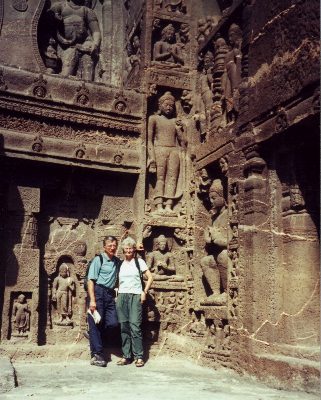
They are huge and
magnificently carved and painted. Most of them consist of
a large central room with many columns flanking the sides
or supporting the ceilings. They all have at least one
figure of Buddha and several are covered in multi
coloured frescoes, really tempera paintings on the rock
walls. The paintings depict the life of Buddha and the
columns and ceilings are decorated with geometric and
floral designs. Many are still in remarkably good
condition. Since this was Dec 29th and many Indians have
holidays at Christmas, there were quite a few tourists,
but we managed to avoid the crush and view them at our
leisure.
It was just mid afternoon when we had completed our
tour of Ajanta, so we decided to continue on to
Aurangabad, two hours farther south. While we waited for
the next public bus, we were offered a ride in a taxi
picking up passengers for the return trip to Aurangabad.
We hopped in the back and were joined in the rickety old
cab by a young family and brother-in-law. I was glad they
were in the front seat and not me, as the bumpy road keep
forcing the passenger side door open. When the other
passengers got out at the half way point, the driver had
to stop and find a screwdriver to fix the door. It didn’t
work very well, but we managed to arrive safe and sound
and find a convenient guesthouse.
The next day, Dec 30, our 35th wedding anniversary, we
took a short ride in the bus to the second group of cave
temples at Ellora. We took the public bus from town and
ended up getting two tours for the price of one. The bus
made an unexpected stop at the Grishneshwara temple where
most of the passengers on the bus were heading to pay
their respects. We were instructed by a helpful family
who spoke English to just hang around and enjoy the
market in progress around the temple and wait for the bus
to carry on to Ellora in about 15 minutes. Sure enough,
they were right, and we all re-boarded the bus and were
on our way again.
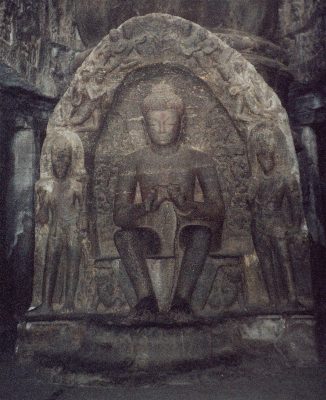
Elora Buddha
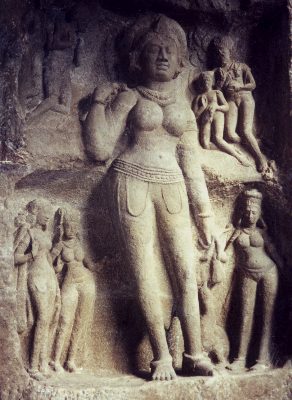
Elora Jain Temple carving
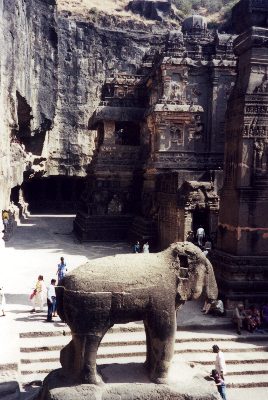
Elora Elephant carving
The slope of the
escarpment into which the Ellora caves are carved isn’t
as steep as Ajanta, so some of the 34 caves have
elaborate exteriors and courtyards.
The caves were
built first by Buddhists between 600-800 AD, continued by
Hindus between 600-900 AD and completed by Jains in 800-1000
AD. Several of the cave temples have remnants of
paintings surviving, but it is the sculptures that draw
the most attention. All
the Hindu caves were hewn out of the rock cliffs from the
top down, leaving huge rooms with the walls and multiple
columns covered in sculpted scenes. We toured them all,
spending the most time in the most famous and most
elaborate, the Kailasa, which certainly is impressive.
There weren’t very many non-Indian tourists,
so once
again we found ourselves the center of attention and were
asked to pose in family photos of their trip to Ellora.
Mostly, we obliged.
For our return trip to Aurangabad, we accepted a ride
in a Jeep taxi. We were the first passengers, but by no
means the last. The driver kept picking up passengers
until by my count we had 19 adults and 7 children, not
counting the driver. Ray ended up with a small child on
his lap for most of the trip. At least he was cute and
very well behaved.
Our last day in Aurangabad was also the first day of
rain. It was not hard rain, just drizzly most of the day.
This meant we cancelled plans to visit the local fort and
just made a short visit to a Himroo factory and a tour of
the old part of the city. The factory was set up with
government support to protect the dying art of Paithani
and Himroo weaving. Paithani is a very luxurious method
for making silk saris. It involves cutting threads
already woven into the fabric and superimposing new
designs into the material. It is done entirely by hand
and it is so time consuming that the weaver only
completes one or two centimeters per day. Naturally this
increases the cost, so these saris are bought for wedding
outfits or very special occasions and passed down through
the generations. Himroo is a local weaving method, using
cotton and silk. It is less complicated than Paithani,
and is practiced in fewer villages every year. There were
just a few looms set up for demonstration purposes in the
factory as most of the work is done in private homes as a
cottage industry.
We left Aurangabad headed for Mumbai (Bombay) on New
Year’s Eve, taking our first overnight train ride. We
travelled by 2nd class sleeper coach, which means each
compartment has two banks of three berths. Ray had a
lower berth and I had a middle berth. We shared the other
berths with three Japanese young men and two Indians.
Yes, that is one extra person. One Indian man was still
wait-listed when the train left, and since he did not
have a reserved berth, he slept on the floor in the
middle of the compartment. This was more comfortable than
the space between the cars which was occupied by four or
five people huddled together. I think that is termed
‘platform’ seating. Our berths were relatively
comfortable, if you can ignore the several stops and
starts and hawkers calling out there wares to sell. The
lights got turned out shortly after 11 PM, but I was
still awake at midnight to see about 12 young Indian
girls, complete with noisemakers, parading through the
car wishing everyone Happy New Year. Ray slept through
the whole thing.
We arrived in Mumbai just after 6 AM, to discover why
Mumbai is reputed to be the most expensive city in India.
The taxi driver demanded Rs 150 to take us to our hotel.
I told him that sounded like three times the price and he
told me this was a night time and holiday premium rate. I
found someone else to take us for Rs 100. This was still
high as a later trip from our hotel to the station cost
Rs 30. You have to bargain carefully.
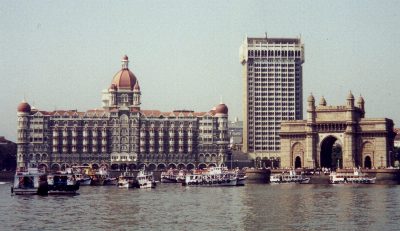 Our hotel room,
in the Colaba area, was conveniently located close to
lots of good restaurants, the famous Taj Mahal Hotel and
the Gateway of India in Mumbai Harbour where the tour
boats leave. Our room was simple but large and a bargain
for Mumbai at Rs 1045. We got cleaned up and spent the
day getting organized for our onward trip and getting
oriented in the city. We needed to buy train tickets to
take us to Goa and we were concerned that we would not
get reserved seats. For this reason, Ray fell prey to
touts in the train reservation office who guaranteed
reserved seats, for a price. We paid the price & got
the tickets.
Mumbai is the most Europeanized Indian city we have
visited, with broad avenues and European style buildings,
a legacy of the Portuguese and British. It also was the
least polluted, mainly because auto rickshaws are banned
in the central section. We did explore a typical Indian
section in the Crawford market, which included live
animals as well as the usual fruit and veggies. We bumped
into an English couple who had taken the same train as us
and shared a beer and experiences in the bar on the top
floor of the Taj Hotel, overlooking the harbour.
The next day, Jan 2, we took the tour boat to
Elephanta Island, one hour from Mumbai Harbour, to visit
another Hindu cave temple, constructed between 450-750 AD.
It was very similar to Ellora, but there was only one
main cave and two smaller ones, compared to 34 at Ellora.
The sculptures were interesting and we also walked up the
surrounding hills to view the other islands in the bay.
On our return boat trip, we talked to an Australian
family, who had seen the Everest Trekking Nepal badge on
Ray’s backpack. Apparently their older daughter, a
University student in Australia, was on a trek to Everest
Base Camp last November. They told us the Nepal end of
Everest Trekking made the arrangements for the group of
students and it was a great success.
That afternoon we toured the Prince of Wales Museum,
where we bumped into the Aussie family again. He said he
didn’t think he had ever seen such a poorly organized
museum. Most of the collection seemed to have been
donated by the Tata family, one of India’s wealthiest
industrial families, and no attempt had been made to
relate one part of the exhibition to another. I just
thought it was typical. Textile design and beautiful
crafts are Indian strengths, but organizational skills
are not.
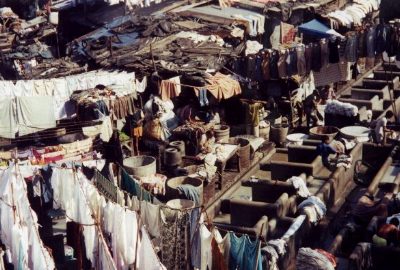 On our
last day in Bombay, we made a trip on the suburban train
system to see the Dhobi Ghats. This is where about 5000
men and a few women wash all Mumbai’s dirty laundry by
hand. You look down from a bridge over the railway tracks
to a sea of washing lines and large stone tubs filled
with soapy water. The Dhobis soak the clothes in the
tubs, rub soap on the clothes on an adjacent stone slab,
and slap the clothes against a stone slab in the middle
of the tub to beat the dirt out. I don’t think my clothes
could survive too many such washings.
We returned to the central city, stopping on the way
to walk along Chowpatty beach. It was not a pretty sight.
The tide was out, exposing all the garbage on the beach
and the smell from several drainage outlets was powerful.
Swimming would definitely be hazardous to your health. We
couldn’t leave Mumbai without climbing a hill, so we
followed a long, steep set of stairs up to the Nehru
Gardens, looking for a restaurant shown on the map in the
Lonely Planet. We never found the restaurant, but we
found another and the garden was pleasant and a favourite
of Indian families.
We took the earliest train yet on Thursday, Jan 4. It
left at 5:15 AM for an11 hour trip to Goa, and we were at
the station one hour ahead of time. We checked the
reservation sheet and seatings when the train arrived,
and sure enough, we did not have seats together. Thank
goodness the conductor was able to easily make the change
and we had very comfortable seats together in the 1st
class A/C coach. We spent the time reading and eating
snacks we brought or purchased from the many vendors who
circulate through the train selling everything from chai
to full meals. We were headed for the town of Panaji,
which is the capital of the state of Goa. We thought that
since this was termed an express train, we were going to
have to get off at Margao, south of Panaji, and take a
one hour long bus ride back to Panaji. Luckily, since the
train was making several stops not on the printed
schedule and we were almost two hours late, we found out
we could get off in Old Goa, just 9 K away from Panaji,
and take a rickshaw the rest of the way.
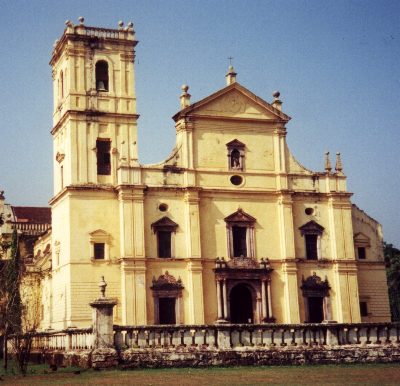 Panaji is a small town on the banks of the Mondavi
River and still retains the looks and feel of its
Portuguese roots. Like Diu, all of Goa, plus Daman,
another town north of Mumbai, were Portuguese colonies
until 1961.
That means that Christianity is still
alive in the area and the Portuguese left a legacy of
large cathedrals in Old Goa, the original capital of Goa.
We took the local bus the next day to visit several of
the churches. Three of the largest , all built in the 16
th and 17th C, are in the center of town, almost right
next to each other. The Church of St Francis of Assisi
has many painted murals depicting the life of St Francis,
Goa’s patron saint, and the floor is covered in
tombstones with coats of arms of the Portuguese families.
The huge Se Cathedral, right next door in the middle of
the same large gardens, is still in use. Both churches
look very Mediterranean with their red tile roofs and
yellow painted exteriors.
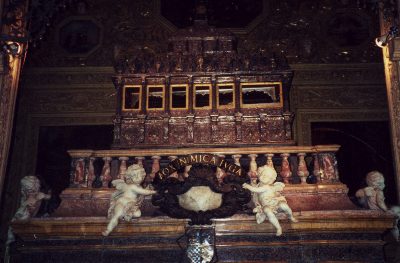
The third, Bom Jesus, across the street
in its own gardens, is the repository of the body St
Francis Xavier. The preserved state of the desiccated
body is considered to be miraculous. Every Dec 3 there is
a huge procession when the body in its silver coffin is
carried from the Bom Jesus to the Se Cathedral across the
street. The body is apparently missing several of its
parts as pieces have been removed over the years and
distributed as relics to several other Asian churches.
Somewhat ghoulish.
We walked from the churches to the riverfront nearby,
where we watched a local ferry, reminiscent of the
Cumberland Ferry, make trips back and forth to an island
nearby. We returned to Panaji and that afternoon I took a
walk to the Altinho area, which is up the hill behind our
Guesthouse. Panaji is the most tropical looking town we
have visited yet, with its palm trees, rich vegetation
and warmer temperatures. It is also a government town,
which means it is quite prosperous looking and has a nice
laid back atmosphere.
Our timeshare was due to start Saturday Jan 6, so that
morning we took the local bus south to Margao, where we
transferred to the bus going to Benaulim. The second bus
took a little longer than we expected as it drove from
the bus station, just outside of town, to the main town
square, where it circled the square three times, picking
up passengers, until the driver considered he had enough
passengers to make the trip worth while. At Benaulim, we
took a ricksha w to the Royal Goan Beach Resort, which we
found out is about 2 K south of town. It is a typical
timeshare arrangement built to Western standards, with a
huge living/dining room with a kitchenette, a huge
bedroom and a large bathroom. All the rooms are arranged
around a pool with one bedroom units on the ground floor
and two story two bedroom units on the upper floor. The
only disadvantage is that the resort is blocked from
beach access by the brand new, very large, five star Taj
Exotica Resort. That results in a 10 minute walk around
the Taj resort to the beach, but the walk is worth the
effort.
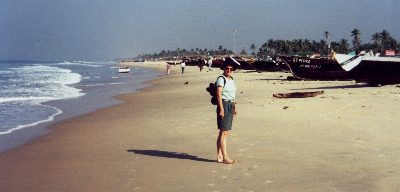 The long, sandy beach
stretches for more than 5 K in both directions and our
section never has many people on it. There are several
small restaurants on the beach that offer free lawn
chairs and umbrellas and we quickly staked out our
favourite, the Seagull, for lunch and sunning. The water
is nice and warm and clean with breakers just large
enough for beginner body surfers. We walked into the town
of Benaulim via the beach and rented ‘no gear’ mountain
bike style bicycles to get around on. We haven’t done
much more than go to town and up and down the beach on
the bikes. We haven’t even made it all the way to either
end of the beach. Most of our time is spent at the beach,
swimming and soaking up the rays.
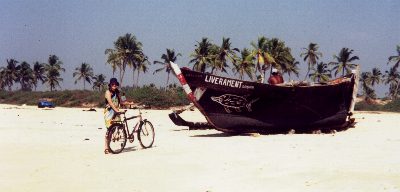 The
The
beach is also home to several local fishing boats that
sell their catch to the local restaurants each morning,
so we are able to sample excellent fresh seafood at our
meals. Thanks to low Goan taxes on booze, the beer is
also cheap and plentiful, so we are taking advantage of
that. We had our one meal at the Royal Goan on Tuesday
evening and were not impressed, but the entertainment was
great. We had a so-so Goan meal, for two or three times
what the surrounding restaurants charge, while we watched
an exhibition of excellent Indian dancing.
Wednesday we took a ride in a local dolphin spotting
boat. We didn’t have to motor more than 1/2 K from shore
before we spotted a pod of about 4 dolphins playing in
the waters. We spent more than 1/2 hour watching them
jump and dive through the waves, always keeping a
discreet distance from our boat.
We will be sorry to leave the Royal Goan and end our
‘chill out’ week this Saturday, but our time is up and we
must travel on. This time we will take an overnight
sleeper bus to Hampi, another of India’s historical
temple sites.
Return to
The India Chronicles Intro
or
Travels
or Introduction