Episode 5: All Around the State
of Gujarat
Page 1
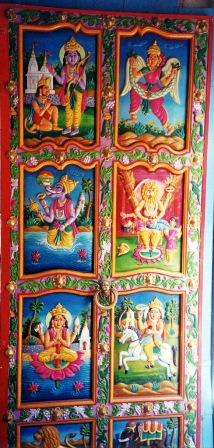
Swaminayar Temple door, Bhuj
Read Previous Episode:
Jodhpur to Udaipur or Next Episode:
Ajanta to Benaulim, Goa
Go to
Episode 5: Page 2
Wednesday December 27, 2000 Ahmedabad
So,
everyone ate too much turkey, drank too much wine and got
too many presents, but I trust that Christmas and New
Year’s Eve were successful. Now you can start those diets
and exercise programs!
(This note was to have been sent from Ahmedabad, but
the server was only up long enough to read our mail and
died when I was ready to send this episode. We have now
taken train from Ahmedabad (10 1/2 hrs) to Jalgaon, a
small town near the caves of Ajanta.)
We are back in Ahmedabad after an enjoyable tour of
the state of Gujarat. We found the people friendly and
the area much less touristy than the majority of places
we have visited in India. Ahmedabad in a large city with
the attendant dirt and dust and pollution, especially
from auto rickshaw fumes, but it is lower key than many
of India’s large cities. Laurie Ham, the daughter of our
friends Tom & Dale Ham, spent a year here working for
the Aga Khan foundation and told us not to expect too
much English. That is true of all the signs, but
thankfully we have found people who speak English and are
helpful. We first arrived in Ahmedabad via a bus trip
from Udaipur on December 13, but we only stayed overnight.
We wanted to visit the town of Bhuj and explore the Kutch
(or Kachchh) region, and we discovered that the only
daytime transportation available was a train the next
morning at 6:40. We couldn’t reserve a seat as the train
originated in Delhi and was already enroute when we made
our inquiries. We were told we would be able to make a
last minute reservation if we were at the station at 5:00
AM. We showed up as instructed only to be told that we
had to wait until the train arrived and get a reservation
from the conductor after all, and the train was already 1
1/2 hours late! So much for an early start. We had no
option but to wait patiently, albeit sleepily. Well, we
were finally on our way at 9:00 AM in a slightly rickety
coach, but at least it was not crowded. The most
interesting part of the trip was crossing the extensive
salt plains and watching the salt retrieval operations.
We passed the time reading and playing cards until 4:00
PM when we arrived in Gandhidham. From there it was a 1-1/2
hour bus ride to Bhuj. Ray told me he hoped the visit
would be worth the long travelling time. It was.
We thoroughly enjoyed our visit to the Kutch region
and our Guesthouse owners were most helpful. The first
day we just explored the relatively quiet town of Bhuj.
It has the requisite city walls and palace turned into a
museum, plus a busy bazaar and market area, but very few
other foreign tourists. The old palace, the Aina Mahal,
has a great collection of paintings and glass candelabra
collected by the various maharaos of Kutch. The new
palace (19th century construction), however, was notable
only from the view of the town from its clock tower. The
main building housed a moth-eaten collection of hunting
trophies.
 We met a couple at dinner the first night and
discovered he was from Vancouver. Jeff and his wife
Claire, who is Irish, now live in Santiago, Chile, where
he is a geologist. Claire had preceded Jeff to India to
attend Yoga workshops in Pune, near Bombay, and planned
to stay on to attend more workshops in Bangalore. We
shared a car and driver/guide on Saturday to explore
villages and their handicraft specialties south of Bhuj.
Our guide, Ab
Sakur, told us that the manner of dress, culture and even
language changes every 36 K and we were about to witness
these differences. Soon after we started we came upon a
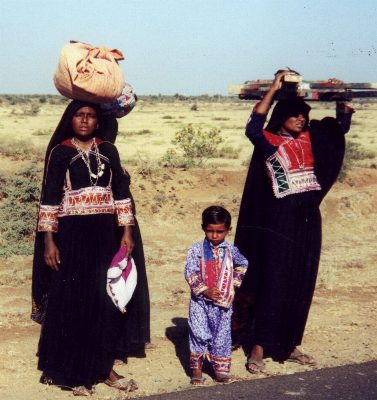
nomadic tribe of people, the Rabari. The women wore
elaborate gold jewelry and were dressed in black skirts
and tops that were covered in richly coloured embroidery.
Even their little boy had large gold earrings and wore a
colourful blue out f it. Our driver stopped and spoke to
the men who were shepherding a large flock of sheep and
goats to see if we could photograph them. They were just
packing up to move to the next grazing field and all
their meager belongings were piled on high bed-like
platforms ready to be transported on the backs of camels
or ponies. The men wanted to be paid for posing, but we
are not professionals and declined. Ray had already taken
one picture anyway, so we lucked out.
As we were passing through one town, Ab Sakur pointed
out a tree by the side of the road. It was festooned with
very large bats, sleeping through the day. Jeff said
these were called fox bats in Australia. We tried not to
waken them.
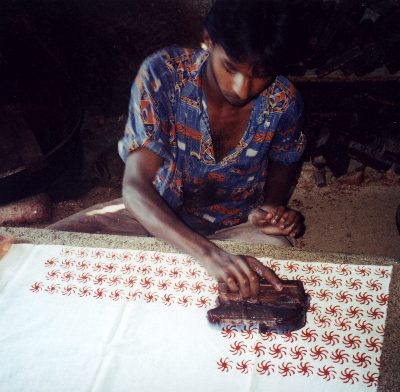 Our main stop in
the morning was a family block printing operation. They
use a batik method with melted wax and hand carved wooden
blocks and were just setting up to demonstrate for us
when we arrived. Claire remarked on the primitive methods
they use to dye the cloth after the wax designs are
applied and subsequent boiling water bath to remove the
wax. No rubber gloves here to protect their hands. We
also visited the family next door who do screen printing.
The block printing family act as brokers for several area
cottage industries, so while we enjoyed a cup of chai,
the sweet Indian tea, we were shown samples of their work.
It really was quite good and inexpensive so we went away
with their home made shopping bags full of hand printed
bedspreads and tie dyed materials.
 Just after
leaving the village, Ab Sakur stopped to talk to a farmer
who invited us to visit his family and their fruit
orchards nearby.
He
hopped in the car and directed us to his home where we
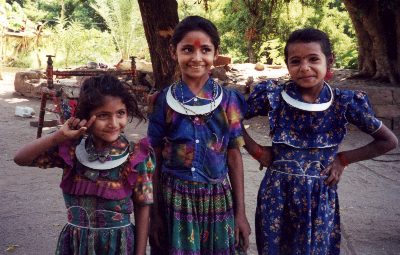
were greeted by a gang of children, his own and nieces
and nephews. Three of the little girls, who were between
five and ten years old, wore large flat silver necklaces,
indicating that they were engaged. The villages don’t
leave these matters up to chance.
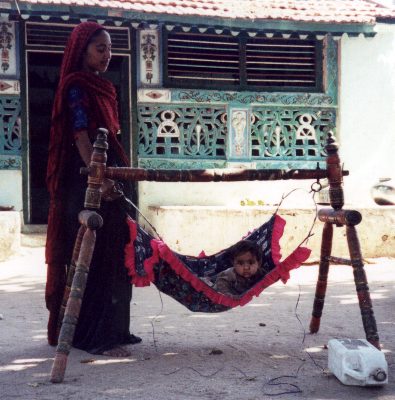 Nearby, their mother
rocked her baby in a wooden swing. We were treated to a
fresh coconut each to drink while we walked around
admiring the many coconut, tamarind, papaya, mango and
banana trees.
It was getting late in the morning and we were hungry
so we drove to the port town of Mandavi to have lunch
atthe fancifully named Zorba the Buddha Restaurant. This
was obviously a local favourite, with good reason, and it
was crowded with people enjoying one of the best Thalis
we have had so far. It even included fruit salad. Mandavi
has an active ship building industry so after lunch we
got to see how large teak wood fishing boats, capable of
withstanding the oceans, are constructed by hand using
traditional methods.
We also drove a few K out of town to walk on the beach.
No one was swimming, but fishermen were drying their
catch on racks at the edge of the beach and a flock of
shorebirds was fishing in the water. Amongst them were a
pair of flamingos that kept a respectable distance, but
didn’t fly away, when Ray approached them. These birds
were mostly white with the familiar salmon pink colour
bordering their wings. I’m told the colour is a fact or
of the quantity of shrimp they feed on. That was it for
the day so we drove back to Bhuj in time for our driver
to take his sons to the mosque for Ramadan services, but
we made a date to meet him again the next day for another
tour.
Sunday it was just Ray and I with Ab Sakur, as Jeff
and Claire were heading out of town to their next
destination. This was our day to visit villages north of
Bhuj where the topography is more like the desert of
Rajasthan, not as cultivated as the area we visited
farther south.
 Our
Our
first stop was the village of Bhirendiara, but you won’t
find it on any map as it is really a road side bus stop
with a few kiosks selling snacks. On Ab Sakur’s
instructions, we bought hard candies to give to the
children in the villages we were to visit. Ab Sakur
varies the villages he visits to make sure they don’t get
too many tourists visiting and turn into show villages.
Consequently,
we didn’t encounter any begging and the candies are a
treat for the children. We drove on a rutted path a cross
the dusty, desert sand to a Harijan (or Untouchable caste)
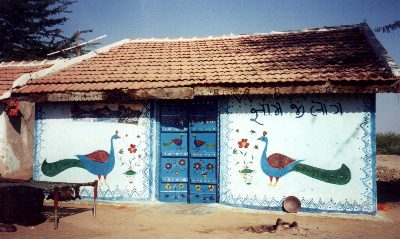
village. Their houses are decorated on the outside with
designs of peacocks and hearts in bright primary colours
and the insides have embossed designs and small round
mirrors on the clay walls.
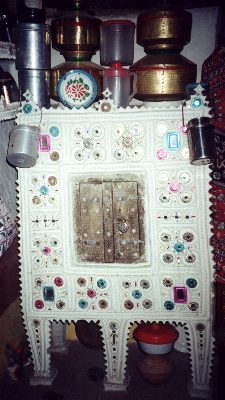 The mirrors are supposed to
ward off evil spirits by scaring them when they see their
reflected image. The women wear a gathered, circular
skirt and a short sleeved, backless over blouse.
The
blouse is made of colourful materials and each has its
own unique embroidered design that incorporates lots of
mirrors.
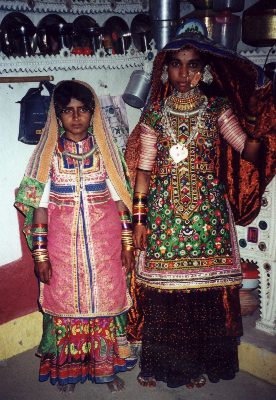 Over the whole outfit they wear a long gauzy
scarf, but unlike the Rajasthani women, they are not
required to cover their faces. After visiting several of
their homes, we accepted their offer of chai and since
this village acts as brokers for their neighbour’s work,
we admired their display of embroidered goods for sale. I
even ended up buying a few items again.
From the Harijan
village, we walked to a neighbouring Muslim village. They
decorate their houses even more flamboyantly than the
Harijans and several of them were works of art. Some of
their houses are round huts with a thatched roof.
The
ceiling inside was lined with wooden poles and the entire
surface was painted with the same bright colours as the
exteriors. The villagers keep sheep, cattle and goats and
sell the milk. They also make charcoal, so on our way
out, Ab Sakur bought, for Rs 80, a large bag of charcoal
that just fit into the trunk of his taxi.
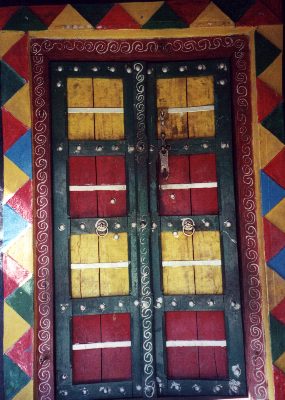
elaborately painted door
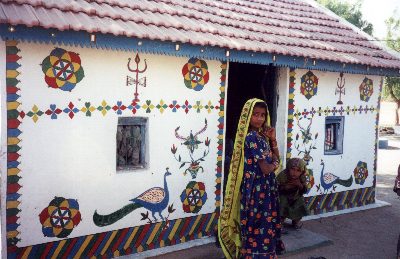
Girl next to her decorated house
We drove from there back towards Bhuj, stopping in a
farm compound in the village of Hodka. The people here
use dung and natural dyes in earth tones to decorate
their homes and they do hand embroidered and beaded
leather work. Nice work, but I didn’t succumb.
 We visited
another farm to see their hand weaving and then ended the
day at the most ramshackle and poorest village we have
seen to date. Instead of the neatly kept farm compounds
we had seen, this one had garbage piled beside huts that
looked in danger of collapsing. They also had the largest
number of small children, all with snotty noses and
unkempt hair. There was an old man lying on a cot who
looked as if he was living his last day on earth. He was
being tended carefully by several of the women. This
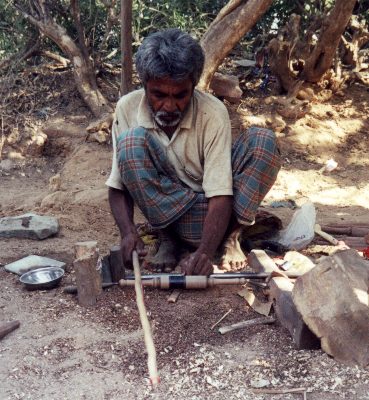
village does very nice lacquer work on wooden implements
and toys. One of the men demonstrated their technique
using a hand driven lathe to turn a chapati rolling pin
and melt the lacquer colours onto its surface. Each one
is different and quite attractive, so I selected a few to
bring home with me.
That was enough for one day and that was the end of
our visit to Bhuj and the Kutch. Except that I ended up
buying more items from a shop in Bhuj. We saw several
very different villages and lifestyles, but we only
touched the surface of this area. You could spend a week
here and not see the same place twice, plus go home with
lots of beautiful craft ware.
Continued…Next: Episode 5: Page 2
Return to
The India Chronicles Intro
or
Travels
or Introduction