Episode 1: Varanasi to Agra
Page 1
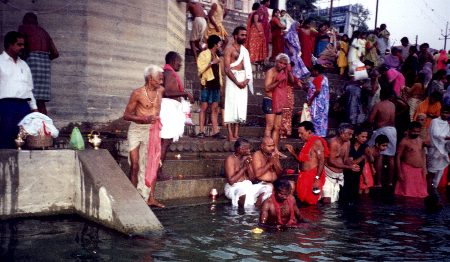
Kedar Ghat, Varanasi
Read Next Episode:
Jaipur to Bikaner
Read: Episode 1: Page 2
Friday Nov 17, 2000 Agra
Yes, we did make it to
India and yes, we are getting used to the numbers of
people, the hustle, the bustle, the dirt and the garbage.
In fact, we are rather enjoying ourselves and have
learned, as Gord Konantz advised us, to keep our sense of
humour. We might as well get this over with as well. The
weather is great. We are enjoying warm, summer-like days,
but not too warm, and the evenings have cooled off nicely.
We even need a blanket at night. Eat your heart out.
Monday, Nov 6 was our flight day to Varanassi. We knew
the plane had to be safe after we had undergone all the
security checks to get on the plane. As well as the usual
security check and body frisking to get into the
departure lounge, your bags are x-rayed and secured with
a yellow plastic closure. When your plane is called, you
must identify your bags before the luggage is loaded and
you have to pass a second security check and frisking on
the stairs leading to the plane. The flight after that
was an easy 1 hour, except we were delayed while the
Indian Airforce performed practice maneuvers over
Varanasi. I read somewhere that British left India with a
legacy of bureaucracy and it is true. We are getting very
good at filling out forms. Going through immigrat io n
and claiming our luggage takes at least 3 forms and 5
officials, but we managed to be one of the first out of
the airport and found the airport bus to take us to a
hotel in the Cantonnment area of Varanasi. This is near
the train station and a little quieter than staying right
in the old section of Varanasi, but it means we had to
take an auto-rickshaw to tour the interesting parts of
the city.
We arranged to be picked up the next morning at 5:30
AM so that we would be at the Ganges River for daybreak.
It was still dark when we got up, but we were ready. Our
driver, a 16 year old, took us to the Kedar Ghat,
 where
where
we arranged to hire a row boat and rower to see the early
morning activity at the Ghats. A Ghat actually refers to
the stairs that lead from the various temples into the
Ganges. The Kedar Ghat is a favourite of Punjabis, and
apparently women, as there were several hundred women
bathing in the waters and discreetly as possible, washing
their hair and bodies. You can rest assured I was not
tempted to jump in. The water did not look inviting,
floating with all kinds of rubbish and the receptacle for
the ashes of the dead. Nevertheless, it was fascinating
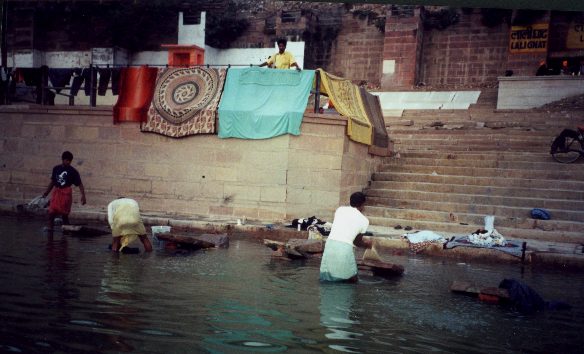
watching all the activity. Each Ghat was a little
different. Some of them operated as the local laundry,
with the washing wallahs up to their knees in the water,
slapping the clothing against large stone tablets
permanently anchored at the river’s edge. One Ghat had a
sign advertising the Varanasi Swimming club and two men
looked as if they were on their way across to the other
side. We had a bit of a hassle with our rower, who wanted
to charge us more to row the entire length of the Ghats,
so we had him let us off and we walked back to our
starting point across the landings on the Ghats. We found
that even more interesting, observing everyone up close,
despite having to wind our way around the dogs and cows
and cow dung.
Our rickshaw driver was waiting for us and suggested a
further tour of the temples; for additional cost, of
course. After some breakfast, we set off, stopping
briefly at several temples and rode through the grounds
of Varanasi University, built in the 1960s. The
University was the most interesting part. The temples
aren’t very old or particularly interesting for us, so we
had the driver take us to the train station for our next
experience; booking a reserved seat on a train. We
planned to take the train to Satna, stay overnight and
then take a bus to visit the temples in Khajuraho. There
is even a special room for foreign tourists with chairs
filled with people and only one desk to serve everyone.
Patience is required and you might as well get to know
your fellow travellers because you will probably be there
for quite some time. It took us 2 hours, and the final
transaction took just 5 minutes.
After that, we repaired to a nearby lunch spot and
refreshed, decided to return to the old part of the city
to explore the back streets. The taxi driver let us off
near the old market, where no motorized vehicles are
allowed. We had gone only a short distance, soaking in
the atmosphere of the busy marketplace, when we were
befriended by a gentleman who became our guide for the
rest of the afternoon. This, we realized, is the usual
practice. People are more than willing to be of
assistance, but often expect to be paid at the end and
you have to decide in the beginning if it will be worth
it. This tour was worth it. We started out by watching a
parade of worshippers led by decorated elephants,
marching bands, women carrying flaming pots on their
heads, and men waving colourful silk banners and
spreading marigold petals over the street. I’m not sure
which festival was being celebrated, as there are so many
in India, but it was fun. After the parade had passed,
our guide beckoned us into the narrow, winding alleys of
Varanasi to see the Golden temple. It was a hive of
activity, but open only to Hindus, so I had to be content
to peek through the door. Our guide led us to a
Guesthouse next door where we climbed 5 flights of stairs
to look down over the golden dome of the temple and out
across the city. Our guide told us that 25 – 40 years ago
most of the sprawling city we saw was still fields. From
there we followed him through more dark alleys to reach
the Manikarnika Ghat, where 150 cremations are performed
each afternoon. We would never have found our way in or
out without him. No photos are allowed of the cremations,
but we were free to wander and observe the burning
funeral pyres and bodies arriving, draped in shrouds and
covered with garlands of flowers. On our way out of the
old section, we turned a corner to hear a 3 piece band
serenading a wedding procession carrying the bride on a
sedan chair to her reception. Enough excitement for the
day. We took an auto rickshaw back to our hotel through
the worst traffic jam and pollution to date. The driver
was a real cowboy who zoomed in and out of the traffic,
liberally using his brakes every few feet. That evening
we were ready for a quiet dinner for 2 on the roof top
restaurant next to our hotel, and ready to leave Varanasi.
The next day we walked to a nearby hotel for breakfast.
As a joke, I bet Ray we would receive 10 – 20 offers of a
rickshaw ride on our 10 minute walk back to our hotel and
I lost count after refusing 15.
Our first train ride was quite comfortable. There was
no first class available on the train but the 2nd class
car , which converts to a 3 tier sleeper at night, was
fine for the 6 hour daytime trip. The first Guesthouse we
tried in Satna, recommended by the Lonely Planet, was a
dump, so we took our rickshaw driver up on his suggestion
and “upgraded”. I’m glad we did. A Danish man
who shared our compartment in the train did stay there
and when we met him again later in the trip he told us he
thinks he picked up fleas there!
The next morning we walked over to the local bus
station and bought reserved seats for Khajuraho. The bus
was quite comfortable and roomy, and thank goodness we
had a careful driver as the roads were almost entirely
under repair, so we weren’t bounced around too much on
the 4 hour trip. A few Km from our destination, 2 m en
got on the bus and proceeded to try to persuade the few
Western passengers to come to their Guesthouse. We did
agree to go with one of them as the photos shown us
looked OK, the price was right, and the room did live up
to its billing. That’s how it is done around here. Lots
of hustle for the tourist dollar. Especially in
Khajuraho, but I remembered to keep my sense of humour
and ended up enjoying the town. Ray found a bank to
change some American money to Rupees, so I sat under a
tree outside the bank, where I attracted the attention of
several postcard sellers and gift shop owners. Once they
understood that I was really not going to buy anything,
they were quite content to sit with me and chat. Everyone
loves to practice English. They even shooed off other
touts while I sat with them.
That afternoon Ray & I decided to just walk around
the area and visit the original, old village of Khajuraho.
We picked up one of the ‘non-guide’ guides on the way.
First a young boy on a bicycle followed along chatting to
us, and then we were joined by a young man who wanted to
show us around his village. We ended up following the 2
of them through the narrow streets as they explained how
the caste system worked in their village and showed us
the ancient water wells, still in use. We even went
through the courtyard of one home to climb to the roof
for a view of the countryside. We visited a village
school where small children were learning to write on
slates and read from a few tattered books, met the
teacher and made a small donation. Our guides pointed out
that the villagers had used parts of ancient temples
found when they dug down for the foundations of their
homes. Statues decorated the outside of the homes and the
cornerstones of many of the houses were ancient pillars.
As we left, we were invited to visit the young man’s shop
and as payment, I bought a small trinket from his very
small supply of goods.
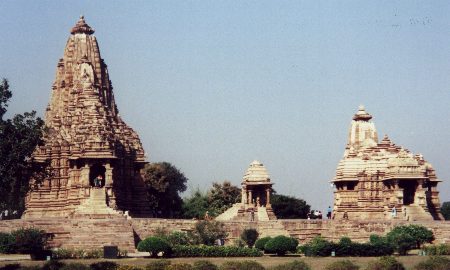
Khajuraho
Temples.
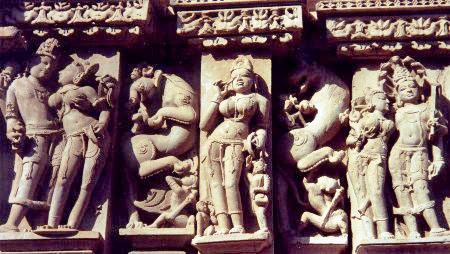
Carvings on temples
Khajuraho was where we discovered that we have arrived
in India just a few weeks too late. The government has
decided that tourists can afford to pay American style
entry fees for many of the historical monuments. Instead
of Rs 5 , the entry fee for the temples in Khajuraho is
now $10 USD, and there is no ‘Free Friday’. The locals
are incensed and worried that this will discourage
business, which it probably will for the smaller areas.
We were a captive audience & so paid up. Ray is
annoyed that the fees are pegged to the US $, not Indian
Rupees. Anyway, we toured the temples,
which are similar
to those in Angkor Wat, but on a smaller scale. They were
built in the same era, 11th C, and are constructed of red
sandstone and encrusted with carved figures of men and
women.
The most common are Apsaras, young girls with
impossible half melon breasts posed with one hip stuck
out. The temples are also famous for their somewhat
erotic depictions of couples in various sexual positions. Sort of like the Kama Sutra in stone. The main temples
are in an area surrounded by lovely, well kept gardens,
so it was an enjoyable place to visit. In the afternoon,
we rented bicycles to pedal a few K out of town to see
more temples. One of these was a Jain temple built this
century to house Buddhas a nd other artifacts and
featured paintings and photographs of famous ‘sky clad’ (naked)
Jain priests.
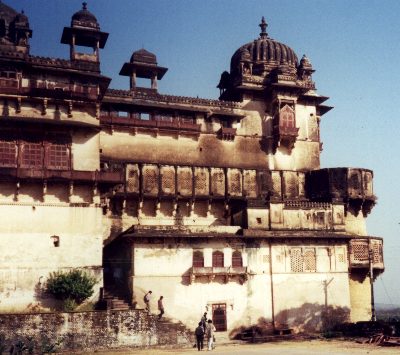
Orchha Palace
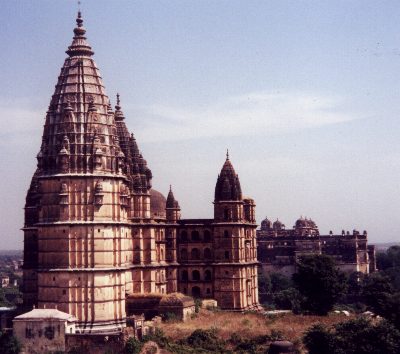
Chatries in Orchha
Saturday we had our 2nd trip on a local bus to the
much quieter town of Orchha, famous for its 17th century
Palaces built of red sandstone on a fortified island.
The Palaces and nearby
temples were quite well preserved, with still visible
murals and great views of the countryside from their
upper floors. The buildings were decorated with domed
turrets and spires that were the favorite perch of
vultures and green parakeets. Under the eaves of the many
roofs were giant beehives, covered with swarms of large
active bees. We were told you could buy the honey in the
local market.
We stayed in the
grandly named Deep Regency Guesthouse, brand new, but the
same simple accom modation we have been choosing: usually
2 single beds pushed together, an overhead fan, a very
firm mattress, firm pillows, a bottom sheet and a blanket
with no decoration to speak of in the room. We choose a
room with an attached bathroom with, if possible, a
western toilet and hot water shower. You have to put up
with power outages and sometimes the promised hot water
is rather chilly, but it is actually quite comfortable
and the price is right. We have been paying between Rs
200 – Rs 350 per night (about 6 – 12 CAD). The
Guesthouses often have small restaurants in a patio or
there are always others nearby. The food has been quite
good and we have not had any problems with the quality,
as we have made sure the food is freshly prepared and the
water is boiled.
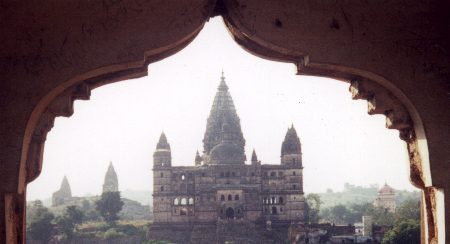
Orchha is along
the banks of the Betwa River, a favorite swimming and
bathing spot of the locals. We walked up the river
admiring the rapids, but according to some other
tourists, we didn’t go far enough to find the cleanest
water for swimming.
 We could have lingered on, but by Monday we were on
the move again and learned a few more lessons on Indian
travel. We took an auto-rickshaw 20 K into the town of
Jhansi to catch the train for Agra. We had left plenty of
time to make the booking, but when Ray got to the wicket,
he was offered tickets on a train leaving in 15 minutes.
He took it and we rushed off for the platform, but of
course the train was not on time. A whole village load of
families, carrying all their worldly belongings in large
plastisized jute bags on their heads, plunked down beside
us and proceeded to have lunch. They were quite
interesting to watch as they communally took care of the
many small children. I asked Ray what car our
reservations were for, but he had neglected to get
reserved seats. Big mistake. When the train did arrive,
it was already full and we were intimidated enough by the
crush of people that we made a beeline for the AC Sleeper
coach door, and sat down in the first available empty
seats. A helpful Indian women asked us what our seat
numbers were and when we explained the situation, her
comment was “Welcome to India”. She went to
find the conductor and arranged for us to get reserved
seats by paying the conductor the considerable extra
charge. It was worth it this time, but in the future we
will be more careful. I must say that we have found the
Indian people very friendly and only too willing to help
the lost looking tourist. They ask where we are from and
what we think of India. They beam when I tell them that
there are lots of people and lots of activities to see.
Next: Episode 1: Page 2
Return to
The India Chronicles Intro
or
Travels
or Introduction