Episode 6: Queenstown to Invercargill
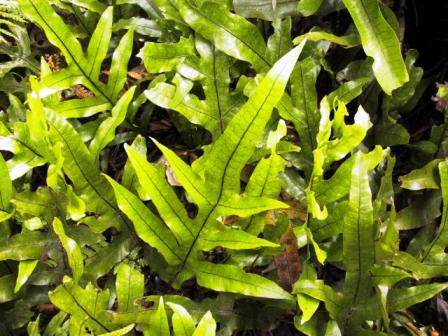
Ferns on Stewart Island
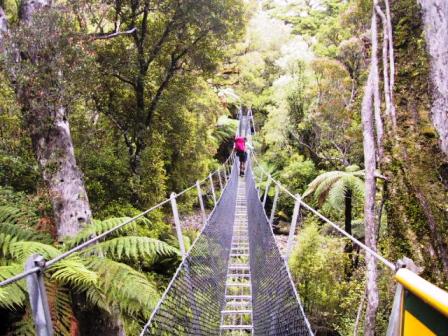
Swing bridge on Rakiura Track
Read Previous Episode
Greymouth to Queenstown or Next
Catlins to Christchurch
Episode 6: Page 2 of 2 Invercargill to Stewart
Island
Sunday 10 February
2002, Invercargill
Boats, Switchbacks, Boardwalks and 10,000 Steps
Continued
from
Episode 6: Page 1 Queenstown to Kepler Track
It seems we got the best three days possible for our
hike. Clouds that had been gathering all day finally
resulted in rain that night. By then we were safe in our
hostel in Te Anau. Then weather was a little better when
we left the next morning, but had degenerated into full
rain by the time we reached Invercargill. Our plan was go
over to Stewart Island and do the three day Rakiura
Track, but the weather was so bad we delayed for another
day.
We put in some time at the Invercargill Museum. There
was a very interesting display of the sub-arctic islands
that are protectorates of New Zealand. They were
variously used as sheep stations or weather stations, but
mainly it was their history of shipwrecks that was of
most interest. Some people did manage to survive more
than two years on the islands after having been
shipwrecked off their rocky coasts. Now they are just
nature preserves.
We finally left for Stewart Island on Wednesday 6
February. We had a choice of a one-hour ferry ride or a
20-minute plane ride. We found out we could go stand-by
on the plane for very little more than the boat. We could
even reserve a seat on stand-by after 5:00 PM the
previous evening and we were able to be on the 8:00 AM
flight.
We arrived in Oban, the main town on Stewart Island,
just in time to catch the morning downpour, so we did the
only sensible thing. We headed for the nearest café to
wait out the storm. Luckily, that was the last rain we
had for our entire visit. Before setting out, we checked
into the local DOC office, got the latest maps, booked a
room for Friday night and signed up for a guided tour of
Ulva Island for the day after our hike. Ulva is just next
to Stewart Island and is a bird and plant sanctuary.
We found the Rakiura hike relatively easy, just 12 K
each day up and down small hills, but hard on our feet.
Stewart Island has a well-earned reputation for mud, the
result of high rainfall and lots of trees. To make it
easier for trampers, wooden boardwalks and steps have
been constructed. The track brought back memories of
Junagadh Hill in India. I have renamed Rakiura the Track
of 10,000 steps. Each step is
about 40 cm wide, covered in chicken wire for a better
grip, but the builders have never heard of a standard
stair height. Sometimes the steps are very short, but
mostly they suit a very long-legged person. I felt like
saying ‘fee foe fie fum” as I went down the steps. I
must admit that the sections without boardwalks were
pretty muddy, but I think the DOC got carried away or
else got a special on wood they just had to use up.
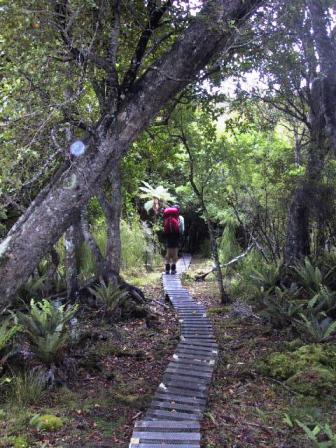
Boardwalk
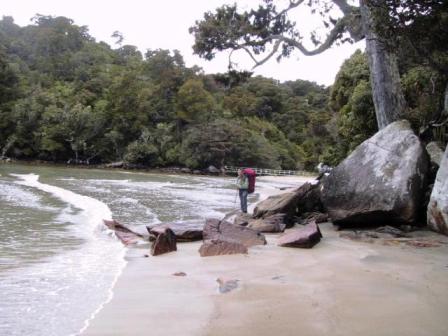
Rakiura Bay
Anyway, the first day we hiked part of the way across
small sandy beaches,
but the majority of the track was through native bush. It
was very quiet and peaceful and Ray and I were alone on
the track nearly all the time. The first night we stayed
at Port William Hut, on a nice beach. The warden was an
Israeli, Haim, who was working there for the summer
season. He was having a ball, fishing for his supper and
rebuilding walkways. We talked to him as he fished at
high tide in the evening. He baited a hook, dropped it in
the water and told us to count to ten. Sure enough, he
had a nibble even before we finished counting. He caught
a barracuda and another small shark that he threw back,
but many of the varieties he caught were good eating.
My only disappointment is that we didn’t see any
penguins or kiwis on our tramp. The second night we
talked to several trampers who had hiked further around
the island and had actually seen kiwi. The price you pay
to see them is hiking eight hours in the mud to the next
mud! I think an easier option would be to join a kiwi
spotting trip. You go by boat in the evening to one of
the more remote beaches around the evening and sit in the
dark hoping you have not frightened off the kiwi. Maybe
next visit we will do that.
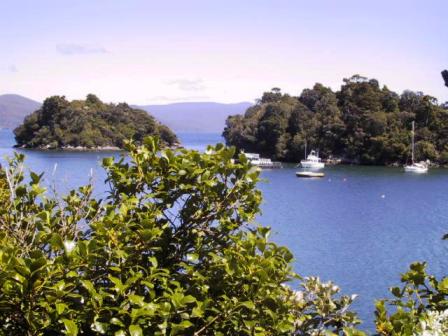
Golden Bay
On our last day of the tramp, we took an extra loop
along the coastline to end up in Deep
Bay, around the corner from Oban. We stayed that night in
a small cabin deep in the woods. It had been built and
lived in by a couple for two years while they constructed
their main house next door. The new owners now rent it
out to people like us. It was pretty simple, but
comfortable for the night. It had a small kitchen, the
bedroom had two sets of bunks and the toilet was a ‘long
drop’ in a converted garden shed outside. The shower
stall was off a small entrance room and was very
ingenious. You heated water in a kettle on the stove,
poured it into a bucket and hand pumped the hot water up
into a plastic container that was suspended above the
shower. To get shower action, you opened a plastic nozzle
attached to the water reservoir. It worked to get the
tramping dirt off us.
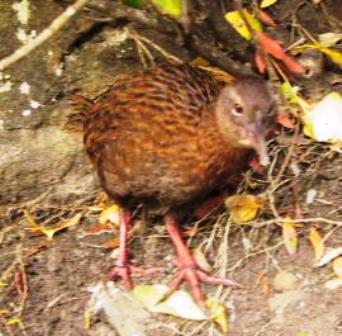
Weka
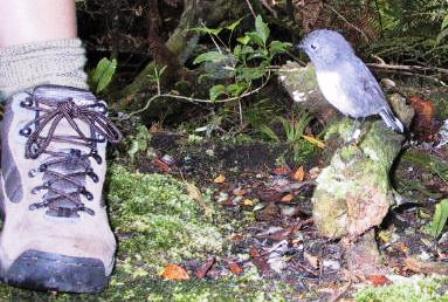
Robin
The next morning we joined our guide, Chris form the
DOC office, and ten others for our nature walk on Ulva
Island. We found it fun and very informative. The biggest
accomplishment for DOC was to have eradicated rats on the
island. These introduced pests wrecked havock on the
native bird species, many of whom were flightless. Now the curious
Weka, similar to a kiwi, were there to greet us as we
landed on the island, looking for a handout. All the
birds were amazingly fearless of humans. We were able to
see many varieties right up close. Chris told us many
interesting tales of the history of the island and
pointed out the many unique plants and trees. We had a tea and
cookie break on a sandy beach, trying to fend off the
Weka, then it was time to return to Stewart Island. Ray
and I spent the rest of the afternoon wandering around
some of the nature walks and the town before boarding a 4:30
flight back to Invercargill.
After lunch today we will drive along the south coast
to explore the Catlins. We hope to see more animal and
sea life, maybe even a penguin or two. From there it is
on to Dunedin and then a visit to Mt Cook. The weather
seems to be cooperating again, so maybe the cold rainy
days are truly over.
Back to:
Episode 6: Page 1 Queenstown to Kepler Track
Read about our visits to the
Cook Islands or
Fiji
Return to
New Zealand
Intro
Return to
Travels
Return to
Introduction