Episode 3: Rotorua Hikes to Havelock
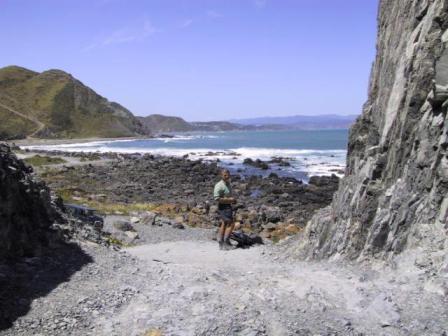
Owhiri Bay
Read Previous Episode
Coromandel to Waitomo or Next Nelson to Arthur’s Pass
Episode 3 Page 2 of 2 Wellington to Kayak Trip
Monday, 7 January
2002, Nelson, South Island New Zealand
Continued from
Episode 3: Page 1 Rotorua to Waikanae
New Years Eve was to be in Wellington, so we said
goodbye to the Shands and set off on Dec 29 via the long
route over the Tararua Range to Upper Hutt. The route was
14 K up on another of those typical NZ roads, very
twisty, narrow and scenic, but it was paved. The route
went down to Upper Hutt for 20 K in several stages, so it
was a little easier.
We arrived in Wellington before noon, only to find the
Backpackers hostel we had reserved had never heard of us.
We were not pleased, but the manager phoned around for us
and we got a double room around the corner at the
Rosemere Backpackers. This hostel had room because it had
been allowed to go downhill over the last ten years and
has only recently been taken over and renovated. We found
the management friendly and we were within walking
distance of everything in the city, so we were satisfied.
Wellington is built on steep hills surrounding Lambton
Harbour. We played tourist, following a self-guided
walking tour of the waterfront, taking the cog railway up
a hill to visiting the Botanic Gardens, touring the
Parliament Buildings and Library and taking in Te Papa,
the national museum.
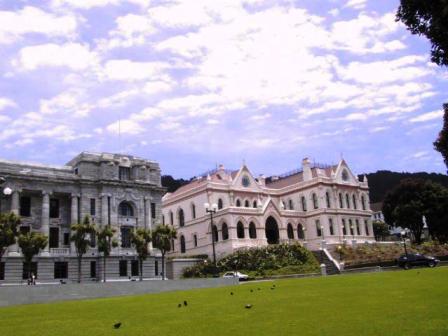 On the Parliament tour, we were interested in the work
done to earthquake-proof the Buildings. We were led to
the basement to see where engineers have taken a slice
out of the buildings at ground level and supported the
two halves with a series of shock absorbers. Wellington
is subject to a series of minor earthquakes, but they
have not experienced a major quake in many years. If one does occur, the theory is that the
two halves would be rocked independently and would not
collapse. Apparently the same technique was used on a
bridge in Japan that did experience a major quake and
survived relatively unscathed. We were also interested to
note that NZ does not have an upper house. It was
abolished in the 1950s after it was determined that they
had never made any changes to any bills introduced in
Parliament over the previous years.
We spent some time exploring the natural history
sections of Te Papa. Many of the exhibits are designed
with children in mind and there were many families there
to appreciate it. Just as we were taking a break in the
lobby, I heard familiar drum beats and a troop of dancers
and musicians from the Cook Islands arrived to perform.
Most of the dancers were young children and they put on a
very good show for their appreciative audience.
Dec 30 is our anniversary, our 36th this year, and we
usually celebrate by going out to dinner. This year was
no exception. We started out by having smoked salmon
snacks and a bottle of the Lombardi wine we bought in
Hawke Bay, then we found a very nice little restaurant
near by where we could BYOB and have a nice seafood
dinner.
On the 31st we packed a picnic lunch and took off on a
tour of the eastern shores. We followed all the ‘Parade’
roads that follow the coastline around the bays and
headlands of Wellington. As we left the shelter of the
harbour and neared the open sea the strong winds were
whipping the surf high against the rocks. Wellington is
not called the Windy City for nothing. There were a few
swimming beaches but many had signs warning of the
dangerous undertow. One beach at the back of the airport
was a favourite with surfers. Dozens of people dressed in
wetsuits were paddling their boards out to catch the
perfect wave in to shore.
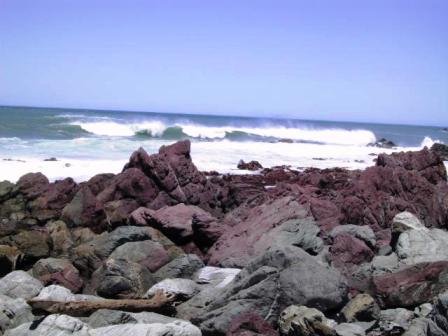
Our destination was a beach walk starting in Owhiri
Bay to see a promised seal colony and some red rocks. We stopped at
some gates leading to an unpaved road along the beach and
asked if the road was passable. We were assured it was so
we drove Alice very carefully over the loose gravel,
through the potholes and over a few shallow creeks. When
we figured we had driven far enough, we stopped to find a
spot to have our picnic out of the wind. Ray took our
lunch bag over to the sheltered side of a large rock and
was immediately attacked by a swarm of pesky flies out
for blood. We quickly looked for another spot with fewer
flies and ate quickly. We walked a few K down the rocky
road, stopping to see the red rocks, but mainly keeping
out of the way of the 4WD vehicles that were trying their
luck navigating the bumps and holes. We did get our first
look at the mountains of the South Island across the Cook
Straight. We followed a side path about 1 K to the top of
a ridge where we could look into the next valley and out
along the beach. On our return along the beach we noticed
a car stopped next to some rocks and the family out with
their cameras. It was a large lone seal lazing in the sun.
I guess he got left behind when the rest of the seal
colony moved on since that was the only seal we saw.
New Years Eve found all of the residents of Rosemere
Backpackers busily getting dressed up for a night on the
town. We were told to make sure not to miss going to the
local pub, the Fishbowl. The pub had been closed over
Christmas and the residents were waiting for the promised
free beer and wine to celebrate the New Year. But first
we wanted to look in at the Civic Center where an outdoor
stage had been set up for free concerts by several bands.
There were already quite a few people present when we
arrived after 9:00 PM, listening to an ABBA Revival group.
When they had finished their set, we wandered down to the
waterfront where a second band shell had been installed.
They were featuring two groups well-known to Kiwis and
wanted $35 admission. We didn’t stay. We were in for free
entertainment for the evening, so we returned to the
Civic Center to hear a local band sing more contemporary
numbers, then went to the Fishbowl for our free drinks.
There was quite a crowd there, including several Rosemere
residents, so we soaked in the atmosphere for a while, as
well as the free beer and wine.
At midnight we rushed back to the Civic Center in time
to join in on the big countdown to midnight. We stayed
for a while getting nostalgic listening to the last band,
The Drifters, a rock and roll type American band from the
50s. All in all it was a good New Years Eve.
We had a reservation on the Lynx, the fast boat to the
South Island, for the afternoon of Jan 1. The boat
 was a
was a
twin hulled vessel, a larger version of the tour boat we
had taken in the Bay of Islands. The passengers spend the
2 ¼ hour trip comfortably seated in airline type chairs
on the top deck, watching the scenery through large glass
windows. It was cloudy when we left Wellington, but the
clouds lifted as we neared the south coast and we had a
great view as we went through Marlborough Sound to dock
at Picton. The mountains rise above the water, spreading
their twisted fingers into the sea, creating a haven for
sailors and vacationers.
Picton is a pretty little town at the head of Queen
Charlotte Sound. Its main industry seemed to be to
service the ferry and to serve as a base for hikers or
kayakers. Beattie and Celia MacKenzie, friends from
Wakefield who stay in NZ for five or six months each
year, were there to greet us. They stay outside
Christchurch but had arranged to meet us in Picton and
take some day hikes with us. The very nice Backpackers we
were staying in, the Sequoia, was full so Beattie and
Celia were staying in a small motel nearby. We quickly
established a routine of sharing our dinners together at
their place.
Our original plan had been to do the four day Queen
Charlotte Trail and to kayak in Abel Tasman Park, farther
east along the coast. The next day we went to the DOC
office to inquire about these activities and found, not
to our surprise, that we were there at the height of the
season. Bookings were at a premium. There were no huts
available on the Queen Charlotte walk, so we cut our
planned hike to two days and planned to tent out the one
night. Meanwhile we tried to get a booking for kayaking
in Abel Tasman. All the 15 companies were booked until
Jan 9. That meant the waters were going to be jammed with
kayakers, so we changed our plans and booked for a much
quieter two days in the Marlborough Sounds.
In the meantime, Beattie and Celia took us on a few of
their favourite walks around Picton. We had a nice half
day walk along a ridge and down to the Snout, a point on
Queen Charlotte Sound. From there we could look out over
the bays and hills of the Sound.
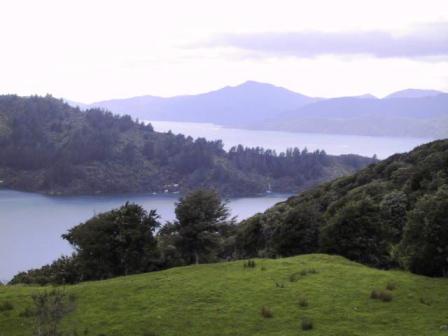 The next day we took a picnic and drove along the
coast to Anakiwa, the end point of the Queen Charlotte walk. We had a good day
following most of the last day of the trail backwards
from Anakiwa almost to Mistletoe Bay. It took us about 5
½ hours for the round trip. When we were almost back to
the car, we were passed by a group of runners. There is
an Outward Bound school in Anakiwa, and the participants
were out for late afternoon team building activities.
Besides the runners, other groups were in busy rolling in
the mud flats at the shore and others were holding hands
in a circle and dunking in the waters to get rid of the
mud. Some people have all the fun, but I am not signing
up.
That night we had a horrendous rain and wind storm. We
were glad we were safe and warm inside, but we starting
having second thoughts about our hiking and kayaking
plans. We had already seen quite a bit of Queen Charlotte
Sound and were feeling a little over programmed, so we
cancelled the hike. We managed to convince the Wilderness
Company, to advance our kayak trip by one day, to start
on Jan 5.
That decided, we packed up and took another typical NZ
road around the coast east of Picton, ending in Blenheim.
Instead of an easy 28 K drive straight south, we took a
50 K scenic tour up the hills and down to the bays. At
least half of the road was paved and there was almost no
traffic. We arrived in Blenheim for lunch at a very nice
restaurant overlooking the town center. Blenheim is the
center of NZ’s most famous wine district, but we were not
in the tasting mood. Instead we drove north again to the
small town of Havelock, on the north coast, about half
way between Picton and Nelson. We stayed that night in a
good YHA, housed in a converted old school house.
Wilderness Company had their storage office right next
door to the YHA so we were able to get waterproof bags
from them that night and pack our gear ready to go. The
next morning we met with our guide, Pania, and our fellow
kayakers, Tom, from Belgium, and Jason, a young friend of
Pania, along to help her out. Two other couples,
traveling independently, were getting outfitted in their
double kayaks and another guide, Jane, was escorting a
fellow on a one day trip. All of the kayaks were loaded
on a trailer behind a van and our luggage was stored in a
second van.
We all climbed in and off we went. I was glad Pania
was driving. The last 20 K was one of those typical NZ
roads up over a hill and down to Tennyson Inlet, our
starting point. The sign at the start of the hill said
‘not suitable for caravans’ but it didn’t mentions vans
towing boat trailers. At the boat launch dock, we all put
on our kayak spray skirts, waterproof jackets and life
jackets. Pania gave us our safety lesson and we had a dry
land drill getting into and out of the kayak. We all
loaded the kayaks up with supplies and Ray and I helped
carry our double kayak and everybody else’s kayaks down
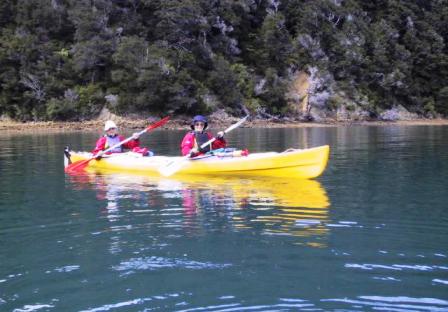
to the water. We all climbed into our kayaks and
practiced paddling in the bay before setting out.
We followed the shore for a while getting used to
paddling together. The view ahead looked lovely with the
sun shining on the islands and forested hills surrounding
the inlet. I looked back to see how Ray was doing and saw a
big black cloud behind us. Sure enough, just as we were
heading for our lunch stop on a small beach, the rain
started and the wind came up. We all paddled like mad
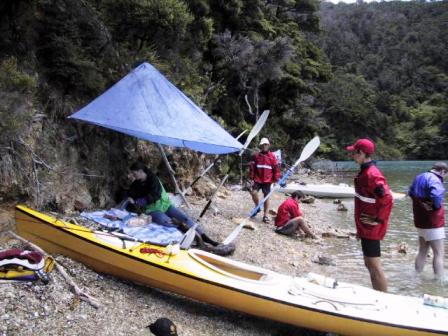
across the bay to the shore and beached the kayaks. Pania
and Jane put up a tarp to protect us from the rain, but
the rain didn’t last long. We were able to enjoy our
lunch in peace. Wilderness prides themselves on the food
they provide and they had lots of goodies for us; make
your own sandwiches, cheeses, dips and other snacks.
Lunch on shore
Ray and Jeanne in the kayak
After lunch we said good bye to Jane and her day
client. Just as we were pushing off from shore, we
disturbed a sting ray resting just off shore. Our
afternoon route was around a large island and across the
bay to Tawa Beach, our campsite for the night. The wind
was still strong, so once we were on the other side of
the island Pania suggested we rig up a sail from the
lunch tarp and sail across the bay. We rafted our
three kayaks together, Ray and I in our double, Jason and
Tom in another double and Pania in a single in the middle.
Ray and Tom had the job of holding their paddles attached
to the tarp and Jason and I had to hold on to the cords
along the sides of Pania’s kayak to keep us all together.
This was not an easy job. The wind was still very strong
and Jason and I had to hold on to Pania’s kayak with all
our strength. Pania attached a tow rope on a carabiner to
the side ropes so I could hold on more easily, but poor
Jason was left to fend for himself. We were making good
time until Jason couldn’t hold on any longer and the bows
started to veer off in different directions. We had to
take the sail down and paddle the rest of the way in, but
we had made it across most of the way.
Given that we had not encountered many other boats on
our journey up the inlet, we were surprised to see a
large family group already camped where we intended to
stay. There didn’t seem to be much space left, but it was
suggested we go just 100 M up the beach to another good
site. I’m glad we did as it was a much airier and better
site for our tents. Our only problem was the sand flies,
and I had forgotten to bring bug repellant. Luckily our
guide had some and we all applied it liberally.
Pania cooked us another great meal, complimented with
wines. The tide was out when we finished eating so we
walked down towards the water to find the oyster beds at
the end of a fresh water stream. You could eat them raw
but built a fire to cook the ones we collected. They took
about five minutes in the coals to open and they tasted
very good.
Ray and I were warm and cozy in our tent. We were only
disturbed briefly by a possum nosing around the campsite.
Pania scared it away but it returned for a second try.
Luckily everything was safely stowed away.
After breakfast the next morning, we pushed off onto a
calm sea and paddled slowly around our bay. We disturbed
a whole pod of sting rays. There must have been at least
a dozen that kept trying to flutter away from us. We left
them in peace and paddled around some of the larger
islands to a small beach on the opposite shore for a
snack and a break.
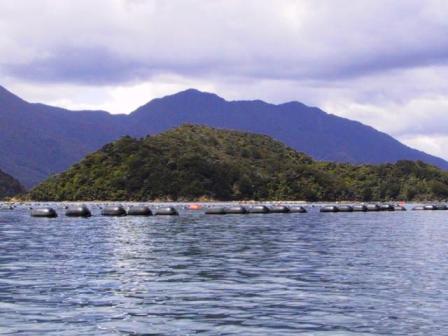 On either side of the beach were large mussel beds
which we explored for quite a while. Long lines of plastic
drums support ropes that reach down to the sea floor. The
green-lipped mussels, a specialty of the area grow in
clusters attached to the ropes. We picked some of the
mussels growing on the ropes close to the service. I kept
my catch on my spray skirt until we reached our lunch
spot. We cooked them in boiling water and all had a nice
appetizer for lunch. Jason had his fishing rod with him
and tried to catch some fish with mussels for bait.
Unfortunately he was outwitted by the fish who enjoyed
the bait but were too crafty to be caught.
After lunch we tried sailing again, but unlike the day
before, there was very little wind. We had our tarp sail
up but it kept collapsing on us. A man on a sailboat,
motoring past under power, stood on the deck making a
paddling motion. We just laughed and tried again. We did
make a little progress but eventually we gave up and
paddled the rest of the way back to the dock. Pania, in
the bow of the double kayak, tried to rig up the sail
herself, but even Ray and I were faster than she was.
Back at the dock, we unloaded everything, secured the
kayaks on the trailer and drove back to town. Everyone
was tired but pleased with their kayaking. I’m glad we
had opted for a two day trip as it takes a while to get
organized and used to paddling. My muscles told me that
two days was enough for this time.
We still haven’t decided our exact route from now on.
We want to travel down the west coast and back up the
east coast, ending in Christchurch where we have our
flight home at the end of February. The only problem is
the weather. It has been terrible the last week on the
west coast so we are not hurrying to get down there.
Today, we left Havelock and travelled just one hour to
Nelson, the largest town in the area. I have spent most
of the day finishing this letter while Ray has been out
exploring. Depending on the weather, we may stay around
here another day or we may head towards the Nelson Lakes
area. We haven’t decided yet.
Back to
Episode 3: Page 1 Rotorua to Waikanae
Read about our visits to the
Cook Islands or
Fiji
Return to
New Zealand
Intro
Return to
Travels
Return to
Introduction