Episode 7: Vientiane to Hanoi and Sapa
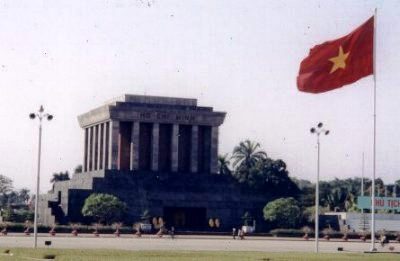
Ho Chi Minh Mausoleum, Hanoi
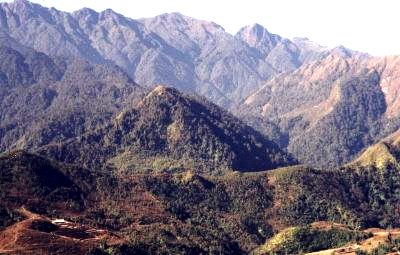
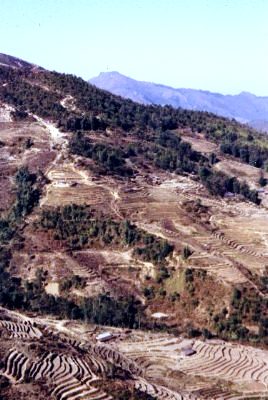
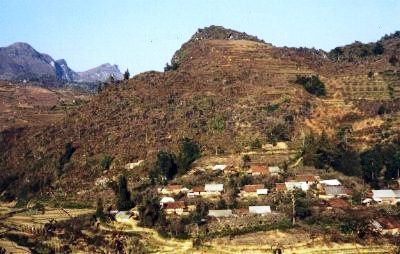
Hills enroute to Sapa
Read Previous Episode:
Luang Prabang to Vieng Vieng or Next Episode:
Hanoi to Halong Bay
Tuesday 28 December 1999Greetings
from Hanoi! The last you heard from me we were in Laos
about to travel from Vang Vieng to Vientiane. That was 20
Dec. It seems like a long time ago. Ray was still not
feeling 100% that day so we took our time and decided
to take the more comfortable bus to Vientiane in the
afternoon. This was a 3 1/2 hr easy ride, and the extra
passengers loaded on as we passed each small town didn’t
bother us. The route first descended through medium sized
hills to a broad plain that got increasingly heavily
populated as we approached Vientiane.
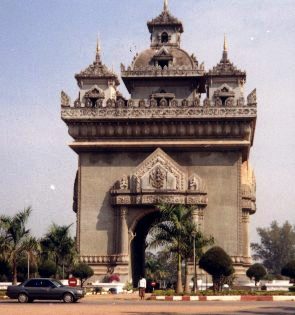 Ray was definitely better by the time we reached
Vientiane so we explored the streets that evening and the
next morning. This is a small city established by the
French & still has remants of the colonial style. To
us it was relatively expensive after the rest of Laos,
but we still only paid 16 USD for our room. We watched the
sun set from one of the many small patio bars on the
banks of the Mekong river and the next day walked along
Vientiane’s version of the Champs Elysee to their Arc de
Triumph, the Victory Monument. This was built in 1969
using concrete provided by the Americans that was
supposed to be for an airport. It is still only partially
finished as only 1 out of the planned 4 staircases
leading to the top are completed. We walked up and got a
good view of the city, much of which seems to be under
construction or renovation.
Took an afternoon flight to Hanoi and then took a
minibus into the city. This was a bargain at 3 USD as it
took 45 minutes from the distant airport to the Old
Quarter of Hanoi, where we are staying in one of the many
mini hotels. This is good value, as we have a arge room
with a modern bathroom, even a bathtub, for 15 USD. We
can walk everywhere from the hotel, although coming to
Hanoi traffic was an adjustment for us. Thailand has
millions of cars, motorcycles and tuk tuks, Laos has tuk
tuks and motorcycles and pedestrians, Hanoi has
pedestrians, motorcycles, cyclos (pedicabs) and bicycles,
bicycles, bicycles.
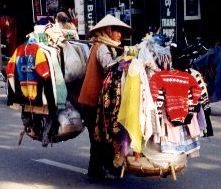 The Old Quarter of Hanoi for us is a cacaphony of
sights and sounds. It was established in the 13th century
with each of 36 guilds laying claim to a street. Today
the street names reflect the original product although
the product sold on that street may now be something else.
On Hang Gai (hemp), you now find silk clothing and
embroidered tablecloths and Hang Bac still has some
Siversmith shops. Every narrow street is lined with
shops, the sidewalks are crowded with street vendors,
extensions of the shops and little restaurants that
consist of a charcoal burner on which is boiling various
version of Pho, the Vietnamese soup.
The customers sit on little stools in a circle around the
fire on the sidewalk. Along the sidewalks and on the
edges of the street walk women selling fresh bread from
burlap covered baskets on their heads, or fruit and
vegetables from baskets hung from a long pole on their
shoulders. Bicycles heavily laden with goods to sell are
pedalled or pushed from street to street. Down the middle
of the street race hundreds of motorcycles and bicycles,
blowing their horns to announce their arrival and usually
ignoring the few stop lights and pedestrians trying to
cross the street. Add to this the local Hanoi people and
tourists threading their way between the vendors and the
motorcycles that are parallel parked on the sidewalk. The
tourists have to fight off the entreaties of people
begging, the boys with loads of maps and postcards, and
the cyclo drivers to use their services “cheap,
cheap”. We are now very adept at crossing streets
without being killed and at saying “no thank you”
and walking fast to avoid further sales pitches.
With all that we are enjoying the city. We have
visited several large local markets selling everything
imaginable, from clothing to live chickens and fish. We
have visited the Women’s Museum with displays of the
native dress of many of the 54 ethnic groups found in
Vietnam and the Ho Chi Minh Museum for the Vietnamese
version of his life and the Vietnamese revolution against
the French and the Americans. We have eaten in several
small travellers restaurants and some good ones as well.
We try to stick to Vietnamese food, but can’t face Pho
for breakfast. We still go for bread or pancakes and
omelets. One of our favourite dishes has been the grilled
fish, called Cha Ca in Hanoi. It comes on its own
charcoal burner with a sizzling pan of flavourful fish on
top.
We spent an enjoyable evening watching the famous
Water Puppets. This art form was started in northern
Vietnam in the 11th century by rice farmers. The stage is
a water tank and the puppeteers stand in the water behind
a bamboo screen controlling wooden marionettes with one
or more sticks underwater. The water is muddy, like the
rice fields, so you can’t see the sticks. An orchestra of
traditional instruments including drums, cymbals, bamboo
xylaphone, flute and an unusual one stringed dan bau. The
performance consisted of folk music played by the
orchestra followed by several vignettes depicting village
life, rice planting and several legends.
Friday, Christmas Eve, we left on a 6 AM minibus with
9 others and 2 guides for a 10 1/2 hour trip to Sapa,
northwest of Hanoi near the Chinese border. Just leaving
Hanoi so early in the morning was interesting. People
were already bustling about setting up shop and doing
their morning limbering up exercises. We passed by a huge
fruit and vegetable market that looks very impromptu set
up along side the road, but is actually the largest
market of its kind in Hanoi. We crossed the Red River on
a long bridge made famous by the number of times it was
bombed and rebuilt during the Vietnamese war. Coming the
other way into Hanoi were hoards of bicycles with the
biggest loads I have ever seen. Andre’s laden touring
bicycle has nothing on these! Most were higher than their
rider and almost as wide as a car.
It was several hours until we came to the plains
surrounding Hanoi. The fields were all carefully divided
into small garden plots of rice, corn or other cash crops.
Most of the work is done by hand or using a water buffalo
to till the fields. Many of the crops are even watered by
hand by people carrying water buckets on each end of a
shoulder pole.
Finally we started climbing into the foothills gaining
altitude until we reached Lao Cai, right on the Chinese
border. It was entirely destroyed by the Chinese in 1979
and is now a thriving but unattractive town with a large
military presence. From Lao Cai, it was 37 K uphill on
tight switchbacks for 1 1/2 hours until we reached Sapa,
altitude 1600 M.
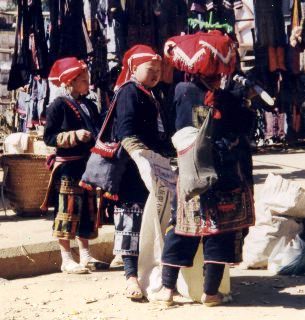 The town is on the top of one of the peaks forming a
circus around a small valley. It exists as a
market town for the neighbouring hilltribe people and as
a tourist attraction for people coming to see the
hilltribe people in their colourful outfits. Sapa means
French soldier in commemoration of the man who discovered
the area in 1914 and establshed the town as a resort area
for the French wishing to escape the heat of the lowlands.
I doubt that the French would have visited at this time
of year.
As soon as the sun disappears behind the hills the
temperature drops and there is no central heating in the
guesthouses. Our room was no exception. With 2 comforters
and our water bottles filled with boiling water under the
covers, we did keep warm, although my thermometer
registered 5 C in the room the next morning. We had also
come well prepared with our warm clothing we used on our
trek in Nepal. It is a beautiful area though, and there
are many trails leading over the hills to the scattered
villages in the area. The highest mountain in Vietnam,
Fansipan, at 3143 M is visible from the town. Apparently
you can climb it in 5 or 6 days, but at this time of year
it would be too cold for me.
There is a large market everyday, but larger still on
Saturday that attracts the locals from all over. The
largest group of people are the black Hmong who wear a
black tunic over knee length black shorts and black leg
wrappings. The outfits have embroidered sleeves and
coloured edgings and the women wear lots of silver
jewelry and carry the children in indigo coloured cloth
carriers. The downside is that the women now make hats,
bags, scarves and shirts and agressively hawk their wares
all over the town. The goods are beautifully decorated
and well made, but you cannot sit or go anywhere without
a hoard of small black clad women shoving articles at you.
We learned to aviod the worst areas & escape to the
trails around town.
Christmas Eve we wandered around town and much to our
surprise found that the center of attention was a
Catholic Church celebrating a special mass for the event.
This was like no other chruch service I have been to. It
was truly a fusion of Hilltribe animism, Buddhism and
Catholism. The priest and his assistants were trying to
set up a PA system to broadcast the service to the people
outside, but were having difficulty, so what was
broadcast was a Vietnamese rock song. The church was
filled with hilltribe people of all ages, some holding
the traditional candles, and coming and going at will.
There was a nativity scene inside a straw cave. It had
figures of Mary & Joseph and a baby that was 10 times
bigger than the parents. Add to this one of those K-Tel
special lights constructed of a bunch of plastic straws
that lit up and revolved behind the family. Very
interesting. Outside the church vendors had set up
portable roadside cafes surrounded by plastic to try to
keep some of the heat provided by charcoal burners in.
Apparently this is a popular hangout area for the young
people of the district to come & look each other over.
 Christmas day the weather was sunny and warmed up
nicely. We went for a walk with our guide in the
morning down into the valley to visit some of the village
homes and to see a waterfall. The other members of our
hiking group were an Italian family with their 2
children, Tessa, who will be 3 in January and Aluna, a
boy who will be 6 in January. The family has been
travelling for 5 months and do not plan to return home
until the end of May. I was most impressed as the
children were well behaved and hiked very well. Little
Tessa was the center of attention with all the local
women who wanted to pick her up and kiss her, much to her
displeasure.
We had a free afternoon so Ray & struck out on our
own to explore the paths leading south out of town into
the next valley. We had a good time & enjoyed the
peace and quiet. The local people around there let us be
and went about their chores.
The next day, Sunday, we got up early to board the
minibus and drive 2 1/2 hrs to Bac Ha, another mountain
village known for its Sunday market. This meant driving
down those switchbacks back to Lao Cai, then turning off
and following more mountain roads up to 900 M. We knew we
were approaching Bac Ha when we started passing person
after person carrying goods or leading a pony laden with
goods. The people in this area are mostly flower Hmong,
named for their very colourful outfits. The women wear
full skirts of a blue patterned material embroidered and
appliqued with more colours and patterns. Their blouses
were bright green or blue or flowered velveteen broadly
trimmed with similar appliques.
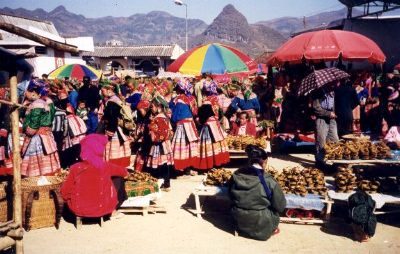
Bac Ha Market
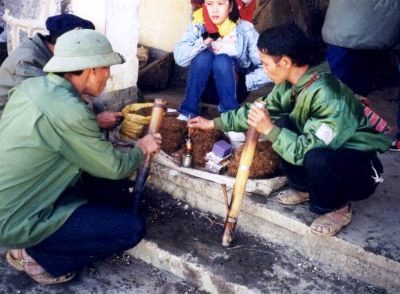
Bac Ha Tobacco
Our guesthouse was right across from the market
so after checking in, we made the rounds. It was like no
other market we have been to yet. It was jammed with
people in all their colourful finery and teeming with
interesting products and foods. There was homemade wine
& liquor being sampled, local tobacco smoked with
long bamboo hookah pipes, spices,
meats, chickens, ducks, a dog market, a pig market, a
pony market, birds in cages, kittens – you name it, it
was there. Ray went through a roll of film very quickly.
When we had walked around the market enough, we borrowed
chairs from the restaurant at our guesthouse & put
them in the sun across the street & sat there just
soaking up the scene.
In the afternoon, our guide took us a walk in the area.
As we walked through the town, we stopped to let a
funeral procession pass by. The parade of people on foot
carried banners proclaiming the deceased war experience
and others carried an altar with incense burning. Next
came the body wrapped in cloths and covered with a
ceremonial blanket that looked like a casket. When it had
passed we continued to a French Colonial style mansion
that was built in 1921 for the King of the Hmongs, a
French sympathizer. It is now a People’s Committee
building and the King & his son live in France.
 From there we headed out of town and followed many of
the Hmong returning to their homes after the market. In the next valley we could
see a large group of Hmong women in the distance and
could hear the sounds of a party. When we reached them,
we discovered that this was the 2nd day of a wedding
celebration and the bride & groom were about to leave
for their new home. We saw them leave then proceeded to
the house where the party had been, but we were too late.
There had been too much wedding wine consumed, so we were
not invited in.
Instead, we went to another home nearby where our
guide gained permission for us to come in & see the
women make their famous corn liquor. The still was in the
dark kitchen half of the house. A large vat, covered by a
pan of cold water was boiling over an open fire. The
resulting liquid was draining through a spigot on the
side of the vat and was filtered through a dirty cloth
into a stone jug. The jug filled to everflowing while we
were there so one of the women sort of cleaned out a
plastic container to hold the liquor from the jug. We
were offered a taste of the homebrew, and since it is
impolite to refuse, we did. It was a clear, almost
tasteless liquid that was very strong, but not unpleasant.
The women were making the liquor in preparation for
another wedding the next week. It is the duty of the
groom’s family to supply 200 bottles of this stuff, about
6,000,000 Dong and 3 pigs to the family of the bride.
The next day we rose early again for the 9 1/2 hour
trip back to Hanoi. All in all an interesting trip. You
could easily spend a few more days in Sapa exploring more
trails and Bac Ha was fascinating.
We are busy now planning the rest of our time in
Vietnam. We will take another overnight tour to Halong
Bay, where we will spend New year’s Eve & then head
south to visit Hue & Hoi An in the Central part and
end up in Ho Chi Minh (Saigon) and the Mekong Delta,
before heading off to Cambodia & Thailand.
Happy New Year’s to everyone, and have a great party
& drink a toast to us.
Jeanne & Ray
Return to
South-East Asian Adventures
or
Travels
or Introduction