On The Gringo Trail
Episode 6: Attitudes and Altitudes
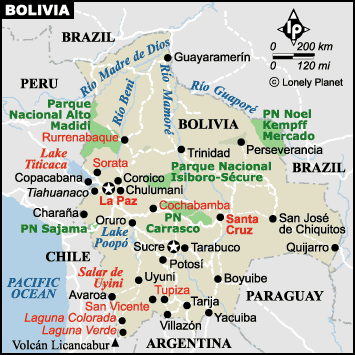
Click
the map above to see a photo
album of Sucre and La Paz. Close the window to return to this page.
Read
Previous
High Desert Tales
or Read
Page 1 of
2
Tuesday January 28,
2003 Arequipa, PeruYes, we are in Peru, but Arequipa,
although still high altitude, is sunny and warm, thank
goodness. We had a lot of rain in Bolivia and were
looking forward to better weather. We found it.
The last time I wrote to
everyone, we had just arrived in Sucre, Bolivia. We
enjoyed our visit to this pretty city. Like many of the
mountain cities, it originated in a valley and grew up
the sides of the hills around it. One day we walked up
one of the steep streets to a Mirador at the Iglesia de
la Recoleta. From there we could look down on the city
center covered with white adobe houses with red tile
roofs. We watched boys play football (soccer) in the
Plaza in front of the church and ate our lunch in the sun
on the patio of an adjacent cafe, just enjoying the day.
Sucre has become a center for the preservation and
teaching of ancient weaving techniques. We visited the
Museo de Arte Indigena, where they have an excellent
display of both ancient and modern weaving. The colours
were wonderful and the patterns unbelievably complex. Two
women and one man were on hand demonstration their skill
on hand looms. I salivated over the weavings for sale in
their shop, but they were a little out of my price range.

Weaving traditional patterns

enjoying fresh fruit with topping
Markets are always a favourite spot for us and Sucre
had an excellent one. Along with the
stalls of fresh fruit, vegetables and meat, there was a
row selling delicious fruit drinks and salads. We ordered
up their deluxe special and shared a mixture of freshly
cut fruit, yogurt, sweetened condensed milk with a
sprinkling of chopped nuts. It was so good we made a
return visit another day.
I read that there were good hiking opportunities
around Sucre. Since there is no public transportation to
the walks and the trails are not marked, we visited a
travel agency in town to arrange a trip. We ended up with
a private tour to see some petroglyphs (prehistoric rock
paintings) in the hills, the Cordillera de los Frailes,
near Sucre. The next morning we were driven 32 K out of
town and hiked with a young guide. Mario was a college
student working for the firm on his summer break and
luckily, spoke very good English. This gave us an
opportunity to ask him all kinds of questions about the
area and life in Bolivia. Although the drive was only 32
K, we were warned when we started that it would take 1 1/2
hours due to the bad roads. In fact, we were told, it had
rained hard in the hills the previous night and we might
not be able to make it to the trail head. The road was
indeed bumpy and full of pot holes, but we made it
through.
We started our walk far above Sucre and and in a short
time we could see down into another valley dotted with
small towns near a river that supplies Sucre with its
water. We headed down to a large rocky ledge, under which
there were remarkably well preserved rock paintings. Most depicted
people, including one of a woman giving birth, but there
were several mysterious rectangular shapes. They are
called Inca machay and Puma machay because they are
drawings from two eras about 2500 years ago. We were the
only tourists around but there were three archaeologists
from La Paz camped there to study the drawings. Mario
poured some water on one rock so that we could see the
drawings cut into the stone. This prompted an outburst
from the woman archaeologist, who rudely berated Mario
for watering the rock. I guess if there were a continual
flow of water the drawings would be worn away but she was
a little paranoid. We retreated to eat our lunch in peace
on top of the overhanging rock.

Puma Machay Rock Painting

Inca Madonna in Chataquila Chapel
We walked back to the waiting car and drove a short
distance to the Chataquila Chapel, a small church on the
side of the road. Mario explained that the Incas in the
area were reluctant to give up their beliefs when the
Spanish arrived, so a compromise was necessary to win
converts to Catholicism. A
large rock by the side of the present road was worshipped
by the Incas as a symbol of Mother Earth (Pachamama). The
Spaniards moved the rock a short distance and built a
small church with the altar right on top of the rock.
They convinced the Incas that the Virgin Mary, or Madonna
was an appropriate substitute for Pachamama and everyone
was happy. Now there is a small open air sanctuary next
to the church with a beautifully painted Madonna and
child on a rock slab. The locals come with gifts of
flowers and candles to place in front of the rock
painting. The sanctuary now has all the essential five
elements of life, according to Inca lore. It is cooled by
the wind, warmed by the sun, has flowers from the earth,
water in the vases containing the flowers and fire from
the candles. Just to complete the picture, the locals
built a small shrine on the original site of the rock and
offer small stones to the Pachamama.
We had planned to travel next to La Paz via Potosi,
staying overnight, then getting the day bus to La Paz.
But as they say, the best laid plans of mice and men go
awry. We got back to Potosi by 4 PM on a Wednesday only
to be told we couldn’t buy tickets for the day bus.
Apparently there had been a demonstration a few days
before by older Bolivians (Jubilados) seeking a pension
from the Government. There had been an altercation and
several people had been killed. This had incensed many
more people and there were demonstrations and road
blockages on the way to La Paz threatened for the next
few days. We were told we might not get a day bus until
Sunday! The only alternative seemed to be the overnight
bus leaving at 8 PM that evening. We had good reports of
the deluxe cama and semi-cama buses in Chile and
Argentina. These buses have roomy seats that recline into
beds, so we decided to give it a try. It was not so easy
in Bolivia.
We took a taxi into the center of Potosi to enjoy an
early supper and relax before our 11 or 12 hour ride. We
arrived back to a mad scene of people milling about
waiting for their bus to load. There were so many wanting
to leave Potosi that an extra bus had been put on. We got
on to find we had the last two seats at the back of the
bus. The seats did recline but not completely flatly and
my feet dangled off the end of the foot rest causing my
knees to seize up after a while. On top of that, the
first four hours of the trip was over a road under
construction. It is an understatement to say it was a
bumpy ride. Even Ray had trouble getting enough rest.
About 6:30 AM, still well out of La Paz, we looked out
the window to see a procession of several hundred people
silently walking along the road towards La Paz. They were
carrying their belongs on their backs and holding huge
Bolivian flags and signs proclaiming their solidarity
with the Jubilados (pensioners). It was an eerie sight.
We arrived in La Paz by 8 AM, having traveled around
the rim of mountains surrounding the city, 400 M below.
We had our one and only glimpse of Illimani (6402 M) with
its three snowy peaks. It is shown on all the postcards
but was obscured by haze and cloud the rest of our time
in La Paz. The city center is attractive, with many
plazas and green parks, but the approach is not. The
mainly unpaved city streets sprawl up the sides of the
hills surrounding the city. A satellite city, El Alto,
has sprung up on the rim and it is not much more than a
huge shanty town.
We were glad to find our simple hostel in the center
of the city, a block from the busy Plaza Mendoza, and
have a rest before exploring La Paz. At 3632 M, La Paz is
one of the highest cities in the world. Our concession to
the altitude is to avoid alcohol. We miss our good
Chilean and Argentinian wines, but we do seem to be
coping very well with the altitude, aside from huffing
and puffing up all those hills.
We found La Paz easy to explore by foot. We climbed up
to a park on a high peak in the middle of the city to see
the view and walked the long way back to our hostel to
see more of La Paz.
In the
Murillo Plaza, where the Impressive Presidential Palace
and Legislative buildings are, we were approached by a
young Bolivian girl with an assignment from her English
language class. She had a questionnaire to ask us about
ourselves and to get our impressions of Bolivia. She was
very pleasant to talk to so of course we gave her high
praise.

Murillo Plaza La Paz

Bridge to cross Valley of the Moon
Another day we took a collectivo for a 10 K trip south
of the city to see the Valley of the Moon. A collectivo
is a minibus with a conductor who hangs out the window
calling out the destinations served by that bus. There is
much competition amongst the buses, and they take as many
passengers as possible, but the system is inexpensive and
works.
With the help of one of our fellow passengers we got
off at the entrance to the park called the Valley of the
Moon. The city has sprawled right past this weird
geological phenomenon, but part of it has been preserved
as a park. The land is very
soft sandstone, worn away by the wind and ancient rivers
to form multitudes of pinnacles and spires, interspersed
by deep canyons. We walked along simple pathways admiring
the unusual shapes. Down in one canyon we saw a
collection of shacks where people were still living and
raising pigs in a makeshift pen. That is third world
living.
The paths led out to the main road again and we had
read that a zoo was about 1 or 2 K further on. It was
described as being on surprisingly spacious grounds and
housed quite a large collection of local and exotic
animals, so we couldn’t resist. The zoo was badly in need
of refurbishment, which we hope our entrance fees
supported, but we did enjoy many of the animals and birds.
There were panthers, a lion, some bears, lots of monkeys,
parrots, some Condors, Llamas and donkeys and a serpent
house.
On our return trip to town on the local bus, we found
the main street blocked off just before our intended stop.
We got off early and walked to our chosen lunch spot past
police in riot gear.

Calle Jaen Museum La Paz
All was quiet during lunch so afterwards we walked up
to Calle Jaen, where there are four small museums in
beautifully restored houses. We paid our
admission, which included visits to all four buildings.
The first depicted life in Colonial La Paz, before the 19th
century and the second was devoted to military campaigns
in the 1820, the time of revolution in South America. In
the third museum, we entered a vault to view the
extensive and fascinating collection of pre-Incan gold
and silver artefacts collected by a German living in
Bolivia for many years. When we were in the last house,
which was owned by a previous president of Bolivia, we
heard loud bangs. We asked one of the guides what it was
and were told it was fireworks being lit by some of the
demonstrators. We continued viewing the collection of
portraits and colonial era furniture.
On our way out, we saw a procession go by the other
end of the street, but we continued on back to our hotel.
Right next to the Plaza Mendoza we encountered a large
body of the anticipated demonstrations. It seemed to be a
large parade of people heading for the San Francisco
Plaza. Some of the people were lighting fireworks to
attract attention, but it was mainly a very orderly march.
For a while we followed one group of women carrying a
banner proclaiming some women’s organization. We were
told that South Americans get very passionate about their
politics.
Next: Episode 6: Page 2
Return to
Travels
Return to
Introduction