On The Gringo Trail
Episode 5: High Desert Tales
Page 1 of2
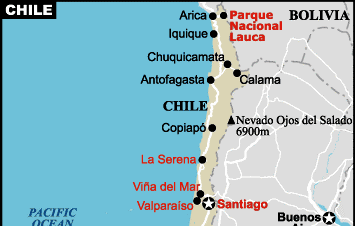
Northern Chile
Click
the map above
to see a photo album of San Pedro de Atacama. Close the window to return
to this page.
Read Previous
Pucon, Santiago, Valparaiso
or Read Next
Attitudes and Altitudes
Sunday January 12,
2003 Sucre, BoliviaSan Pedro de Atacama was a delight.
We left the last paved roads behind in Calama, but the
town is peaceful and attractive, although it had the most
tourists per capita that we have encountered so far.
There are no junky storefronts. The houses are all one
story adobe style building clustered on just a few
streets around a small plaza. The town is situated in an
oasis so there are actual trees and flowers to relieve
the brown dust of the Atacama desert. Our hostel was
quite nice with all the rooms clustered around an inner
courtyard and the restaurants in town were good, so we
enjoyed our stay.
 We
We
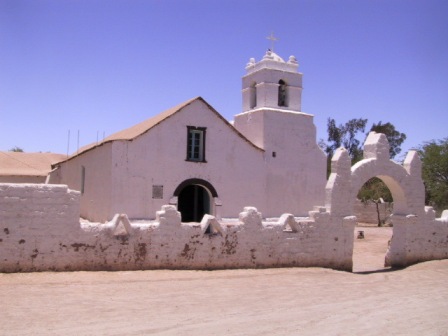
walked around town to see the local Spanish mission style
church, built centuries ago with local materials and held
together with llama leather instead of nails. We visited
the Archaeological Museum, put together jointly by a
local Belgian Priest, Gustave Le Paige and a Chilean
University. It gave a very complete story of the
evolution of the area from prehistoric times to the
coming of the Spanish. There were numerous artefacts,
from ceramic bowls to somewhat gruesome mummies. The
practise of the Indian tribes of burying their dead in
protected graves dug into the ground combined with the
dry climate resulted in many well preserved bodies for
archaeologists to find. Their most famous mummy is
nicknamed ´Miss Chile´ because of her fine features and
elaborate dress.
We didn’t get much sleep the night before our
visit the El Tatio Geysers. The geysers are at their best
while the air is still cold, hence we had to leave at 4
AM to drive 2 1/2 hours across the desert to see the
geysers at sunrise. Our minibus load of 20 people joined
lots of other vehicles for a starlit tour across the
desert. We were advised to sleep if we could but that
proved to be a little difficult when you are bumping
across washboard roads. There is usually a main trail on
the desert but it gets rutted easily and the drivers just
pick their own trail parallel to the main one.
 We
We
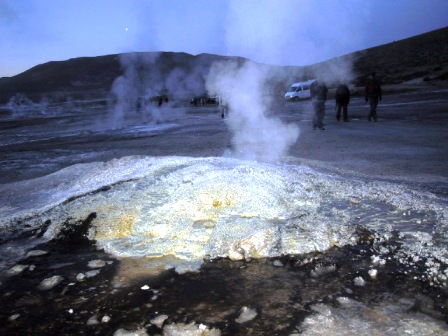
arrived in time to see steam rising from hundreds of
fumaroles over a wide area. This was the broad crater
floor of an old, but still active volcano whose sides had
collapsed. We had been warned to bring warm clothing as
at an altitude of 4200 M the air is freezing until the
sun warms things up. I had on a warm fleece, my Gore-Tex
jacket and gloves but I forgot my toque and my ears were
freezing for a while and I kept warming my hands over the
hot geysers. There were no geysers that spout forth as
high as Old Faithful or some of the ones we saw in New
Zealand, but they were impressive. We were free to wander
wherever we wanted, unlike the well guarded sights in
other parts of the world.
We ate a tailgate breakfast at the site, then walked a
short distance to a thermal pool on the edge of the
geyser plain. Some of us took advantage of the warm 33 C
waters to put on our swim suits and have a good soak
before boarding the minibus again for the return trip. By
this time it was daylight so we could admire the scenery
and the wildlife. We saw a few very tame foxes, used to
feeding on scraps thrown by the many tourists. There were
lots of vicunas, a small llama variety with prized, soft
wool, some emus and a herd of domesticated llamas.
We
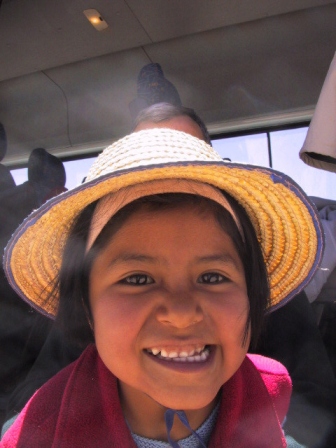
stopped at a small village, permanent population of 7, to
have a break at their small store. The cute, five year
old daughter of the family was delighted to see us come.
She was not at all shy and engaged several of us in her
games. Ray
and I played hand and counting games with her and she
laughed with delight. It was nice not to be besieged by
begging children, although our driver gave her a candy
bar as we left. I hope she doesn’t become too jaded
in the future.
We stopped a few more times to see numerous waterfowl
in a shallow river and flamingos on a lake, so it was
about 2:30 by the time we got back. We were hungry by
then so we shared a pizza in a restaurant that just
happened to have a quartet playing traditional
instruments and singing folk songs for our lunch time
entertainment. They were very good.
That evening we were just going out to find a
restaurant for dinner when we spied an English couple we
had met in Bariloche. They joined us for dinner and we
caught up on all our travels since we last saw each other.
That is one of the bonuses of travelling the gringo trail.
You often bump into the same people over and over again
and get a chance to renew your acquaintances.
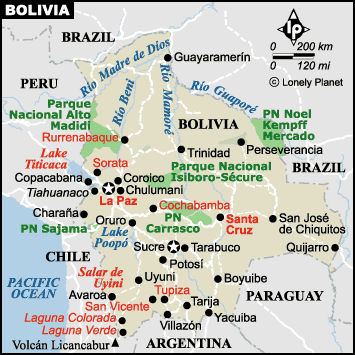
Click the map above to see a photo
album for Part 1of the Salar de Uyuni trip. Close the window to
return to this page.
The main reason we came to San Pedro was to take a
three day jeep tour across the desert to Uyuni, in
Bolivia. There are lots of fascinating sights along the
way and we had a great time, despite a few unexpected
events.
We left San Pedro in a minibus with 10 others. We
took the unpaved Paso de Jama road, part of a pan-oceanic route from
Antofagasta, Chile on the Pacific coast, through Argentina, Paraguay and
Uruguay to Brazil on the Pacific ocean. Of course, we didn’t go all the
way. We turned off at Volcan Licancabur (5960 M) right on the Bolivian
border. We circled the volcano to reach
Laguna Blanca and Laguna Verde on the north side. The two
lakes were once joined but the waters receded long ago
leaving two distinctly different lakes separated by a
narrow road. The Laguna Blanca is ringed with white
chalks and salts and is home to many flamingos who eat
the algae that flourish in the waters. The Laguna Verde,
at 5000 M altitude, is emerald green, but it is a dead
lake. No fish or flamingos call this lake home as the
various minerals in the waters are poisonous to life. It
was beautiful to look at anyway.
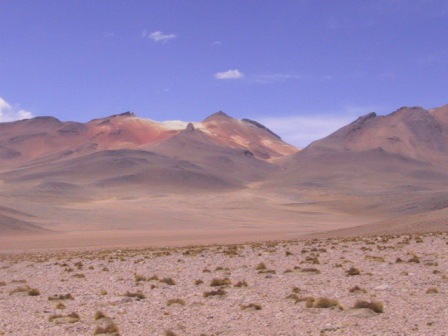
On the Salar de Uyuni
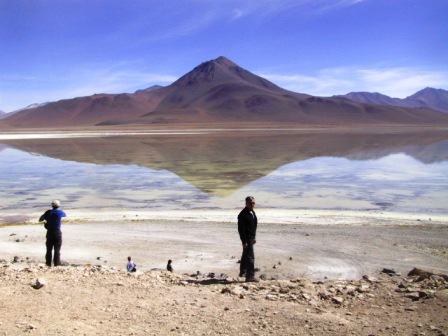
Volcan Licancabur from Laguna Blanca
At Laguna Blanca we left our
minibus and were divided into two groups of six to travel
the rest of the way in Toyota 4 X 4’s. The groups
were formed so that there were Spanish speaking people in
each group as our drivers/guides spoke almost no English.
Our group consisted of Ray and I, Amelia from the US, and
Karin, Axel and Harry from Germany. I can speak and
understand a little Spanish, but thank goodness Amelia
and Karin spoke more Spanish than I do. We got along well
the whole trip, which was good as we were to share the
jeep and dorm rooms for the next three days.
Our next stop was the Termas de Polques, a small
thermal pool. We had packed our swim suits but the pool
was quite shallow so most of just paddled around in the
warm waters. From there we went to see more geysers at
Sol de Mañana, said to be the highest in the world at
4950 M. The area was smaller than El Tatio, but they were
more active and definitely noisier. We wandered around
taking pictures of boiling mud pools and smoking holes.
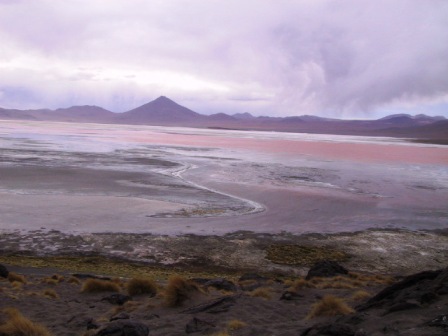
Laguna Colorado
Back in the vans again we made our way downhill to our
hostel for the night at Laguna Colorado, altitude 4200 M.
Since we had left San Pedro that morning at a mere 2800 M
and climbed all the way to 5000 M at Laguna Verde, most
of the people were feeling the effects of the altitude.
At that point we didn’t feel too bad, the result, we
thought , of our previous days trip to El Tatio. We left
the rest of our group napping in our room and went for a
walk around this large, shallow lake. It was home to
hundreds of flamingos as well as many other water birds
and was quite a sight. The center was flamingo pink and
the 61 Km perimeter was ringed with white salt flats.
After our walk we were starting to develop a headache,
so it was our turn to have a rest. Our appetites were
somewhat depressed, but we took some Ibuprofen (Tylenol)
and the next morning we were feeling fine again. Karin
had a supply of coca leaves from her Machu Picchu hike so
we all had some with our breakfast tea, which helps with
the aclimatization. Thankfully all of us recovered well
so we didn’t worry about the altitude anymore.
Day two of our trip was a little more adventurous than
we had anticipated. We had a leisurely breakfast and
ended up being the last jeep to leave the hostel. We
thought that was a bonus because when we reached our
first photo op spot, we had the place to ourselves. We
were not the only tour groups on the route, there were at
least seven other jeeps going the same way. We stopped to
take our group photo at the Arbour de Piedra, a 15 M high
rock shaped by the wind and ancient lake waters in the
form of a tree, sort of like the flowerpot islands in the
Bay of Fundy.
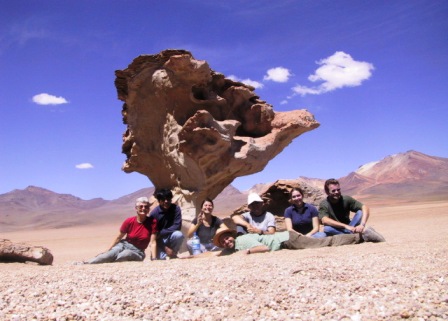
Photo Op under stone tree
the jeep breaks down
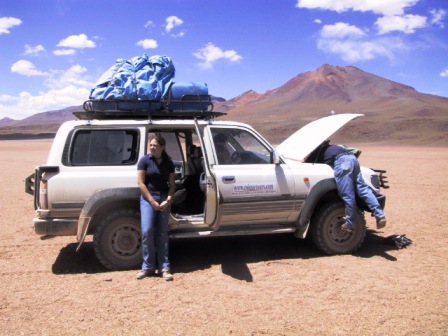
Our driver, Teo, had checked under the hood of the
jeep before we left the Arbour and about a half hour
later, at 11 AM, he slowly turned off the main path and
stopped to check again. This time we didn’t start
again. Teo spent a long
time fiddling with the engine, with suggestions from the
fellows in our group, but it was no good. A bolt had come
off the engine block and all the oil was gone. The two
litres he had as emergency rations was not enough to get
us going again. This is when we realized that being last
to leave in the morning was now a detriment. The jeep had
no communication system. We would have to wait until jeep
groups travelling in the opposite direction reached us in
the afternoon. At least there was a breeze to cool us, we
had food and water and the shade of the jeep.
We lounged around and had lunch. About 1:30 PM Teo
suggested that he and I walk across the desert plain to
the east side. The jeeps are free to choose their own
routes over the desert and Teo wanted to make sure we
could stop as many jeeps as possible to get enough oil to
get the engine started again. It was about 1 Km across
and when we were about half way across we saw the dust of
a vehicle approaching from the south, the direction we
had come from. Teo ran to catch them and I stayed in the
middle, waving my fleece around my head and watched the
proceedings with my binoculars. The vehicle saw us and
stopped. As Teo was talking with what turned out to be an
old car with no extra oil, a jeep approached our broken
down vehicle, where the rest of the group was waiting,
from the north. They stopped, then took off. I found out
later he had contributed a small amount of oil and told
our group to wait for the other Colque, our tour company,
jeeps to arrive.
It was a good thing that Teo had crossed to the
opposite side as that was the last jeep to take the east
side route. All the others chose the path on the west
side. Eventually about seven jeeps had stopped and Teo
had what he thought was enough oil to get the jeep going
again. Eventually the jeep started, but it didn’t
sound good. The engine had been damaged by the time the
oil leak had been discovered.
It was 3:30 PM by this time and most of the group
wanted to return to Laguna Colorada and start out again
the next day. Teo was against this as it would mean
another day and our food was limited. After much heated
discussion and assurance from Teo that we would reach our
hostel for the night about 7 PM, we agreed to take
another jeep and keep on heading north. One of the
waiting jeeps distributed their passengers and baggage
amongst the other jeeps. Teo was to drive the disabled
jeep the one hour drive back to Laguna Colorado in convoy
with the now overloaded jeeps.
We all piled into our new jeep with our new driver,
Zumdi and took off.We roared off across the desert. About
a half hour later we seemed to swerve in the soft sand.
Axel, sitting in the back said we had a flat tire and we
all called out to Zumdi to stop. Sure enough, one of the
back tires had pancaked on the rough road. All the
fellows helped to change it for the spare and 15 minutes
later we were on our way again.
Flamingos on Lago Hedionda
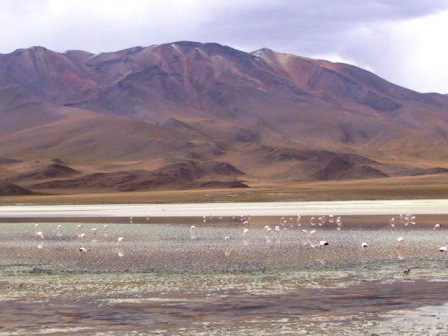
We stopped very briefly to admire more flamingo filled
lakes and
take pictures of a smoking volcano, but it was a long way
and it was getting late. We came to a tiny community
where the weekly train between Calama, Chile and Uyuni,
Bolivia, makes a stop at the provincial border post. We
had to report in and show our passports, then we were off
again across a vast plain.
We saw a truck on the east side of the plain and then
we noticed a person running towards us waving a white cap.
We stopped and Zumdi had a discussion with a woman who
was asking for assistance for her husband’s broken down
truck. Zumdi refused at first, then he asked us if we
would be willing to give the truck a push start. We said
sure, piled the woman in with us and drove about 1 Km
across the desert. We all got out, got behind the truck
and pushed until the motor started. We said our goodbyes
and were on our way again. It was starting to get dark.
Gone are the days when we were in Torres Del Paine and it
was still light at 10 PM. We are farther north now and we
put our watches back one hour when we crossed the border
to Bolivia. As I looked back, the truck had not moved at
all, but we could do no more. They were in for a night in
the desert if another vehicle did not come along.
About 8 PM we came to a small community with hostels
used by other tour companies. I knew our hostel was
further on. I asked Zumdi how far it was and he said, one
hour! Everyone groaned but what could we do. Just out of
town Zumdi got out and removed rocks serving as road
blocks and carefully drove over broken bottles. We
figured he knew a short cut but we found out later he was
avoiding another police checkpoint. Other jeeps had been
stopped and had to do a lot of talking to proceed. We
drove on next to plowed but barren fields until at 9:00,
as promised, we saw the lights of our hostel, near the
edge of the Salar de Uyuni, a 12,000 sq km salt lake that
we were going to cross the next day. We piled out of the
jeep, checked into our room and went inquiring about
dinner. At first we were told we were too late but with a
little persuasion they came up with a good dinner for us
at 10:00 PM. We ate heartily and went to bed.
Read Next:
Episode 5: Page 2
Return to
Travels
Return to
Introduction