On The Gringo Trail
Episode 5: High Desert Tales
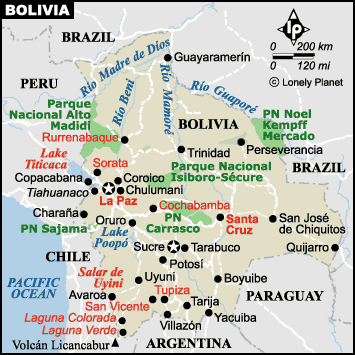
Click
the map above to see a photo album for
Part 2 Salar
de Uyuni. Close the
window to return to this page.
Read Previous
Pucon, Santiago, Valparaiso
or Read Next
Page 2 of 2
Sunday January 12,
2003 Sucre, Bolivia
Continued from Page 1
The next morning most of us got up to see the sunrise
over the Salar. The sky was peach coloured but we were
still too far from the Salar to see the reflection on the
salt. Oh, well, after a good night’s rest we were in good
moods and all keen to get going.
We had breakfast and piled into the jeep again. We
drove to a road built over the mud flats leading to the
Salar and soon we were driving on the salt. It was an
eerie sensation, like driving on a frozen lake with a
light covering of snow, except the traction was good.
Zumdi was soon going close to 100 km/hr over the smooth
surface. What a change from the rough surfaces we had
traversed the previous days.
We stopped at a spot where the locals had been cutting
blocks of salt and leaving them piled up to dry in the
sun. The Salar at this point is 4-5 M deep layers of
white salt and brown soil sitting on a layer of water. Water seeps up
through the salt layers causing the salt to crack like
ice does over a lake. The cracks form in a hexagon
pattern, like the crystalline structure of salt itself.
The salt can be harvested 6 months of the year in the dry
season. The rest of the year there can be a layer of
water over the salt. The lake itself is so big that you
cannot see the edge in many places.
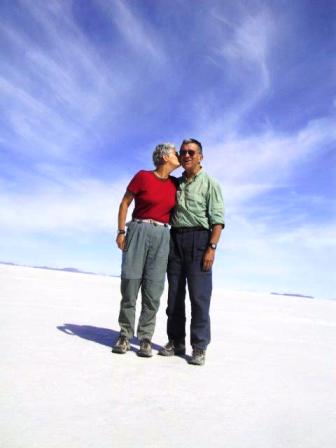
A kiss on the Salar
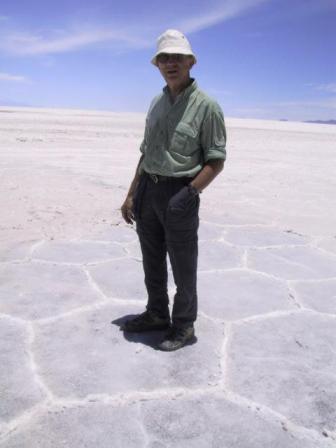
hexagon shape of salt
Our next stop was the Isla del Pescador (fisherman’s
island) which is a park called Incahuasi (Inca house). It
is a rocky volcanic outcrop covered in giant cactus, the
largest of which on the island was 12 M high. Most of
them were just tall pillars, but several had developed
side arms, like the one Snoopy’s cousin Spike
talks to in the desert (for those of you who read
cartoons). When dried, the cactus is as hard as wood.
There was a dwelling built into the side of the rocks
with a double door made of the cactus wood. We followed a
path marked by cactus wood signs to the top of the hill
on the small island to get a good view across the Salar.
Back in the jeep, we had a lunch break at the Hotel
Playa Blanca, sitting on the Salar and constructed
entirely of slat blocks. The project is halted right now
due to environmental concerns about waste water runoff
affecting the Salar, but we were able to eat our lunch
sitting at a salt block picnic table. We all kept our sun
glasses and hats on as the glare was fierce.
Further on Zumdi stopped to show us an area where
water bubbles up through the salt, like the geysers we
had seen previously. Next we stopped to see where the
alt is scraped into large cones and left to dry for a
day before being trucked into a small salt refinery on
the edge of the Salar. We had
a tour of this cottage industry. Salt is shovelled onto a
platform heated underneath by a fire of local bushes. The
salt is dried for 30 minutes, iodine is added and it is
crushed to a fine powder and hand-scooped into 1 Kg
plastic bags. They sell the salt for B$6 (less than US$2)
per 50 kg. Wages are low here.
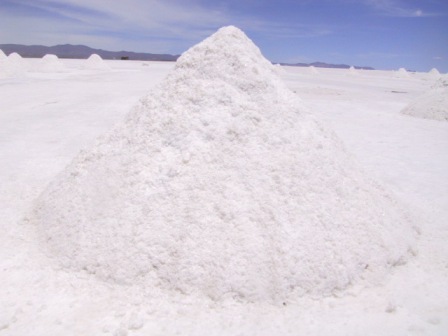
Harvested salt left to dry
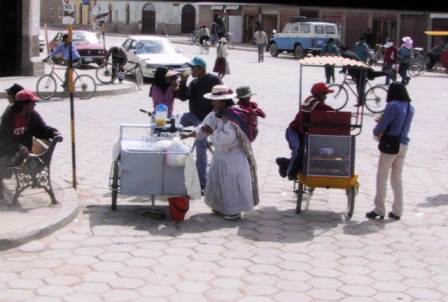
Uyuni vendors in traditional clothing
That was the end of tour. We drove the short distance
to the grubby town of Uyuni and found a hotel for the
night. There was a bustling local market in progress on
the streets near our hotel. The population is almost
entirely indigenous and most of the women wear their
traditional costume. They favour a blouse and a
wide pleated skirt that falls just below the knees,
covered by a full length apron. Their long, black hair is
braided with beaded ends and on their head they wear
either a bowler hat, a fedora or a more stylish straw hat.
We had a good time looking at all the goods for sale and
buying fruit and bread for our snacks.
That night we had a farewell dinner with 10 of the 12
people who had started out from San Pedro in the minibus.
Some of us were staying overnight and taking the bus out
the next day and some were leaving that night on an
overnight bus to La Paz. We were all happy with our trip
but anxious to get to our next town.
Our next destination was Potosi, about 6 hours away by
bus. Another couple and Ray and I were the only gringos
on the bus the next morning. The roads were unpaved and
we bumped along over the mountains. We stopped at a small
town to let out one passenger right beside a sign erected
by the local tourist bureau advertising their claim to
fame as the most famous silver mining town in the 19th C
and the site of a train robbery by Butch Cassidy. I guess
the lure of silver brings many people to the middle of
nowhere.
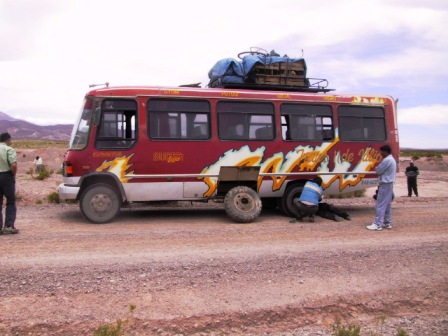
Another flat tire to fix
Shortly after the bus driver and the conductor
got out to check their back tires. Another bus happened
by, stopped and rolled a spare tire over to our bus. We
took off but shortly after we stopped again. This time
they changed the offending tire for the rather bare spare.
We seem to pick all the vehicles with problems!
Finally we were on our way again, rattling over the
hills. The first lessons the bus drivers learn on that
route is how to use their horn. It was needed on many
blind curves and to scare the llamas and sheep off the
road.
We stopped for a short break at a little store by the
side of the road. When it was time to leave, the driver
started the motor and beeped the horn. We all piled in
and took off down the road. A few minutes later some of
the other passengers started shouting at the driver. He
had left a mother and her young child behind at the store.
We stopped and a few minutes later another bus overtook
us and stopped. A very irate woman, carrying a baby, got
off and boarded our bus, giving the driver hell as she
took her seat.
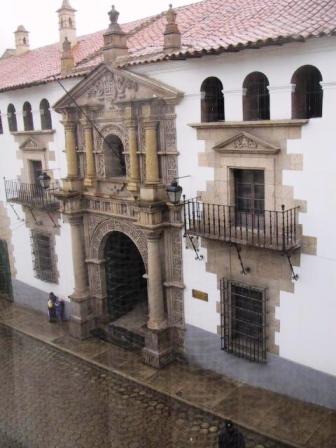
Potosi: Casa de Moneda
Click the photo above
to see a photo album for Potosi. Close the window to return to
this page
We finally made it to Potosi, seven hours after
leaving Uyuni. Potosi was a major silver mining center
for several centuries and a co-operative mine still
exists. The entrance was not very promising with hills of
mine tailings and the usual flotsam of plastic bags
lining the roads.
We took a taxi to the center of the city and were
pleased to find a distinctly different town. Most of the
buildings, including our hostel, were built by the
Spaniards centuries ago and retain a pleasing colonial
flavour. We stayed two nights and enjoyed touring the
streets.
It was rainy the next morning, perfect for touring the
Casa de Moneda, the
original mint, built between 1753 and 1773. The Spaniards
wanted to control the production of colonial coins so
they built this huge structure which covers a whole city
block. It is now a beautifully restored museum and has an
eclectic collection of religious art, the country’s first
locomotive, silver coins and the stamps used to make
them, all kinds of machinery used in silver production,
silver artefacts, a mineral collection and an
archaeological display complete with mummies and deformed
skulls. I soon gave up trying to translate all our
Spanish guide was telling us. Instead we just made our
own interpretation and admired the numerous displays.
Ray did his own tour in the afternoon while I did my
Episode writing. It cleared up enough for him to walk out
of town towards Cerro Rico, the mountain overlooking the
town where the majority of the silver mining was done. A
popular tourist activity is a tour of a silver mine.
These are still worked as a co-operative effort, but the
air is so foul that most of the miners die of silicosis
after ten years. You have to crawl on your stomach
through narrow tunnels with nothing more than a miner’s
lamp for light. Ray said the air was full of dust as he
walked up the mountain. We elected to skip the tour.
From Potosi we took the bus to Sucre. For once it was
an easy, just under three hour trip on paved roads! We
are checked into a nice hostel in a quiet area in the
center of town. We plan to spend a day or two exploring
this historic town. It was once the capital of Bolivia
and although La Paz has the majority of government
business, Sucre still has the country’s courts.
So, our Bolivian adventure continues. We have even
come down in altitude quite a bit so the uphill walking
is easier. In a few days we will return to Potosi for
overnight, then take a long bus ride to La Paz.
Back to Episode 5: Page 1
Return to
Travels
Return to
Introduction