Fountains and Parks
Tuesday
1 October 2013
Read Previous Episode
When It Rains
or
read Next
Family Time Back in Rome
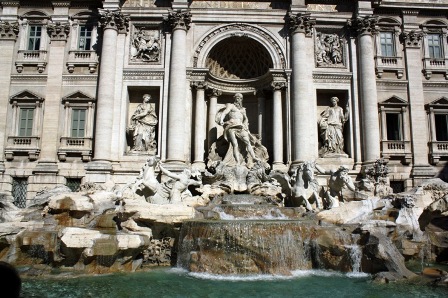
You can tell if the famous site you are visiting is one of the Top Ten
Attractions of Rome by the number of tourist there. Trevi Fountain is one of the
Top Ten, with good reason. Completed in 1762, it is the largest and most famous
fountain in Rome. In 19 BC, Emperor
Agrippa built an aqueduct connecting the new capital, Rome with springs 19 km.
The Fountain was commissioned to adorn the end of the canal and named
Trevi for the three converging roads leading to the fountain. Taking up one
Entire side of 17th C Palazzo Poli , it is a theatrical ensemble of
mythical figures, wild horses, and cascading waterfalls. Neptune is led by a
Triton and two seahorses, one wild, one docile, representing the moods of the
sea. The legend is that a coin tossed into the fountain insures you will return
to Rome. All coins are collected daily and given to the Catholic charity
Caritas. In 2002 it was discovered that a man had been helping himself to coins
in the fountain for 34 years. It turns out that it was only illegal to jump into
the fountain. I think they created a new law to prevent others from collecting
the coins We didn’t toss coins but we had out picture taken by a fellow tourist
from Hamilton.
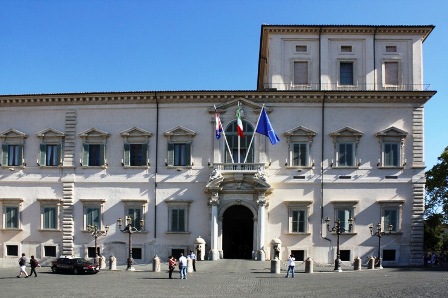
A few blocks away is the Palazzo del Quirinale The finest architects of
the era were commissioned in 1573 to build a summer residence for the Popes. The
palace was reluctantly given up in 1870 to Italy’s new king. It is now the
official residence of Italy’s head of state with once impressive mansions
surrounding the site mostly government offices. The palace faces Piazza del
Quirinale The large square, used originally for grazing cows, typifies Roman
elegance with an obelisk, ancient statues and a fountain.
Palazzo del
Quinale
Borghese Museum
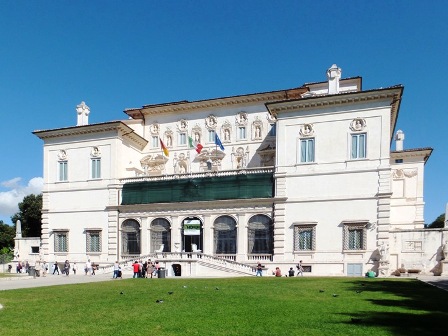
Villa Borghese is Rome’s largest public park. It contains two museums, an
art gallery and national academies of art. Part of the Aurelian Wall, once
delineated the limits of ancient Rome and now forms the southwest boundary of
the park. The wall is so irregular in shape that it was called Muro Torto (the
crooked wall) and is the source of numerous legends.
We had been advised to buy tickets in advance online for to the Borghese
Museum, inside the park, which we did for 1 PM Tuesday. Our Rome Lonely Planet
stated that if you were to visit just one museum in Rome, it should be the
Borghese. A sign on the ticket booth said the first advance tickets available
were for the following Friday. We had been given good advice.
The collection is housed in the Little Palace, an imitation of a medieval
fortress, designed in 1613 for Cardinal Scipione Borghese, an avid art
collector. Two architects were hired, one for the buildings and one for the
gardens, which we toured after the museum. During the Napoleonic period, many of
the works were sold off and are now in the Louvre in Paris. There is still much
to see, sculptures by Bernini and others, paintings by Caravaggio and Rubens,
frescoes on every wall and ceiling and ancient mosaics and carvings. We had two
hours to tour, which was plenty of time. You can rent an audio guide for €5 or
pick up plasticized sheets in each room giving detailed information on the works
displayed. You need some kind of guide or you would be just wandering blindly.
Spanish
Steps
After our visit we headed to the famous Spanish Steps, walking through the park,
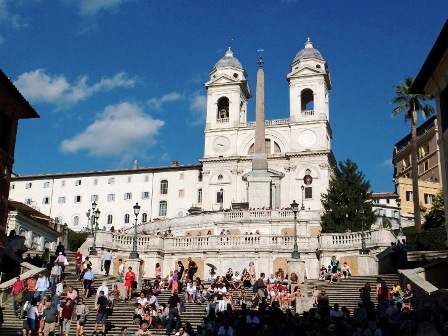
popular with joggers, dog walkers and picnicking families. The Spanish Steps,
built between 1723-26, rise in three flights from the Piazza di Spagna to a
piazza in front of Trinita del Monti church. The church was founded in 1495. It
was severely damaged by French revolutionaries during Napoleonic times and is
still French property. We entered by the highest point on the piazza of the
church and looked down over the largest crowd in the smallest area. We took
photos of each other on the crowded steps as ‘find Jeanne’ and ‘find Ray’
puzzles.
That was our last stop in Rome before leaving for Palermo tomorrow, but
we will be back on Oct 26 for more wanderings.
Return to
Roman
Holiday Intro
Read
Sicily Oct 2013
Return to
Travels
Return to
Introduction