Episode 7 Bagan: Temples and Eclipse
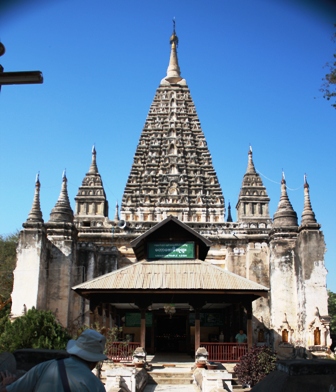
Click
the photo above
to see an album of photos. To return to our website close the
window.
Read previous
Ancient Cities or
next
16 January 2010 Bagan
Never again will I complain about the poor quality of roads in Ontario or
even Quebec. They are in pristine condition compared to the main through fares
in Myanmar. Our seven hour bus ride from Mandalay to Bagan demonstrated that.
Our first choice was to motor down the Ayeyarwady River for a relaxing eight to
nine hours on the Express boat but there were no seats available until the 18th
of January, far too late for our schedule. There is a slow boat but it takes 12
to 15 hours. Our rejection of that option was a good decision. I later met
tourists who took the slow boat and arrived 27 hours after they left Mandalay.
It did not sound like fun.
Even though it costs many times more than the bus, I would recommend flying.
Some of the roads we traveled on where literally under construction. I think
they use the bus and truck traffic to pack down the stone and gravel being
spread on the road. I am not sure if there was any intention to pave the road.
The countryside was flat and boring after a while and the promised AC was barely
there. At least we had assigned seats. We stopped at village after village
picking up yet more passengers. The lucky ones had stools in the aisle while the
late comers crowded at the front of the bus.
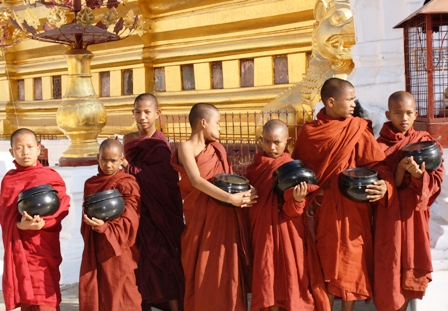 Once we reached Bagan we were glad we had come. It is fascinating. Bagan is a
72 sq km area covered in temples, most of which are the conical, pointed style
made of red brick. I am not going to bore you with details of every one we saw.
You will have to come yourself and pick your favourites. Some people will be
content just to visit three or four of the most popular but others, like us will
visit many more. Each has its own charm and there is always something new to
discover.
In the 11th C the Mon King, who ruled a huge area from the Ayeyarwady River
Delta south of Yangon east as far as Thailand and even into Cambodia, sent a
monk to convert the Bagan King to Theravada Buddhism from Mayayana Buddhism, the
variation prevalent in India. The Bagan King embraced the new Buddhism so
fervently he went into a temple building frenzy that lasted 230 years until the
area was over run by the Mongols under Kublai Khan in 1287. By that time there
were 4,400 temples strewn over the plains of Bagan.
Blame is laid on the Mongol invasion for the destruction of Bagan but other
historians say that the current king panicked at the threat of a Mongol invasion
and destroyed many of the temples to build fortifications. Then he fled the area
before any of the invaders arrived. Nevertheless, the area was deserted for the
next 4 centuries. It was said to possess bad spirits so only bandits dared live
there. The people only moved back to Bagan after the British established a base
in the mid-18th C. In the meantime the temples were subject to natural erosion,
looting, damage from bat dung and even earthquakes, including a devastating one
in 1975. UNESCO has been active in the area since the earthquake, cleaning
murals and helping repair damage to structures.
Bagan has three main residential and hotel areas. We stayed in Nyaung U with
the most economical hotels, guest houses and restaurants. About 3 km away is Old
Bagan, with a thriving local market and a few good restaurants. We ended up in
Old Bagan for lunch every day. Since it is closest to the most popular temples,
it also has several high end hotels. In 1990 the government moved the villagers
who had settled in Old Bagan to New Bagan, 3 km farther south. People have
returned to Old Bagan to live in a shanty town behind the market while New Bagan
remains a quiet area with a few budget guest houses and restaurants and a few
very good high end establishments. We had a relaxing morning break in New Bagan
admiring the river view from the terrace of a small restaurant.
A word about food: the variety in all of Myanmar is endless, the price is
very reasonable and the quality, even from the simplest establishments is very
good. We have enjoyed Chinese, Indian, Thai, Bamar (the largest ethnic group in
Myanmar), Shan (one of the hill tribes). Italian, French and Korean are also
available, just take your pick.
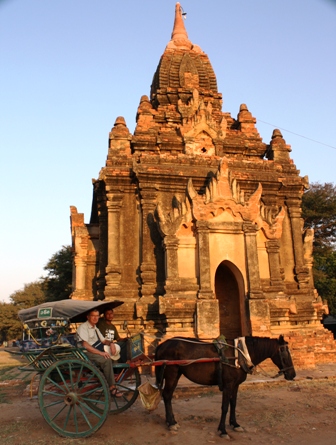 You can hire a car and driver/guide to tour the temples but the most popular
way to visit the temples is by horse cart. There was a bevy of carts and drivers
at the bus stop when we arrived from Mandalay. We accepted a ride to our hotel
from one young man and hired him to take us on a temple tour the next day. Ray
sat in front with the driver and I lounged on a mattress under a canopy in the
back. It wasn’t a quick trip but we were making frequent stops to visit the
temples.
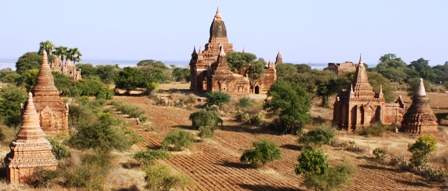 Monasteries, the Royal Palace buildings and the homes of the common people
were built of wood and have not survived. What remains are more than a thousand
temples, most built of red brick, shaped like huge dunce caps with a bell shaped
bottom. There are remnants of stucco carvings both inside and on the outside of
the buildings and frescoes, mostly of Buddha’s life covering many of the inside
walls. Some need a flashlight to see and do not allow photos to preserve the
ancient paint. Several have upper outside platforms with stairs to climb to
admire the view. The most popular temples have their pinnacles covered with gold
leaf by the faithful. It is quite a sight both during the day and lit up at
night. Inside each temple is at least one Buddha, some huge and often several in
the same building. There are also niches filled with smaller statues of Buddhas
and other spirit deities. I had to keep track of the temples we visited that day
by marking them in my Lonely Planet. Otherwise I never would have been able to
keep them straight and I would never have been able to sort out the many photos
both Ray and I took.
Sometimes I am tempted to describe Bagan as the biggest souvenir market in
the most beautiful setting in Myanmar. Almost every temple had an array of
souvenirs for sale at its front entrance. There were T-shirts, brass ornaments,
traditional painting on cloth, lacquer ware, postcards and even gems of dubious
quality. For such an important stop on the tourist trail Bagan was not crowded.
Except for the occasional tour group, there were very few other tourists at each
of our stops. That meant there was a dearth of customers for the vendors and
their products were often very good. That also meant some vendors were a little
too assertive in their approaches to a possible buyer. We learned to not get
annoyed and to pleasantly talk with the locals and politely tell them we were
not buying.
As we learned in Nepal, we do not give money, pens or candy to the children.
It only encourages them to expect a handout from every tourist and does not help
their impoverished condition. You are encouraged instead to give donations of
money or supplies directly to a school or aid organization that will ensure the
children in greatest need receive the benefits. Two small children wouldn’t take
bye-bye for an answer at one temple and followed me inside. When they indicated
they were willing to pose for me I couldn’t resist and we ended up having fun
getting the right expressions. I gave them two small shampoo packets from our
hotel as a thank you. This was enough to send them away very happy with the
transaction.
We made one non-temple stop at a lacquer workshop in the village of Myinkaba,
between Old and New Bagan. It is the center of lacquer ware production, the most
popular purchase in Myanmar. I had no idea it was such a complicated process and
so time consuming and it is all done by hand. Everywhere you go in Myanmar you
will pass shops displaying bowls, cups, trays, boxes, vases and even furniture
for sale. Lacquer is produced from the sap of a tree and must be filtered many
times before it can be used. The frame of the item is woven from bamboo strips
and the better pieces are wrapped in horsehair. The item is then coated in
lacquer, dried for two weeks, polished and the lacquer process repeated up to 18
times. Only then is it ready for the decoration process. Designs are etched onto
the lacquer surface by hand and colours applied one at a time using a batik
method. There are no shortcuts taken to produce a quality item. We were able to
observe workers at each one of the steps necessary to produce a finished
product. We couldn’t resist buying a few small items to take home as souvenirs.
The next two days we rented crummy Chinese bicycles and set out to visit some
of the temples we didn’t get to on our horse and cart tour. A mountain bike is
what is really needed to navigate the paths to the temples, but it is rare to
find one in Myanmar. There are just two paved roads and the temples are all off
the road on dirt roads. This is the dry season and some of the roads were just
soft sand. We had to push the bikes through those sections. We even pushed them
across a few plowed but unseeded farmer’s fields to get from one temple to the
next. It did get us where we wanted to go and gave us a little more exercise
than sitting in a horse cart but it is not for the faint of heart.
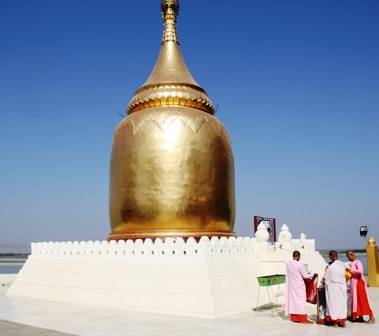 It is not only foreign tourists who come to Bagan. Myanmar people come
regularly to offer gifts of flowers, food and money to their favourite temples.
There were several Malaysian monks and nuns touring some of the same temples we
visited. On our last day in Bagan we visited temples right across from our
hotel. Swezigon Paya is a temple very popular with Buddhists from all countries.
The huge main temple, surrounded by smaller ones, is covered with gold. We heard
singing coming from one of the smaller temples in the complex and went over to
discover a group of Korean pilgrims paying homage to the gold Buddha inside the
temple and singing a hymn. We heard them again repeating their prayers and song
at another temple on the site.
Wasn’t that thoughtful of the heavens to arrange a solar eclipse for our
Bagan visit? We couldn’t believe our luck and the skies were clear blue for our
viewing pleasure. The eclipse on the 15th of January could be seen in parts of
Africa and Asia, including just where we were. It was an annular eclipse, when
the diameter of the moon is appears to be smaller than the sun. That meant that
there was a bright halo around the moon at the peak of the eclipse.
If possible, every tourist made sure they stayed in town long enough for the
eclipse, scheduled to be at its height around 3 PM. We were just finishing our
lunch in a small restaurant in Old Bagan when two of the employees dragged a
shallow bowl of water to the area just outside the restaurant. There were
another two bowls of water set up outside an adjacent restaurant. These were
intended to let us view the eclipse as a reflection in the water. Even the
reflection was too bright for me. One local man had a piece of film that worked
well.
 We abandoned our plans to move to one of the temple sites for the viewing. We
stayed right at the restaurant until it was all over. We took turns viewing the
start of the moon’s journey across the sun through the film. A few other people
had pieces of dark coloured glass. That worked the best for me. I used the glass
as a filter in front of my camera lens and using my telephoto lens, I was able
to get a few good photos of the passage.
One English woman we were talking to asked if I could send her my eclipse
photos by email as her camera didn’t work well enough for good photos. In
conversation with her and her husband we discovered he might be a long lost
cousin! John Burnham said he does not know many other Burnhams in England so it
was a big surprise to meet us. He and his wife had rented out their house in
England and were on a three year odyssey, mostly in Asia. They had already spent
more than two years and were a good source on where to go in Indonesia, our next
destination. What an end to our visit to Bagan.