Episode 6 Ancient Cities, Plus Moustaches
Click
the photo above
to see an album of photos. To return to our website close the
window.
Read previous
Road to Mandalay or
next
Bagan
11 January 2010
The crowd of tourists, Ray and I among them, has arrived at 10:15 AM and are
eagerly awaiting the monks file in to the Maha Ganayon Kyaung Monastery in
Amarapura for their once daily meal. We have toured the kitchens where vast
cauldrons of food and rice are heating over wood fires. We pass by large
sleeping buildings where up to 1000 young monks stay, then walk around to the
dining room where a food distribution table has been set up in a courtyard at
the entrance. A young junior novice, dressed in white robes, is waiting to
distribute two oranges to each of the monks. He is amusing himself making a
tower of oranges while he waits for the monks to come. A group of Asian tourists
come into the courtyard carrying plastic bags full of small packages. These are
donations of items for personal care. You can buy already assembled packages in
shops in Mandalay and bring them with you to a monastery. After the donations
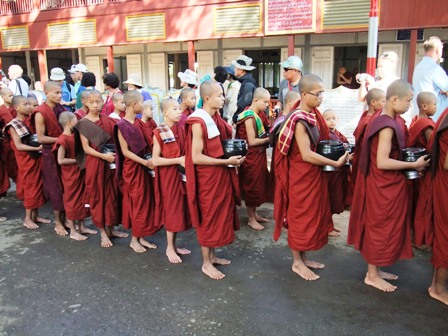
are received and blessings given the monks briskly march in, several hundred of
them, single file, barefoot and carrying their begging bowl. They receive their
oranges, fill their bowls from big vats of rice and a meat stew and file in to
take their places at long wooden tables. It is almost like watching animals in
the zoo and I feel rather ashamed but I take photos along with every one else.
At least I don’t stick my camera in the face of a monk as they file past.
 From the fall of Bagan in 1287 until the mid 19th C the Royal cities
alternated between Amarapura, Inwa and Sagaing, towns not far from Mandalay.
Mandalay only became the seat of power for the Burmese empire from 1860 until
the British conquest of Mandalay 25 years later. We hired a car and driver to
take us on a tour of some these three ancient cities. We visited two smaller
monasteries in Amarapura before reaching Maha Ganayon Kyaung, both quiet places
not as much on the tourist route. After the parade of monks we stopped at a
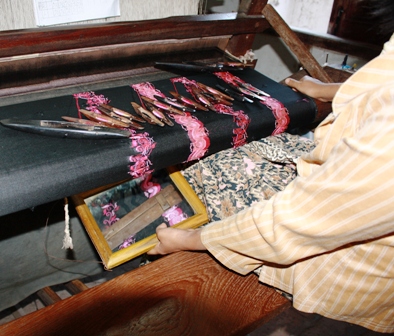
small textile weaving shop to watch women create beautiful lengths of silk and
cotton for longyis and blouses. The shop sold a version of the longyi more
suited to western tastes. It had a slit at the waist and ties to fasten the
garment more securely. We saw several westerners wearing the longyi but we stuck
to our usual travel clothes.
Inwa, formerly known as Ava, served as the capital of the Burmese kingdom for
400 years, longer than any other city. It is an island separated from the
mainland by two canals in the Ayeyarwady River. Our driver left us at a ferry
jetty where he waited for our return. We shared the flat-bottomed boat with
several other tourists and locals and motored across the canal to Inwa. Horse
carts and drivers were waiting for the tourists and we got in one to be taken to
some of the remaining pagodas on the island. There is no thriving city here,
just fertile fields of rice, soybeans, sunflowers and rice. It was very
peaceful. We passed by a few small huts where the driver greeted his young son.
The remains of the old city gates were on our route and we stopped to explore a
few small red brick temples.
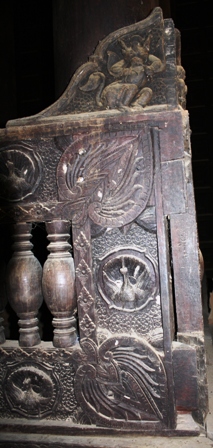 Further along was a large teak monastery, Bagaya Kyaung, which dates back to
1834. The monastery was built on stilts, supported by 267 teak posts, the
largest of which was 18 M high and 2.8 M in circumference. Many of the original
carving survived. Small peacocks carved in the wood were repeated at regular
intervals all around the building. We found one larger image over a door
depicting a half woman half bird figure. Inside was a small monastery school
with a few children reciting from a book held by a young monk. A large dark room
with the requisite Buddha took up the other side of the building. A young monk,
sweeping the support poles was disappointed when we didn’t give him a large
donation to take his photo.
A 27 M high masonry watchtower, Nanmyin is the only remaining feature of a
palace built by one of the kings is. After the upper portion was shattered by an
earthquake in 1838, it developed a decided list and ever after became known as
“the leaning tower of Inwa”. It had been reinforced sufficiently to allow us to
climb steps to a platform where we had a good view of the fields and other
temples in the area.
It was lunchtime by the end of our tour. We enjoyed a peaceful meal in a very
nice garden restaurant conveniently located near the ferry jetty.
 Back on the mainland, we drove across the Ava Bridge to Sagaing. Government
run, our driver had to pay 200 K tolls at both ends of the bridge. Sagaing was
the Burmese capital only periodically but Sagaing Hill still dominates the
landscape with more than 500 stupas and numerous monasteries that house more
than 6000 monks and nuns. Sagaing is named for the trees hanging over the
Ayeyarwady River and is a place where monks and nuns come to de-stress. We
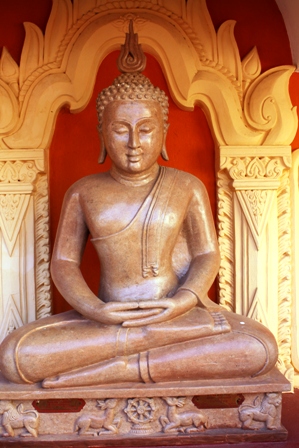
visited a new building our driver called Buddha University. It was ringed by
marble buddhas depicting almost every style typical of all the Asian countries
from the 2nd century to the present day. Inside were photos of major religious
sites throughout Asia and explanation, in Myanmar, of their significance.
Every trip to Sagaing includes a drive, or a very long walk, to the top of
the hill crowned by a golden temple. We drove up to admire the view and then
returned to Amarapura.
U Bein’s Bridge, the most photographed bridge in Myanmar, stretches 1240 M
from Amarapura across the shallow Taugthaman Lake to a village on the other
side. The teak footbridge was built 200 years ago and is still in use. We
elected to walk across and take a boat back to get a different perspective from
the water. We were there in late afternoon when the daily commute of locals to
their village on the other side begins. Beggars, some in pitiful condition, sat
on the bridge hoping for donations from the many tourists. Fishermen worked the
waters below us and one man herded his flock of ducks to their overnight
location. Our boatman was waiting for us on the far side, having rowed across.
He rowed us back standing, using two long oars to propel the long flat boat. We
had an option to wait for sunset for our return trip but we were content to
enjoy the view during the ½ hour ride before it got dark.
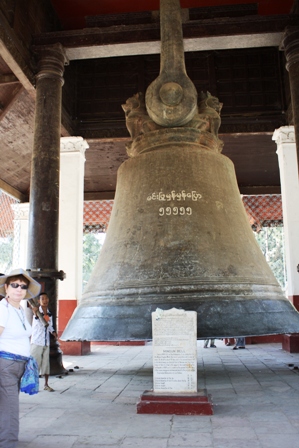 A relaxing one hour boat ride with some more pagodas at the end sounded like
a good way to spend our last day in Mandalay. King Bodawpaya had grandiose ideas
for the small river community of Mingun. In the late 18th C and early 19th
C he built several temples, intended as his personal meditation area and as a
legacy for his reign. He installed a footprint of the Buddha in one shrine and
had a gigantic 90 tonne bell cast and hung beside his greatest work, the Mingun
Paya. Construction was begun in 1790 with a labour force of thousands. The
structure was intended to be three times its current height of 500 ft but work
was halted in 1819 with his death. An earthquake in 1838 split the structure and
reduced it to partial rubble. It is still impressive and if you climb to the
top, it is a great site to view the countryside and river.
We spent a pleasant morning touring the site, escaping from the ever-present
souvenir vendors and having a quiet lunch at a simple village restaurant.
Lonely Planet highly recommends attending a performance by the Moustache
Brothers Troupe. We hired a “blue taxi”, a converted pickup truck with benches
in the back, to take us to the home of the brothers. They are famous for their
political jokes which have more than once landed them in jail. They are
currently under house arrest and are allowed to perform in their home for
tourists, not local people. Nine of attended that night, sitting in plastic
chairs facing a small stage. Lu Maw, who speaks the best English, opened the
performance with a review of their history including DVD clips of mentions and
support they have received from Western comedians and actors. He also told us
that profits from the show go towards supporting political prisoners. Despite
official bans for support of Aung San Suu Kyi, the opposition leader who has
been under house arrest off and on, mostly since 1989, the brothers prominently
display posters of her and themselves with her. The rest of the show consisted
of corny jokes, which managed to be funny and traditional dances performed by
brothers Par Par Lay and Lu Saw, Lu Maw’s wife, two sisters and a sister-in-law,
a truly family enterprise. We left at the end of the performance but others
stayed to talk and ask questions of the brothers. It was an interesting and
informative evening.