Episode 4 Inle Lake March of the Monks
Click
the photo above
to see an album of photos. To return to our website close the
window.
Read previous
Biking the Lake or
next
7 January 2010 Nyaungshwe Myanmar
It is 7 AM, I have on two fleeces and I can see my breath. My wait is
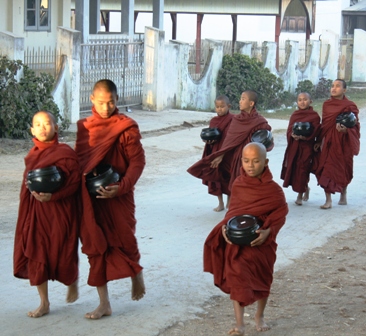
rewarded. It is just like the many paintings for sale in the shops. A single
line of barefoot red robed monks each holding a black begging bowl come striding
down the road to the doors of one of the large monasteries in the town of
Nyaungshwe, at the north end of Inle Lake. Each one pauses at the door to
receive a scoop of rice ladled out of a large pot by a nun from the women’s
monastery across the road. There are about 500 monks in this small town and
every morning starting at 6:45 AM they leave their individual monastery and
march along the dirt roads to the designated monastery for morning prayers. It
is quite a sight. Most are very well disciplined but the youngest and last
group, some only 10 years old, straggles along in groups. Single file is too
much for them.
Nyaungshwe is a small, laidback market town with many guesthouses and small
restaurants for the economy class tourists, of which we are two, who come to
visit Inle Lake. The town is conveniently located on a main channel leading to
the shallow, 13.5 mile by 7 mile lake surrounded by more than 1000 pagodas
(temples).
You would think that Inle would be hot and steamy but it is not. It is at a
higher elevation than Yangon and Mandalay and as soon as the sun goes down
behind the hills flanking the lake, the temperature drops. The day we arrived
was warm and sunny but that night we were wearing our fleece and glad of a heavy
quilt for a bed. The temperature did moderate during our visit but it was still
cool at night.
Very few roads are paved in town. Most of them are dusty dirt streets, more
suited to the horse carts, ancient cars and trucks, trishaw pedicabs, Chinese
bicycles and motorcycles that provide transportation around town. Old pickup
trucks with benches along the sides are buses to the surrounding villages. We
have been in town for 4 nights, having flown from Yangon, and would stay longer
if we had more time.
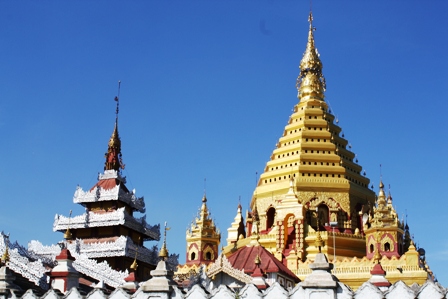 The most attractive element of the town is the monasteries. There are four
major ones and several small ones within the town boundaries. All are well cared
for and highly decorative with their upswept roofs, elaborate entrances and
golden stupas. The rest of the town is a series on one story wooden houses, with
the exception of a few guesthouses topping up at six stories. We are in one of
the larger ones in a large room with electricity and hot water only part of the
day and a great breakfast in their rooftop dining room. The saving grace for the
town is the kindness and helpfulness of the people. Just as we found in Yangon,
help is readily available and the only payment expected a thank you and a smile.
Puppetry is alive and well in Myanmar. Elaborately dressed marionettes play
out traditional stories and dances. We found a puppet master in his small
theatre in the front room of his house. Ray and I were the only audience for the
evening and had time to find out that the puppeteer was justly of his 1994 first
prize award in a national puppet master contest in Mandalay. He told us he is
the fourth generation of puppet masters and is training his two teenaged
children the art. The performance was most enjoyable. There were seven
traditional dances expertly performed by different marionettes. Recorded music
and an English commentary prepared us for each dance. We hope more people find
his small theatre and keep him in business.
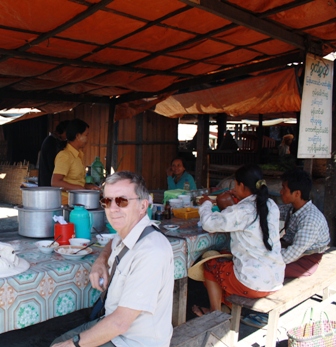 Markets are a favorite of ours and this was no exception. Market days are on
a traditional five day cycle, moving from one of the larger villages to another
around Inle Lake. We thought the market displayed an interesting assortment of
goods on a regular day but the market day was special. All the booths were in
operation and thronged with locals buying and selling. Everything from household
goods, clothing, fruit and vegetables, artifacts and crafts were on offer. The
food court offered a variety of local specialties, tea and juices. We found one
we especially liked and ate there twice. The Shan Noodle Soup was delicious.
Similar to Vietnamese Phô, it was full of noodles, vegetables, a little meat and
a tasty broth.
A Frenchman and his Dutch wife were eating at the food stall during our
second visit. It was obvious he was familiar with the woman who ran the shop and
her son, who spoke good English. The Frenchman was invited to their home for
dinner that night. They were unavailable so we were invited instead. How could
we refuse?
The son picked up in his trishaw that evening and drove us a few km out of
town to his mother’s simple stilt home next to a large orphanage run by a
Catholic priest. We took off our shoes to climb open wooden stairs to the living
level. The walls were woven bamboo, typical of this area, with a large living
room and two smaller curtained off rooms. A low table was set in the middle of
the large room, already arrayed with six dishes of food. Since there was no
electricy yet, the son lit a candle and set it on the table. We were invited to
sit on grass mats on the floor and more dishes of food were brought for us. It
was a veritable feast. We helped ourselves to steamed rice and sampled all the
offered dishes. There was chicken, pork, cauliflower, greens, a delicious tomato
based salad, all served with various condiments and sauces. Dessert was
guacamole, which comes with most meals in her restaurant. We had an audience of
three little grand daughters who live in nearby houses and chatted with the son,
as the mother spoke very little English. At the end of the meal we thanked our
hostess, paid her for the meal, which was worth far more than we gave her, and
returned to our guesthouse by trishaw. Visiting a family in their home is always
an opportunity not to be missed. What better way to find out more about the
country and how ordinary people live.