Episode 3 Biking The Lake
Click
the photo above
to see an album of photos. To return to our website close the
window.
Read previous
Cruising Inle Lake or
next
March of the Monks
7 January 2010 Nyaungshwe Myanmar
We hauled ourselves and our bicycles out of the long-tail boat that had just
ferried the four of us, our Belgian friends Edgard and Jeannine, Ray and me,
from the East side to the west side of Inle Lake, docking at the village of
Kaung Daing. The dock, next to a small monastery, was crowded with townspeople
who seemed very excited at our arrival. Had someone told them we were coming?
No, they were waiting for four long-tail boats docking right behind us.
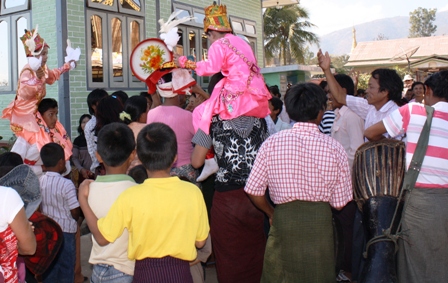 The boats were bedecked with flowers and women were singing and dancing as
they came to the dock. Out of one boat stepped a few young men with big drums
and braces of cymbals. They all started to play and sing as the next boat unloaded
golden icons and the last its young passengers dressed in elaborate traditional
costumes. Two of them, young boys, were hoisted unto the shoulders of strong
young men and the whole group proceeded with great merriment to dance and sing.
This was a celebration before the two young boys entered the monastery to be
ordained as monks. Each boy is required to spend some time in a monastery
between the ages of 10 and 20 and this was the time for these two young boys who
looked no older than 11 or 12. We watched for quite a while before continuing on
our bicycle ride.
We were doing a small circle route on the lake. We started down the east die
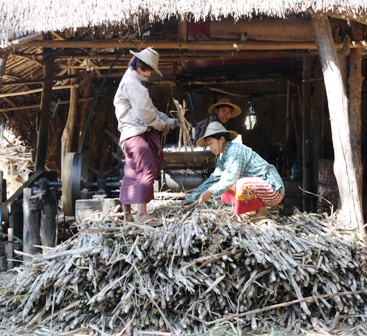
of the lake, bicycling between fields of sugar cane. It was the cultivation
season and workers were busy in the fields cutting cane and gathering the canes
into bundles to be taken to the sugar mills we passed along the way. Ox cart was
the most common form of transportation for the cane although there were a few
tractors hauling a box and sometimes bigger trucks. We passed a few monasteries
where monks were hanging out their laundry of red robes and relaxing until the
next prayer time.
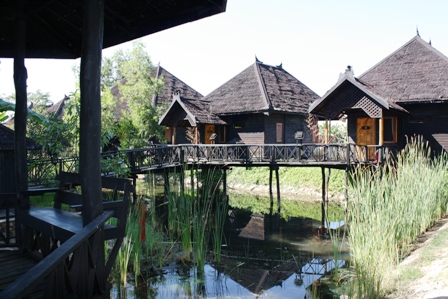 We took a side road leading to the ultra-luxe Inle Princess Resort. They were
not many guests so we were offered a tour of the resort. If I come into an
inheritance I was not expecting or win a lottery, I would book into this resort
for several days. There are several more resorts on the shore of the lake but
this is the cream of the crop. Large teak bungalows surround a small water lily
lake or face Inle Lake. The least expensive bungalows are on stilts over a canal
and have balconies with a mountain view. The interior of the bungalows are
beautifully furnished. Every request of the guests has been anticipated from a
Bird Book and binoculars to seating areas for writing, having a snack or sunning
on the balcony. There is even a large bathroom with both a tub and an outdoor
shower. You can have a drink in the bar, breakfast in a pavilion on the shore of
the lake and watch a show after dinner in the dinning room. Save up for that
extra special occasion and come here!
We continued on to the village of Maing Thauk, half of which is on the
mainland and half is filled with stilt houses over the water. The two halves are
joined by a 450 yd wooden bridge where we bartered with a boatman to take us
across the lake.
 After leaving the monastery festival on the other side we bicycled a short
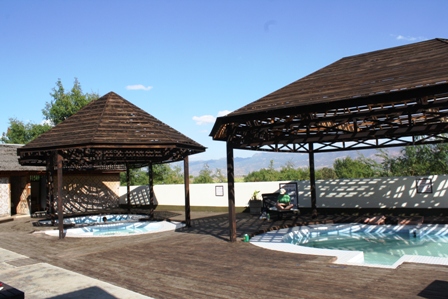
distance to Hu-Pin Hot Springs Resort for lunch. After lunch we investigated the
hot springs pools. There are two segregated pools available for both locals and
foreigners and a separate Foreigner Only area with three smaller pools of
increasingly hot waters. I was the only one interested in a soak but the others
agreed to wait while I relaxed in the mineral waters. I had not brought a
bathing suit but for my admittance fee I was given a towel, soap, shampoo and a
longyi. The attendant taught me how to tie the longyi and I sank into the first
pool. It was not much hotter than a bath but was very relaxing. My biggest
problem was keeping the longyi tied when I went into the pool. It had the
annoying habit of filling with air like a balloon and collapsing with a loud,
rude noise with enough energy to pop my longyi. It didn’t entirely fall off and
I eventually learned how to keep it tied. I tried the waters in the other two
pools and found them not much warmer than the first, which wasn’t a problem with
me. There were about ten other foreigners in the pool area, mostly sunning on
the long deck chairs. I made two circuits of the pools, had a shower and joined
the others.
We all headed north along the road, past more cane fields and trucks and
carts full of the cane. Jeannine started to have problems with her bike. The nut
holding the left hand pedal in place was gone and the pedal was loose enough to
come off. Ray got a rock and banged it back in place but it continued to loosen.
Finally we stopped beside a roadside stand near a large sugar mill operation.
Some local men tried to fix the pedal without success. Finally one man took the
bike back to factory and returned with the pedal bolted in place. Jeannine gave
him a small amount of money for his help and we were on our way again.
The only problem was that we discovered from our helpers that we had gone
past the turn off to Nyaungshwe. We were about 2 or 3 km past the turn off! We
were almost there when Jeannine discovered she had also lost the nut holding the
front fender and wheel in place. We could only hope it held until we got back to
town. It did. We pedaled the last 6 km on a very rough dirt road, running
between two canals and shaded by trees. We all could have used a soak in a hot
tub after our ride but we celebrated instead in a local bar with 600K ($0.60)
mugs of Myanmar beer.