Medinas of Casablanca, Rabat, Meknes,
Volubilis
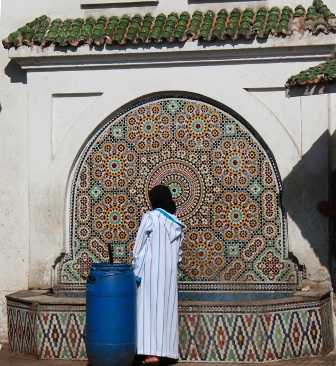
Fountain in Casablanca Medina
Read Next
Episode:
Fez
28 Sept 2009 Morocco (we are now in Fez)
Coming from Paris to Morocco is not as much of a culture shock as
it might have been. Morocco was a French protectorate from the early
20th C to 1958 and the legacy lingers on. The second language is
French and there are cafes, patiseries and boulangeries on every
corner, just like there are in Paris. English is studied by some as
a third language in school but my bad French is being well used. The
Moroccan version of Arabic, Darija, remains a mystery to us, both in
the written and spoken version.
Dress is a mixture of Western and Arabic style. Half of the women
and men wear the jellaba, an ankle-length loose fitting robe with a
pointy hood and silk knotted buttons down the front. The men favour
a plain coloured jellaba and sometimes wear a small white cap. Wild
patterns, especially African animal prints, are the choice of the
women for their jellabas. Some women wear the hijab, a scarf that
covers the hair, colour coordinated to their outfit, and some wear
their hair loose. Only the very conservative women wear a face veil
and even then the eyes are not covered. Shoes are either babouches,
pointy-toed slippers, or the latest fashion western footwear.
I think the Moroccans have learned to drive in Paris. Hundreds of
tiny cars clog the streets, racing as fast as they can around the
corners and round-abouts. There are a few traffic lights and cross
walks but only the drivers can see the lights. We learned early on
to stick close to a local and cross the street when they do. Our
street crossing skills are improving.
Sidewalk tables outside the cafes are filled all day with men
drinking sweet mint tea or strong coffee and chatting to their
friends. In the evening we spied men smoking hookah pipes inside
some of the cafes. Women, except for tourists, are seldom part of
the cafe scene. They are too busy going to work or shopping for the
family. An evening visit to a patiserie is when you will find the
women enjoying a snack with their friends or family. The evening is
also the family shopping time. The streets are crowded with people
strolling and shopping for the goods displayed in every shop window.
Casablanca, the first city we visited, is full of art deco
buildings built during the Colonial period. Some are in beautiful
repair and some could do with a coat of paint. Several of the
government buildings are decorated in the traditional style with
intricately carved facades and richly coloured mosaics.
We walked to the fishing port in Casablanca hoping to have lunch
in a recommended seafood restaurant. It had been closed for Ramadan
and was reopening the day after we left. Instead, we watched the
fishermen, home from the nights fishing, repair their nets and sell
their catch in a small market next to the crowded docks. We finally
had our seafood lunch in Rabat, our second stop, in a popular
restaurant right on the beach. We were entertained while eating
watching boys ride surf boards and body boards through the
impressive Atlantic Ocean breakers.
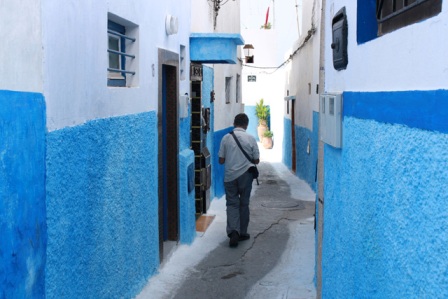 Rabat has a pretty and peaceful Kasbah, even older than the
Medina. The Kasbah des Oudaias began life as a fortress-monastery
built by the reigning Berber tribes in the 8th C. Muslims fleeing
Spain in the 18th C populated the kasbah. Their whitewashed houses
form a wall on either side of the narrow cobblestoned streets and
are decorated with a broad sky blue stripe from ground level to
about 5 feet. On the highest point of the kasbah is a parade deck,
the best spot for views of the Atlantic Ocean and the mouth of the
river Oued Bou Regreg. Walled Sal , once a pirate stronghold, is on
the other side of the river. The southern end of the kasbah was the
Royal Palace. The Palace now houses a good museum while the gardens,
designed by the French are a beautiful and peaceful place to take a
break. The southern end of the kasbah was the Royal Palace. The
Palace now houses a good museum while the gardens, designed by the
French are a beautiful and peaceful place to take a break.
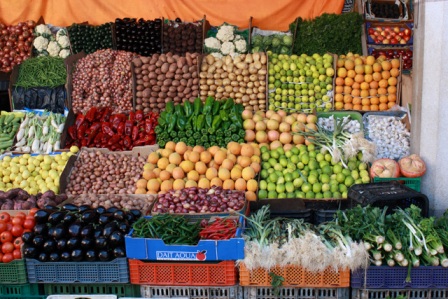 Every
Every
city so far has had a walled Medina, the oldest part of the city,
where much of life goes on as it always has. The narrow streets
lined with small shops are thronged with locals seeking a bargain.
Each shop displays their wares in the most artistic way possible. I
snapped photos all over of mounds of fruits, olives, dates, crafts,
spices, carpets and whatever else took my fancy.
It is almost impossible not to get lost in the warren of alleys
in the medina and we have discovered hidden gems while trying to
figure out where we are. In Meknès last Saturday, we took a side
alley to find ourselves in a slightly wider area with a line of
women standing in the middle. Each had an open bag at their feet
overflowing with fabrics. Men carrying fabrics or carpets circled
the women calling out their wares. They would stop and unroll a
carpet or display their fabric for a likely customer. This was a
weekly carpet and textile market and the women were from the
neighbouring countryside. They buy the goods in the medina and
return to their villages with new stock for their own shops.
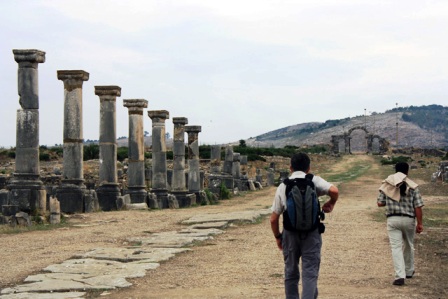 One of the main reasons to go to Meknès, besides the Medina, is
to take a half day tour to see the Roman ruins of Volubilis, now
designated a UNESCO World Heritage Site. We shared a taxi and driver
with an English couple for the half hour ride to Volubilis. The 40
hectare site was the Roman Capital in Morocco from 45 AD until 280
BC. At its height 20,000 people lived in the city. The French
excavated Volubilis from 1915 until 1975 but there still remains
more than half of the area unexplored. Ray and I agreed to hire a
guide for a one hour tour of the site. It was worth the small extra
charge. Our guide took us around the most important buildings and
private homes, named for the beautiful mosaics covering the major
rooms. There was a sophisticated water system, for which the Romans
are noted, that serviced the buildings and the popular baths. On the
high point of the city was the Capital with law courts, a forum and
the main market area. Broad avenues running North-south and
east-west linked the parts of the city.
Just 5 km from Volubilis is the hilltop town of Moulay Idriss.
August finds hundreds of Muslim pilgrimages coming to worship at the
tomb of Moulay Idriss, the founder of the first dynasty in Morocco.
Our driver let us off at the base of the town and gave us time to
explore on our own. We walked into the market area, as usual crowded
with shoppers and donkeys waiting for loads to carry up the steep
streets inaccessible to cars. A local stopped to give us advice as
to the way to Moulay Idriss mausoleum and before we knew it, we had
the services, unasked for, of a guide. He did lead us up to the best
spot for a view and prevented us from getting lost but we ended up
paying him for his services, although less than he had hoped. The
lesson learned is to firmly insist you want to go on your own and
not to express any thanks for unwanted advice. Oh well, everyone
needs to earn a living and it is difficult in Morocco.
We have been travelling from city to city by train since arriving
in Casablanca and are now in Fez. We will stay here for a few days,
exploring yet another medina, before setting off by bus further
inland. There are more interesting towns to visit and we are looking
forward to the rest of our trip.
Return to
Morocco Intro
Return to
Travels
Return to
Introduction