Essaouira, a Town of Many Names
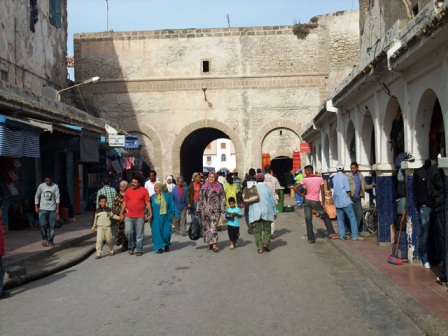
Shoppers near old gate in Essaouira
Read Previous Episode:
Ourika Valley
Morocco 28 October 2009
The Phoenicians established the first
settlement in the 7th C on the present site of
Essaouira on the Atlantic coast and called it Migdol, which
meant watchtower. The settlers built a lucrative industry
extracting a purple dye from a local mollusk. For centuries the
town provided a safe harbour and a fresh water source on the
trade route between the Cap Verde Islands and the equator. The
Portuguese gained control of the bay as a trade and military
post in the 15th C and renamed it Mogodor. By the
mid-16th C the Portuguese had lost the port to the
Saadians, descendants of Mohammed from Arabia. Sultan Sidi
Mohammed ben Abdallah hired a French architect to build a city,
which he named Essaouira, meaning “well designed” on the shore
of the bay. This name lasted until 1912 when the French reverted
to the name Mogador. Finally, when Morocco regained independence
from the French in 1956, the city once more became Essaouira.
It was a
long, boring bus ride from Marrakesh. Next year travelers will
take advantage of a new divided highway but right now it is just
stretches of construction. Instead of 3 hours it took 3 ½ hours.
Our return trip on the bus to Marrakesh was designed to connect
with the train to Casablanca. There was only ½ hour between the
bus and the train but despite our worries, we did make it with
15 minutes to spare.
The old walled city and fortifications of
Essaouira mostly date from the 18th C. You can walk
on part of the ramparts where a row of brass cannons dated 1790
point out to sea. Essaouira is now a tourist destination with
lots of restaurants and shops, but smaller and quieter than
Marrakesh or Casablanca. Most tour groups only come for the day
so the evening reverts to local families who love to walk the
streets after work, buying snacks from the street vendors and
doing their daily shopping.
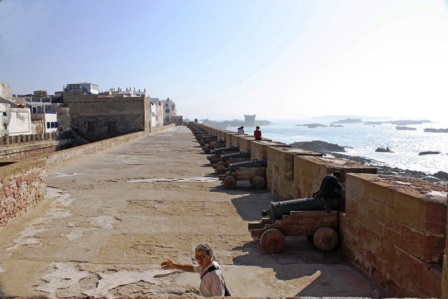
Ramparts
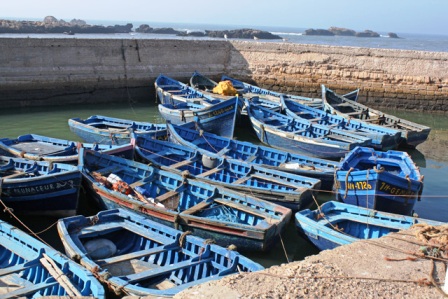
Fishing boats in port
There is a busy fishing port full of small
dories and bigger deep sea fishing boats. Fishermen sit by the
wharf with their catch spread before them hoping. You can select
a fish for your meal and have it cooked at one of the nearby
fish restaurant stalls. They were loading sharks into a truck
but they got very annoyed when we tried to take a photo of the
sharks. I think it was because the shark fins had been removed
for the Asian shark fin soup market.
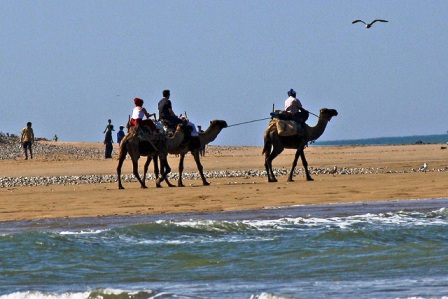
Ride a camel on the beach
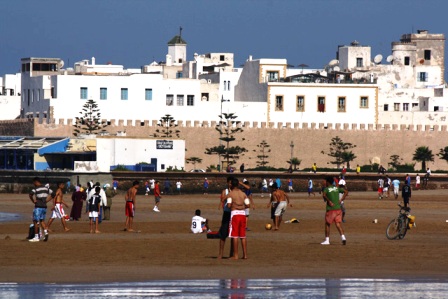
or join a football (soccer)
game
The beach starts right beside the walled
city and stretches for a km to sand dunes at the far end where
camels strolled waiting for tourists to take a ride. Sunday is
pickup soccer day on the beach. At least 10 soccer fields were
laid out on the hard packed sand. Uniforms and even shoes were
not required, neither were goal posts.
It
was just a fun day for the participants. The tide was out the
morning we walked the beach. The beach has a reputation for
being very windy but it was relatively calm. There were beach
chairs and umbrellas to rent. It is still the chilly Atlantic
Ocean but several families were wading into the shallows to
catch the small waves breaking on the shore. Later in the day
the wind increased enough to bring out the boards and
surfboards. It looked like a good place for beginner surfers as
the waves were still not very big.
We stayed in a riad in Essaouira. Riads
were townhouses built for the wealthy townspeople. Many of them
have been turned into luxury hotels but Riad Nakhla is in the
budget category. The houses are built so densely together in
Essaouira that some streets are just a tunnel. Some enterprising
builders have built a bridge between two sides of a narrow
street and added rooms over the bridge. We wondered what we were
getting into when we found the front door of Riad Nakhla in a
just such a tunnel. Opening the front door allayed our fears.
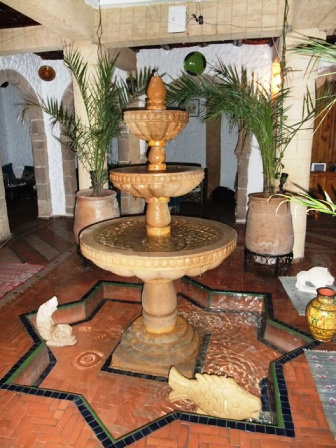
Riad Nakhla fountain
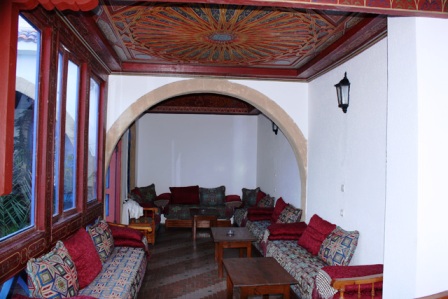
Even the roof of the terrace
is decorated
Riad Nakhla is a very good example of a
carefully restored Riad with well decorated common areas. On
each floor, the rooms face an atrium open to the sky. The main
flour is centered with a working fountain. Simple, not
luxurious, rooms are on the next three floors. Our room was
large with an attached toilet and shower. On nice days breakfast
is served on the roof top terrace.
When
it is rainy or cold a glass-enclosed room on the rooftop is
perfect. Cushioned sofas line the sides of the room and the
ceiling is painted in brightly coloured designs of plants and
flowers, like the Bahia Palace in Marrakesh. This room was
perfect for our late day card games.
Right behind the riad is a large mosque
being completely rebuilt. We were lucky never to be too close to
active mosques. The call to prayers emanates from the minaret
via loudspeakers five times a day. The first call of the day at
4:30 AM is far too early for us.
What is a typically Moroccan experience no
visitor should skip? Going to a Hammam. I finally visited a
hamman (public bath) in Essaouira and I can unconditionally
recommend it for anyone who likes a little pampering. You can go
to any number of upscale spas for your hammam experience but I
chose a small, traditional one for women only. The hand painted
sign above the door simply said “douches publique”. I went all
out. For Dh100 (15 CAD) I was handed a loofah mitt and a plastic
package of dark oil for a “gommage” (a body scrub) and a massage
as well as the bath. I was led past a roaring wood fire that
heats the water for the baths into a change room with lockers.
Stripped down to panties, I was given three big plastic buckets
and led into a large tiled room with a trough along one side.
The buckets were filled with hot water from taps in the trough
and sluiced over me. I followed the lead of two other women
seated on the floor and began scrubbing myself with a loofah
mitt. My attendant arrived and offered an unusual mixture for me
to smell. A mixture of clay, dried herbs, roses, lavender and
some of the black oil is used for the gommage. She proceeded to
rub some of the mixture on my limbs and scrape it down with
mitt, ever now and then sluicing me down with more hot water.
Next came the oil massage, performed not on a special table but
on the tiled floor. The treatment ended with a shampoo and a
soap down. It took about one hour for me to feel completely
cleansed and renewed. Try it, you’ll like it!
Our visit to Morocco ended where it
started, in Casablanca. We booked into a different hotel,
Oued-Dahab Hotel, the poor sister of the more upscale Guynemer
Hotel, down the street. I had reserved a room with a shower and
that is what we were shown, a double room with a shower and
sink, no toilet. When I asked if there were any rooms available
with attached toilet, I was told that all had common toilets in
the hall. The facilities were somewhat antiquated and in need of
refurbishment but clean and it was only for one night so we
stayed. The owners turned out to be very attentive and kind.
They phoned the Guynemer the next morning and arranged for us to
have their buffet breakfast at half the street rate and then put
us in a taxi to the airport for the same price as the less
convenient train.
 We enjoyed our second visit to Casablanca,
discovering a few places we missed the first time, including a
gem of a fresh fish restaurant right across from the Central
Market. All in all it was a great trip.
So now we are back in Paris. The weather
has been moderate, not as warm as it was in September, but still
pleasant in the sun. Instead of the usual tourist attractions
this time we are taking care of our grandsons, Atticus and
Roman, while their parents have a little holiday in Barcelona.
We did have a very nice visit with Andrew’s parents, Mary and
Herb Auerbach, on their last day in Paris. We visited one man’s
fabulous collection of ancient Korans and other artifacts at the
Arabic Center, had lunch at Bread and Roses, a small restaurant
owned by friends of the Auerbachs, and indulged in a big family
style dinner at La Cave de L’Os a Moelle. With the children we
have gone swimming, taken the boys for their semi-annual haircut
and spent a lot of time in parks.
Time is passing swiftly and we will soon be
back in Ottawa. We hear there are still lots of leaves for us to
rake and our garden needs winterizing. We will be sad to leave
the Parisien family but it will not be long before we return to
Paris for Christmas. Now it is time to see the rest of our
family and friends in Ottawa.
Return to
Morocco Intro
Return to
Travels
Return to
Introduction