Ourika Valley
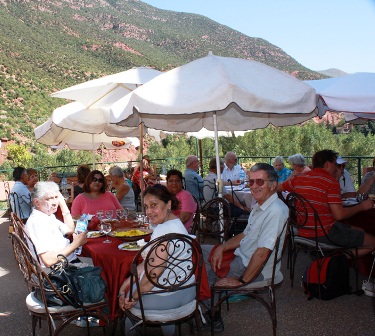
Lunch in the Ourika Valley
Read Previous Episode:
Marakesh or Next Episode:
Essaouira
16 October 2009 Morocco – Ourika Valley
As much as we prefer to be independent travellers, we
occasionally take advantage of a tour. Our day trip to the
Ourika Valley, in the High Atlas Mountains about 30 km from
Marrakesh, was one such incident. Eleven guests of the Residence
Amina set out in a minivan with our guide Aziz.
We
made several stops along the way. We stopped at a pottery
workshop to watch a demonstration of pottery making. We stopped
beside a mosque to admire an irrigation canal built just six
years ago to bring water to the many gardens and groves of
olives and fruits outside the city. More interesting for me was
the explanation of numbers painted on the side of the mosque.
During election times the 38 recognized political parties post
their party’s platforms under designated numbers for all the
local residents to read.
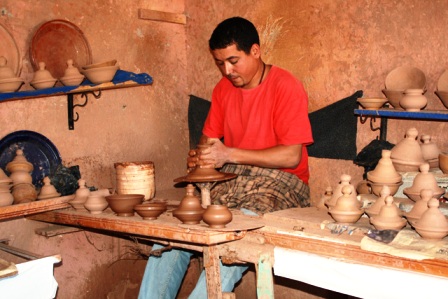
pottery workshop
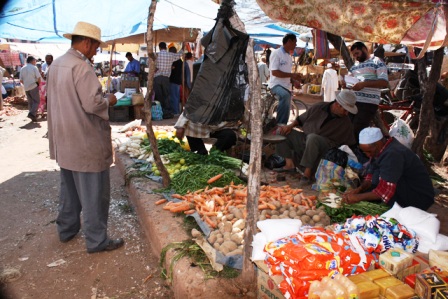
Market in Trine
Monday is the weekly market day in the village of Tnine.
We
were there, along with several other tour groups and most of the
inhabitants of the area. It was a going concern with meat
markets, fruit and vegetable stalls, household goods stalls,
barber shops, food booths and whatever else the locals find
necessary. Ray and I would have loved to take our time exploring
the market but when you are in a group you are hustled along for
fear someone would get lost. As it was, a few of our group
didn’t heed the warning to ignore the jewelry salesmen. As a
result we were shadowed the entire way by men desperately hoping
to make just one sale. There were slim pickings with our group
and Aziz as our leader.
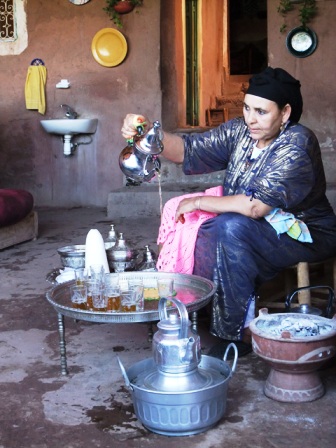 A treat was a visit to a traditional Berber home for tea. A
multiple generational family live in this home built on the side
of a hill. The décor was simpler than our guide Mahjoub’s home
in the Todra Gorge, but it was similar. We climbed several sets
of stairs, with rooms at each level. One room was for several
cows, more were bedrooms, one was a kitchen and one large
terrace was where we assembled for tea. One of the women sat
down in front of a very large metal teapot and proceeded to make
our tea while Aziz explained what she was doing. She started
with green tea, never black tea, and hot water. She poured out
some of the water to determine if the tea was steeped enough,
then added lots of fresh mint, some sage leaves and more hot
water. Last came a large piece of sugar cut from a large cone.
Tea was first poured into a glass and then poured back into the
pot to properly mix the sugar. When the tea was deemed ready, we
were all given a glass. We drank appreciatively.
Our tea was the aperitif for our dinner at a large restaurant
at the foot of the Atlas Mountains. We weren’t the only tour
group there for lunch but it was very good. We had Moroccan
salad, chicken done tajine style, cous cous with vegetables and
fruit for desert. As well as the usual bottled water, we shared
a bottle of passable Rosé wine, the first alcohol we had drunk
in Morocco. Alcohol is available in some better restaurants and
bars, but it was either too expensive or not available where we
ate. We have become quite used to the teetotaller style,
although I am sure that will be forgotten once we return to
Paris.
Our group passed up the opportunity, for a price, to sit on a
camel and have your picture taken at one of a few spots along
the mountain road on our way back to the city.
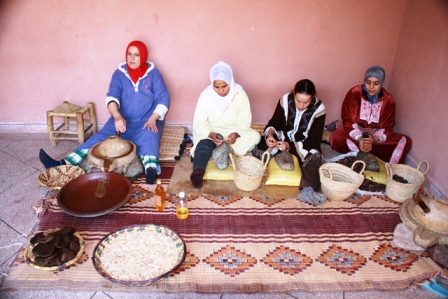 We did stop at a Herb and Argane shop and listened to an
exhaustive list of the herbal remedies available and their many
benefits. I was more interested in learning more about Argane,
termed the “new olive oil” with even more benefits.
Four
women sat near the entrance of the shop demonstrating the
processing steps for producing oil from argane seeds. The argane
trees are found in only a few places in the world and this area
is one of them. According to my Lonely Planet the seeds were
originally fed to goats whose digestive system removed the touch
outer shell while leaving the kernel intact. It was the job of
the women to separate the kernels from the goat dung and grind
and press them to produce oil used both in cosmetics and in
cooking. There was no mention of the goat step in this shop, so
I guess they use the new improved goatless method. After
sniffing and trying out some of the proffered products, I did
buy a small bottle of the oil suitable for cooking. I will have
to determine if salad dressing made with argane oil is worth the
price.
Return to
Morocco Intro
Return to
Travels
Return to
Introduction