March 2011
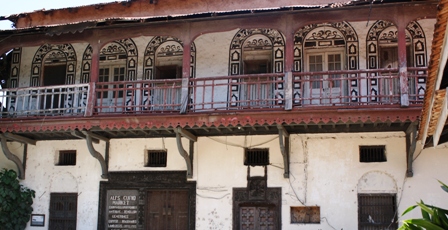
Click the photo of Mobasa balconies above
to see an album of photos. To return to our webite close the window.
Read Previous Episode: Lake Nakuru
or Next Episode: Malindi
Journey to the Coast: Nairobi and Mombasa
Nairobi and Mombasa Kenya
4-7
March 2011
Big African cities have lots of traffic, lots of small shops and usually,
lots of rubbish. We don’t usually stay long, preferring to get to the more
peaceful countryside. Nairobi was simply an overnight stay, a place to catch up
on the internet and catch a bus to the next destination. I did the internet
while Ray walked around the business section of downtown Nairobi, where our
hotel was located. He found the area surprisingly clean and full of new,
prosperous buildings. There were not even dodgy looking characters waiting to
snatch your backpack or purse that we had been warned about. Still, we were
anxious to be on our way.
At least the Horizon bus to Mombasa gave us the
roomiest and most comfortable ride we had encountered so far in East Africa.
With heavy traffic at both ends of the trip it took over seven hours to reach
Mombasa and our backpacker rest house.
Mombasa is finally realizing that
tourists are drawn to the old historical sections of the city. Old Town Mombasa
dates back to the 16th century and much of it looks its age. The Historical
society is striving to preserve the best examples of East African architecture
but has far to go. There are a few lovely examples of buildings with decorative
upper balconies with decorative screens protecting the women from prying eyes.
We spent our one day in Mombasa exploring the area. We started out in the
crowded Old market where shop keepers beckoned us to “come, just look” at their
wares. Women now stroll the streets on their own in search of market goods. Many
are covered in the black burka with only their eyes uncovered but glimpses of
colourful dress clothes can be seen underneath and elaborate designs in sequins
decorate the sleeves and front of the burka. We found our way to the Old Fort
Jesus, built by the Portuguese in 1593 as protection against marauding bands of
Arab invaders. Next to the fort was an archway leading to a harbour where
several people were swimming. It didn’t look clean enough to tempt us. We kept
to a harbour side walkway to enjoy the views and gradually made our way up
through the warren of narrow unpaved streets of the Old Town. We found the
Island Dishes restaurant recommended by Lonely Planet and enjoyed a very good
African style buffet lunch before walking back to our hotel.
The next
morning we took a taxi to the minivan stand where Matatos to the beaches north
of Mombasa start their trip. We chose an Express minivan going directly to
Malindi where we had reserved a condo for the next week. Half an hour later the
minibus was full and we were speeding northward. Our driver believed that time
was money and drove as fast as he could. Thank goodness the road was straight,
flat and paved. That didn’t prevent the driver from being stopped and fined for
speeding at one of the police checkpoints. We continued on at almost the same
speed, arriving safely in Malindi about noon.
A Last Look at Nairobi Kenya
Nairobi, Kenya
Tuesday 15 March
2011
Nairobi the bad, watch your
belongings and be careful where you go. That is what we were told about the
city. Thankfully, we encountered only friendly people and a clean, prosperous
city during our brief visits.
On our way to the Kenyan coast we stayed overnight in an older hotel
right in the center of the city. Most of my time was spent in an internet cafe
while Ray roamed the business center streets. Our return to Nairobi was for two
nights before flying to Paris. We elected to stay at a very nice backpacker
spot, Wildebeest Camp, in the western suburbs. A large house, built in 1935, on
an acre of land was the former home of one of the British Colonials before Kenya
gained its independence. It is now owned by an English-Australian couple who
live with their small son on the second floor of the house. The gardens have
been improved and extended the gardens surrounding a line of Safari tents for
backpacker tourists. If you have your own tent, you can pitch it in one section
of the gardens. Lighting for the tents and the umbrella topped patio tables
scattered around the gardens is solar powered. Dinner is a buffet served in the
former large living room of the house and breakfast and lunch are served at
patio tables or in the dining room on rainy days. We arrived Monday evening in
time to meet some of the other guests and to have the buffet supper.
The
next day we decided we needed a little exercise. Downtown Nairobi was a bus ride
away through often gridlocked traffic or a 30 minute walk, mostly downhill. Most
of the route was shaded by flowering trees and bushes. The city beautification
project is producing impressive results. We had been warned, several of the
public buses belched black diesel fumes. Ray kept his handkerchief over his nose
and I held my breath as the worst ones passed. Whenever we stopped to consult
our guidebook to get our bearings, we were offered assistance from local
pedestrians. They were all very friendly.
We came to the large Uhuru
(which means Freedom in Swahili) Recreation Park where lunch time workers rested
in the sun. One corner was like Hyde Park in London with a speaker expounding
his views for a crowd of spectators. We stopped to snap a photo of a clock tower
in the middle of a landscaped traffic circle. Suddenly, several men, some in
uniform came running out of the park. One jumped into a car slowing down at the
circle. Uniformed officers ran into the circle and stopped traffic in all
directions. Those of us on the sidewalk were urged to stay back. Everyone
stopped to see several cars with “President Escort” signs race around the corner
followed by a few police cars and finally two very official black sedans in one
of which was the Kenyan President. Living in Ottawa we can expect to encounter
motorcades conducting some official to a meeting, but it usually is not quite as
dramatic an entrance as this Nairobi one.
We continued on to view City
Hall and the Jomo Kenyatta Monument in front of the Judiciary building, all
surrounded by more flowering plants. We found an outside beer garden to have a
lemon soda to refresh us and relax before starting on the walk back.
Our
flight to Paris via Cairo was scheduled for 4:30 AM. A taxi driver was booked
for 1 AM. We were glad we had reserved a second night at Wildebeest even though
we would not be able to stay the whole night. We at least got some rest before
heading out to the airport and managed some sleep in the plane to Cairo. I am
writing this blog in the plane on the second leg to Paris and will send it off
when we reach Erica and Andrew’s apartment.
Click one of the following to read about
Tanzania,
Rwanda
or
Uganda
Return to
Travel Intro
Return to Introduction