March 2011
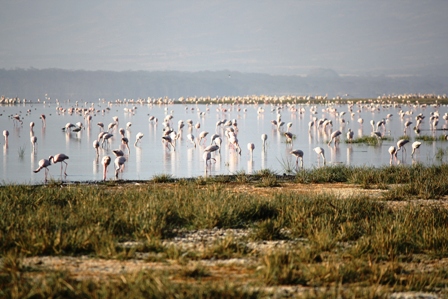
Click the photo of flamingos above
to see an album of photos. To return to our webite close the window.
Read Previous Episode: Masai Mara
or Next Episode: Mombasa-Nairobi
Flamingos
in the Lake-Nakuru NP Kenya
Lake
Nakuru National Park Kenya
Friday 4 March 2011
The smell
of fire lingers in the air and smoke issues from several still smouldering
trees. This was not a managed fire to control the underbrush. It most likely
started as a result of carelessness in one of the communities bordering the
eastern edge of Lake Nakuru National Park. As well as burning the underbrush the
fires destroyed many mature trees. It will take more than one rainy season for
the park to recuperate.
We were supposed to stay in Lake Nakuru Guest
House, located within the boundary of the National Park, as part of our tour.
The fires had destroyed power lines to the guest house and ruined the already
problematic water system, necessitating a shift to a hotel in Nakuru town close
to the park gates. This was a good alternative except that it eliminated one
game drive in the park. The entry fee for the park is good for 24 hours,
provided you do not exit the park. We had an option for a game drive on Thursday
afternoon and pay an extra fee for another game drive Friday morning. We had
seen all we had hoped to see and then some in the Masai Mara. We opted for some
time off and have just one game drive early Friday morning before driving to
Nairobi in the afternoon.
The
180-sq-km Lake Nakuru National Park was created in 1961 to preserve the unique
alkaline lake with its blue-green algae, the food source for greater and lesser
flamingos. The park is also noted for its wealth of birds, especially shore
birds. Both black and white Rhinos were reintroduced to the park some years ago
and have thrived. We saw several white rhino families foraging in the bushes
close to the lake and one black rhino settled into the tall savannah grasses
near the south end of the lake.
We had
started our drive along the western shore of Lake Nakuru. For once we were
encouraged to get out of the minivan and walk on the salty mud flats as close as
we could to the flocks of flamingos and pink backed pelicans. We managed to
identify several other birds, including the omnipresent but ugly, Marabou
Storks. Rare African Spoonbills shared space with Yellow Billed Stork and tiny
plovers and stilts searched the lakeside pools for food.
Antelope of many varieties, zebras and cape buffalo grazed beside the
lake but the fabled leopard failed to appear. We drove up the edge of the
escarpment to enjoy the view from Baboon picnic site. A few baboons made an
appearance, as they usually do in an area where picnickers may have left tasty
bits to eat. At the south end of the lake we encountered several herds of white
legged giraffe; a different species from the giraffe in the Masai Mara munched
delicately on Acacia leaves.
One of the few remaining trees in the burned
out eastern section had a family of black and white colobus monkeys tearing off
leaves to eat. As we watched them through binoculars, a limb occupied by one
monkey crashed sending the hapless monkey down several feet to land on top of
his mate. Both continued happily tearing off leaves as if nothing had happened.
A lone impala delicately made its way through the burnt savannah foraging for
anything edible.
We left via an eastern gate and joined the highway to
Nairobi. Just past the Sleeping Man Mountain we were rerouted by police onto the
old road to Nairobi rather than the faster new road. Our guess was there was a
traffic accident blocking the new road. The old road snakes up the side of the
Rift Valley, climbing several 100 m to give us views of the extinct volcano Mt
Longonot and other lesser hills in the valley. The trip took a little extra time
to reach Nairobi but we would have missed the best viewpoints had we taken the
new road.
Click one of the following to read about
Tanzania,
Rwanda
or
Uganda
Return to
Travel Intro
Return to Introduction