Java Episode 2: Bogor
Kampuns and Gardens
Click
the photo above to see an album of photos. Close
the window to return to this page.
Read
previous Jakarta or
next
Thursday 28 January 2010 Bogor Indonesia
There is nothing like walking the back streets of a town with a local who
knows the area. We had that chance in Bogor, just a one hour train ride from
Jakarta.
Selfi, the agreeable and knowledgeable daughter of the owner of Abu Pensione,
our very pleasant guesthouse in Bogor, gives walking tours of the kampun (a
township) near Abu. Ray, An Aussie woman and I followed Selfi down a back alley
through a warren of simple homes on the banks of a small river. Selfi siad that
despite the crowding, there is a real sense of community in the kampun.
Everybody looks out for and helps their neighbour, just like a small town.
There is electricity in the kampun but no running water. Fresh water is
pumped through pipes from the nearby mountains to common outlets at the side of
the river. There the women of the kampun do the laundry, wash dishes and fill
buckets for daily needs. Toilets are behind a low concrete wall at the side of
the river. People still fish in the river but you wouldn’t want to swim there.
We paid 1000 Rp ($0.11) each to cross the river in a wooden ferry, just large
enough for an driver and two or three small passengers. The driver just hauled
on the attached cable to get to the other side. We scrambled up the other side
and walked through what was rice fields when Selfi was in high school. Now it is
where the “rich people” have built homes.
A tofu factory was just outside the gates, broken, of the gated community.
Our eyes had to get used to the heat and dark inside the factory. The only light
was from a roaring wood fire. One man sat on the floor soaking soybeans to
remove the skins and grinding them to a watery paste in a machine beside him.The
paste was heated in a large cauldron until it was thickened sufficiently. Then
it was scooped out of the cauldron, strained through a cloth and placed in a
barrel with heavy weights on top to remove more of the water. The tofu was
further processed with spices, cut in pieces and bagged for sale in the market
the next day. If customers prefer tempeh, the tofu is sent to another factory
for the final fermentation process. And you thought tofu just came from the
health food store!
We took a “colt” a small mini bus that constitutes local transportation in
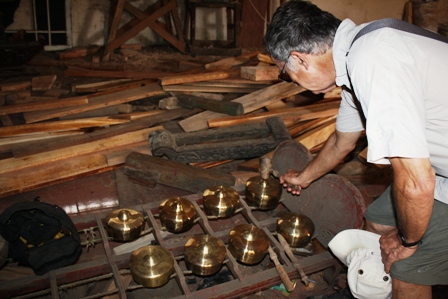
Bogor. For 2000 Rp each we were taken to a Gong workshop. Gamelin is the
traditional music of Java and Bali. The instruments are copper gongs,
kettledrums, xylophones, bamboo flutes and a zither type stringed instrument.
This workshop specialized in copper instruments. We heard what sounded like a
three note orchestra coming from a wooden building. Inside was a man heating a
pancake of brass in a hot wood fire. When it was red hot, he took it out with
tongs and laid it on the concrete floor. Quickly, three men lifted their 6 kg
mallets and pounded the brass in turn. They had to be quick or someone would bet
pounded instead of the copper. When the brass has assumed the correct diameter,
it is shaped over a concrete form, polished and adjusted for sound. The workers
are justly proud of their skill at producing their sought after musical
instruments.
Nearby was a small cracker factory, but unfortunately the workers had a day
off so that maintenance could be done on the machines. Selfi pointed out where
noodle dough was mixed, then poured into a press. Three men sit below the press
curling the extruded round noodles into a pancake shape. The pancakes are then
dried on a concrete pad in the sun and deep fat fried. We tried some we bought
at a neighborhood store. They were very good.
The end of our tour left enough time for us to visit the Botanical Gardens.
Covering 87 hectares in the center of Bogor, the gardens were started by a
German-Dutch Botanist in 1817. They are very well kept and the pride of
Indonesia. When we paid our entrance fee, the ticket seller told us that the
Bunga Bangkia was in bloom. We had no idea what that was but we were shown a
picture of it and where to find it. We followed the signs posted at each
crossroad through the park to a fenced and cordoned off area. Sure enough, there
was the giant Amorphophallus Titanium. Bunga Bangkia means “corpse flower”,
because of its pungent odour, meant to attract insects for pollination, which
thankfully was not noticeable. This one was fully erect but the bottom leaves
were not open.
This is the rainy season in Indonesia and especially so in Bogor, which has
322 days with thunderstorms and the highest annual rainfall in Indonesia. The
clouds were gathering. We ducked into the Orchid House to see some of the
hundreds of varieties grown there, then as the rain started, we ran to the park
restaurant. We got there just before the skies opened. The rain didn’t let up
for the next two hours. That was fine with us. We had time to enjoy an
Indonesian Ristaffel and watch the rain from the comfort of a covered balcony.
Young boys made money by renting their umbrellas to customers coming to the
restaurant. They ran with the customer, getting thoroughly soaked but having a
great time.
As soon as the rain let up enough for us to leave we returned to our
guesthouse, buying an umbrella on the way. Now we are prepared for the next
rainstorm, as long as we remember to bring it with us!