Java Episode 8: Volcanic Moments: Ijen
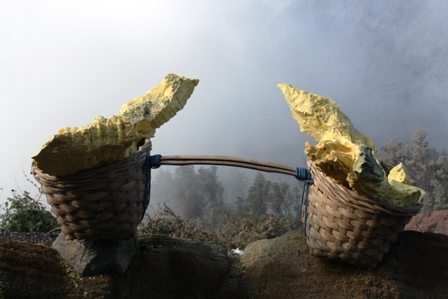
Click
the photo above to see an album of photos. Close the window to
return to this page.
Read previous
Mt Bromo
Tuesday 9 February 2010 Ijen Plateau, Java, Indonesia
Bromo was interesting, but Ijen was spectacular. We were glad we decided to
brave another early morning wake-up call.
We were having our breakfast at our hotel at Mount Bromo when the first of
the next day’s batch of Bromo watchers returned. Two other tourists were also
continuing on to the Ijen Plateau. The four of us, plus others bound for other
destinations, piled into a minivan and returned down the mountain to
Probolinggo.
We four who were Ijen bound boarded another minivan and off we went again. Of
course it rained for much of our journey and of course the traffic on the two
lane roads was horrific. Our driver was more cautious than our driver from Solo
so it was a bit slower, but less nerve racking drive.
Finally we turned off the main road and reached the peaceful country side,
passing rice paddies and sugar cane which gradually became fields of market
vegetables at higher latitudes. We stopped at a viewing platform to look over
the hillside covered in coffee. Our hotel for the night was in another
coffee plantation, further along the road.
We had to go through the town of Sempol and down another hill to reach Kebun
Balawan plantation. The road ever since we turned off from the coast had been
getting more and more potholed, but it was nothing like the road to Kebun
Balawan. The rains of the previous days had caused mud slides which shut part of
the road. At the top of a very muddy stretch sat several motorcycles, hesitating
to proceed. One man started very slowly but he wasn’t getting the traction he
needed. We had to go down this road to get to the hotel!
The motorcycles pulled to the side so that we could go down. The driver
cautiously made his way down the hill, staying to the hillside, away from the
gaping void on the other side. I would have preferred to walk but we all stayed
put and tried not to look. There was another minivan with three more tourists
behind us. Just past a turn in the road it started to slip and stopped across
the road. Our driver stopped our minivan and ran back to help. With the
assistance of several motorcycle drivers who had been waiting just past the turn
to go up the road, they succeeded in straightening the minivan and we all made
the rest of the trip without incident.
The main house of the hotel used to be the home of the Dutch coffee
plantation manager prior to 1949. I hate to think of the long journey back then
to get to the plantation. Today the main house has been divided into sitting
rooms and hotel rooms and additional rooms, where we stayed have been
constructed. A coffee processing plant is right next to the house. The picking
season is July and August, so the plant was not active during our visit. A
purpose-built town is next to the hotel and plant. We walked along a street
lined with small, well-kept, linked concrete bungalows, homes of the workers.
Behind the front row was another row of similar houses and in a valley below the
town was a community of smaller bamboo huts. It looked like a typical company
town hierarchy for housing.
With all the problems with bad roads, the trip had taken almost an hour
longer than expected. That meant the promised hot springs, a short distance away
were closed for the day. There was a pool at the hotel but the water temperature
was too cold to tempt any of us. We did get to soak our feet in a small hot tub
beside the pool. We all had a simple supper at the hotel and went to bed early.
Thank goodness Ijen was much warmer than Bromo so we only needed two blankets to
keep us warm overnight.
We were not returning to the hotel after our walk. The 3:30 AM call gave us
just enough time to dress, pack and eat a small breakfast before leaving in the
minivan for a return trip up the mountain. I told our driver I was not looking
forward to going up the slippery, muddy section again. I said I would pray for
him. He said we could give him a good tip if he got us up safely. He earned his
tip.
It was the first visit to Kebun Balawan for the second minivan driver so we
left in convoy. We made it as far as the beginning of the mud. The road divided
at that point but the left hand branch had a tree branch blocking the way. Our
driver slowly started up the right hand side and started to slip. I said I
wanted to get out and walk. When our driver stopped to asses the situation the
motor stopped and he couldn’t get it started. Everyone from both minivans got
out and started to walk up the closed left hand side. We had to climb over a
mudslide covering the road but it wasn’t far to rejoin the road. Our driver
backed up the minivan until the motor started again then gunned the motor and
made it to back to where we waited. We cheered. Our driver parked his vehicle
and ran back to help direct the second minivan. Both vehicles made it the rest
of the way without a problem. Even a jeep would have problems on that muddy
section.
The Ijen volcano complex is inside a national park, the headquarters of which
were near the town of Sempol. We parked beside the park headquarters and started
our walk to the Ijen caldera. With our slow ride up the muddy hill, we had
missed walking in the dark to see a sunrise. That didn’t matter. The 1 1/2 hour
walk on a well-used dirt trail through the jungle was much easier in the
daylight and it was still early enough, before 5:30 AM, to be cool.
Several times each morning locals climb the hill to the rim of the Ijen
crater and walk 200 M down to the caldera to collect sulphur. We were passed by
one, and then several men carrying empty baskets which would be filled with
sulphur. Two baskets are attached to either end of a flat wooden pole that is
carried over one shoulder and across the back. Each load of sulphur weighs
between 70 to 100 kg. It is literally staggering. The men often carry the load
of sulphur partway down the hill, leave it on a rock resting place part way down
and return for more. We passed several full baskets left by the porters. The
sulphur carried by the porters is in a solid form. It is used for fertilizers,
matches, insecticides, fungicides, sulfa drugs and many other chemical
compounds.
Many of the men passing us said “photo, photo, cigi, cigi?”, suggesting they
would pose in return for a cigarette. Ray realized what our tour guide meant
when he suggested we buy a pack or two of cigarettes. The cigarettes they all
smoke can’t be doing and more harm than the sulphur fumes they breath every day.
Even so, I wished we had at least brought a package of cookies as payment.
At 2214 M is a communications tower for mobile radio and cell phones, plus a
way station for the porters where they can rest and eat. We still had a ways to
go but the path from there on was more level and out in the open around the rim
of the caldera. It was a clear day, no rain, and the view was spectacular. Other
volcanoes, mostly inactive and covered in forests came into view. Finally we
sighted the smoke from Ijen. The vegetation on the walls of the caldera had been
killed by the sulphur fumes. Bare grey rock was all that remained. We looked
down to the floor of the caldera to see a mound of yellow sulphur on one side of
a one km wide tourquise lake with patches of red streaking the center. It was
quite a sight.
We walked to the point at which the porters walk down a 200 M path to collect
the sulphur. Tourists can walk down as well but parts of the path can be
slippery and we had a good view from the top. The sulphur is red when molten and
turns yellow when it cools. A network of ceramic pipes channels escaping gasses
to the side of the lake where it cools and turns solid. Men labour all morning
with metal stakes to slice off slabs of the sulphur and break it in small enough
pieces to fit in the porter’s baskets. By the time a porter has carried his load
back up to the rim of the caldera he is tired. To make any money he has to
deliver his load to the bottom where it is weighed and make at least one more
trip to get another load of sulphur. No wonder many of the men looked old before
their time.
After we had taken enough pictures, we walked down the hill back to the
minivan. We headed down a different road, even steeper and rockier than our
route up the day before. Back on good paved roads we drove through pretty
country towns of neat, concrete houses with red-tiled roofs. We were back
through coffee plantations, fields of vegetables and then the rice paddies
before we hit the coastal road.
It wasn’t long before we were at the Ketimang ferry terminal and on a ferry
headed for the Island of Bali. In a speed boat the journey would only take about
15 minutes, but our trip took one hour. Most of this time was spent motoring
slowly part way across, then waiting while a landing dock became available. It
was the same as circling an airport waiting for landing instructions. There seem
to be many more ferries than berths available both in Ketimang on Java and on
the Bali side.
We made the rest of the trip to Lovina, a nice, relatively quiet beach town
on the North coast of Bali, in a Bemo, a public minivan. For most of the trip we
were the only passengers. We stowed our bags on the seat behind the driver and
sat in relative luxury in front beside the driver. In less than two hours we
were at the hotel of our choice, Lovina Beach Hotel. We have a good room facing
a lovely garden, just steps from the swimming pool, restaurant and warm ocean.
We will be here several days. Can you blame us? It is time to work on our tans.
This is the first time I have been in shorts since we left home in December.