Java Episode 6: Solo: Princes and Hindu Temples
Click
the photo above
to see an album of photos. Close the window to return to this page.
Read previous
Jogja Temples or
next Mt Bromo
5 February 2010 Solo Indonesia
Batik is king in Solo. There are even more shops in the city than Yogyakarta,
if that is possible. It sounded like a good idea to look for a batik replacement
in Solo for one of my T-shirts that is getting a little worse for wear. We
started the search in the Batik Market. It was too much for me. We found our way
to a huge indoor market packed to the gills with small stalls, all selling batik
fabric and clothing. I could not image how a shop could possibly fit the stock
they were selling into their small space, let alone add anything more. The
choice was mind boggling and none of it suited my fashion sense. I gave up
looking and just admired the variety.
Each state in Java was traditionally ruled by a “susuhuman” or prince. The
prince of Solo State lived in Karosuro, a town about 10 km away from Solo until
the town was sacked in 1742 by warring factions. The ruling prince heard voices
saying the village of Solo was a “place decreed by Allah and it will become a
great and prosperous city”, so he moved everything, including the sacred banyan
trees, to Solo in one day. The Kraton was built in 1785 and became the home of
the ruling family. A subsequent prince built another palace, the Puri Mangky
Negaran, in 1757 for his own use. Both complexes are now open to the public. We
visited both.
The Kraton is now owned by the government and is showing its age and lack of
upkeep. The displays are poorly labelled and dusty and the most important
artifacts have been sold off or moved by the government. It was a bit of a
disappointment.
The Puri was much more enjoyable. It is still owned and operated by the
current prince, who retains only ceremonial duties. The prince used to reside in
the complex but now lives either in a house in the more fashionable section of
Solo or in Jakarta. The Puri is used for entertaining guests. We had a very
knowedgeable guide for our visit to the Puri. She showed us through several of
the official rooms and gardens and pointed our the many gifts from foreign
governments and artifacts and souvenirs collected by the generations of princes.
The mother of the current prince was revered for her herbal medicine knowledge.
An elderly woman, a follower or the now dceased mother, sold several remedies in
the Puri. There were lotions, powders and arromatic oils to sniff and try. I
bought a small packet of powder guaranteed to repel insects from cloth. I plan
to try out its effectiveness against moths that I cannot get rid of in our
house.
We have been enjoying sampling the various local delicacies. We have tried
Nasi Gudeg, a jackfruit curry, served with a hardboiled egg cooked in brown
sugar and garlic. Ray liked Sop Matahari, a soup with mushrooms, chicken,
biscuit croutons and the same kind of hardboiled egg. Chinese food is also
popular, introduced to Indonesia by the generations of Chinese workers and
businessmen. We went to a popular food stall and had a dinner of dim sum
delicacies. Weplan to visit a street in Solo famous for its Nasi Liwet, which is
rice cooked with coconut milk and served with side dishes. There is always
something new to try.
The traffic getting out of Solo was the usual Asian crush of motorcycles all
jockeying for position on a narrow two lane road. It was a relief to get into
the countryside again. The rice fields spread ahead on either side of the road.
Here the rice has grown tall and green and is starting to head up.
We were heading up the slopes of Gunung Lawu, a huge mountain of 3265 M. We
were not going to climb the mountain, we were going to visit two Hindu temples,
built in the 15th C, just before Islam swept the country. Candi (temple) Sukuh
was built about 50 years before Candi Ceto, which would be our first stop.
As we got higher, the fields switched from rice paddies to market gardens.
The soil is rich and fertile and the climate is temperate. Carrots, cabbages,
beans, sugar cane, you name it, are grown in this area. Coffee plantations used
to cover the slopes but the government decided that rubber trees would be more
profitable so the coffee trees were torn out and new rubber trees planted.
We climbed through misty low clouds to the tea plantations where women were
busy picking the tender top leaves and others were pruning the tea plants on
adjacent hills. The minivan struggled up the steep inclines, there were few
switchbacks to ease the drive, to a small community at 1400 M.
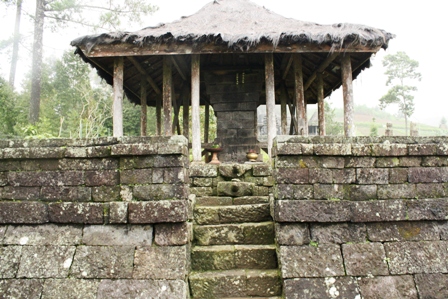
Two towering entry posts, stone blocks built in a series of steps with a
saw-toothed edge facing outwards, marked Candi Ceto. A mixture of Shivaism and
fertility worship, it was built by one of the Majapahit rulers who found himself
the victim of warring factions at Candi Sukuh. He fled and found just the quiet,
peaceful place he was looking for in Ceto where he built a meditation center for
himself and a few of his loyal priests and guards. Th original temple had 14
levels with gates at each level reaching to Nirvana. By the time the ruler and
his priests died, the countryside had converted to Islam and there were few
people left who understood the meaning of Ceto, so the temple was
abandoned. Rediscovered in this century, Soeharto decreed it must be restored.
Archaeological studies had not yet commenced so Soeharto declared that he didn’t
care how it was restored, as long as it was symetrical. One of the 14 levels was
eliminated and the first gate was built much higher than the others. The temple
evolved into a rite to determine whether a young man was a virgin and would be
able to marry his intended. While his intended watched, the young man would
circle the largest level 50 times, then sit in the center. If he had an erect
penis by that time he was a virgin. If not, he failed the test and could not
marry!
With the rise of Islam, Hindu followers fled to Bali. Ceto is now a
pilgrimage site for many Bali Hindus. As a result, many of the villagers in Ceto
have converted to Hinduism and remain a small pocket of believers in an Islamic
country. Locals come daily to place fresh flowers on the foot of the sculptures
of their favourite dieties.
Candi Sukuh was 7 km farther down the mountain. We arrived to find it was not
merely misty, it was raining. We sheltered under Ray’s umberella and waited out
the short shower.
Many of the sculptures are roughly carved, suggesting, according to our very
knowledgeable guide Ajib, that it was built in a hurry using unskilled workers.
More detailed sculptures were added as stone carvers were found. There are two
themes to the temple. One is the lifting of a curse, depicted by sculptures
relating to the story of Durga, a consort of Shiva being cursed for
unfaithfulness and the subsequent lifting of the curse. Two large sculptures of
headless Garudas, one half-human and half-bird, the other half-bird and
half-human, tell a similar story of a curse and its redemption. The other theme
is fertility, depicted by several lingam (penis) statues and figures with
oversized erect penises. The favourite photograph taken by tourists is of a
young man posing behind one figure that is headless. Ray wouldn’t cooperate for
a photo.
A rite evolved after the temple was built to determine if a young woman is a
virgin. Wearing a sarong, she had to stride across a large lingam. If her sarong
got caught on the lingam, she was a virgin. If not, she failed. We couldn’t see
how high she had to step as the lingam now resides in a museum.
The trip down the mountain was a lot quicker, even stopping for photos alng
the way and a lunch in a small restaurant. It was an enjoyable day.