Popoyán and Silvia Tuesday Market
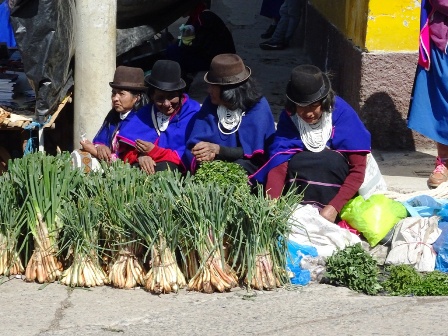
Click the photo
above to see an album of the Silvia Tuesday Market. Close the window to return.
Read previous Episode:
Cali
or Next Episode:
Zipaquira
January 25-27 2016
We lucked out. Our planned two night stay
in Popoyán coincided with the weekly Tuesday Market in Silvia, the center of the
Guambiano region, 53 km NE of Popoyán, The Guambiano people, who live in small
mountain villages a distance from Silvia, are one of the most traditional
indigenous groups in Colombia; they speak their own language, dress
traditionally and farm using simple farming techniques. All the gringos who made
it to Popoyán the previous evening, Ray and I included are in Silvia this
morning for the market. We have come over the mountains on a public bus from
Popoyán, a long 1 1/2 hour trip on the narrow mountain road.
Guambianos started arriving at daybreak, either walking
over the hills, riding motorcycles, or more commonly, in chivas, colourful
open-sided buses. The market is already in full swing, with sellers patiently
displaying their wares and buyers looking for the freshest produce. It is a
carnival of colour. The Guambianos do not like their picture taken, so we
politely ask if we can photo their produce and every now and then, get a photo
from a distance of the crowd of people.
I can’t get over how reminiscent of Bolivian indigenous
people the Guambianos are. The women sport the same bowler hat and full
hand-woven navy blue skirt trimmed with white stripes. In Silvia the women add a
bright blue shawl edged in pink and multiple beaded necklaces. Young girls are
distinguished by their flat straw hat decorated colourfully and often sporting
flowers. The men have the same bowler hat but wear a blue skirt, like a sarong,
crossed over in the back with a pink fringe. The men also wear a dark blanket
over their shoulders, also edged in pink. All wear sturdy work boots. A few
women sit in the church plaza, taking a break from the market, spinning raw
wool, not yet died that clear blue.
Ray and I edged our way around the closely packed stalls
in the indoor market, amazed at the variety of potatoes and onions, some of
which were unknown to us. Outside a group of men debated the merits of a few
small pack horses and the few remaining piglets for sale. The streets
surrounding the main market were lined with women with their produce artfully
displayed against the curb.
Taking a break from the market, we walked through the
streets of the small town to climb a small hill topped by a church, where we
were treated to a 360 view of the area. We returned to Popoyán at the end of the
morning, glad to have been a witness to perhaps a dying way of life.
After lunch in town we spent the rest of the afternoon
wandering around Popoyán, admiring the well preserved Colonial architecture.
Popoyán, nicknamed the La Ciudad Blanca for its wealth of white buildings, was
founded in 1537 by Sebástien de Belálcazar. The town was the most important
stopping point between Quito, Ecuador and Cartagena. Its mild climate attracted
wealthy families from the sugar haciendas in the hot Cali region who built
houses, schools and imposing churches and monasteries in the 17th C. Popoyán was
the capital of southern capital for centuries until Cali overtook it.
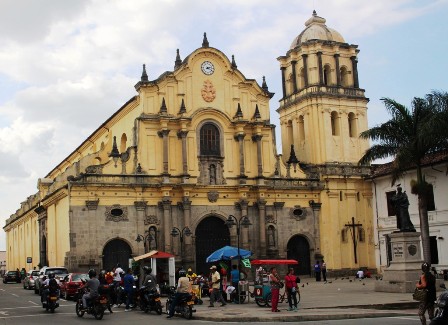
Click the photo
above to see an album of Popoyán. Close the window to return.
That night we shared dinner at The Italian Restaurant
with Rick and Chris, new friends staying at the same Hotel Krone and with whom
we shared the day in Silvia. We talked about the kindness of the hotel manager,
Don Bernardo, who had personally driven all his clients to the bus station so
that they could be sure to get on the correct bus to Silvia. Bernardo also
repeated his kindness to Ray and I the next day when he insisted on driving us
to airport for our flight back to Bogota. It was fitting to spend the last
evening with good friends and good memories of our visit to Popoyán and Silvia.
Return to
Columbia Intro
Return to
Travels
Return to
Introduction