Mompox Colombia on the Magdalena
Click the photo
above to see a Mompox album. Close the window to return.
Read Previous Episode:
Casa Barlovento
or Next Episode:
Medellin
January 15-18 2016
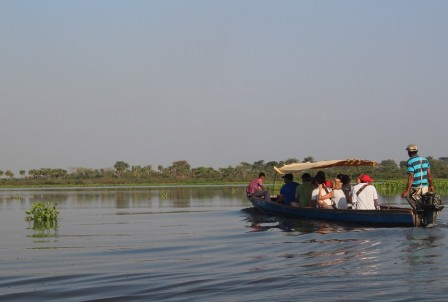
Our long motor boat puttered down the Magdalena River
with Ray and me and eight other tourists aboard. We were seeing the Magdalena
almost like the original explorers, albeit not in a dugout being paddled by the
indigenous people. Our vehicle was a steel hulled boat, the same shape as a
dugout, with removable wooden seats, a canvas shade cover, and a 40 hp outboard
motor. We had stopped a short distance further down the river to join up with
eight more tourists in a similar boat.
The Magdalena is still important to the community, not
just to take tourists on an afternoon tour. The road system around Mompox (also
spelled Mompos), is not the best, and there are few bridges. A motorboat, like
the one we were in, is still the best way to ferry people back and forth across
the river from their small villages to the bigger community of Mompox. We passed
a few men digging in the muddy bank beside the river and then panning the sludge
for gold or other minerals. It looked like a hopeless and dirty operation but
apparently there are still flakes to be found. Our guide pointed out, in
Spanish, the various trees, birds and iguanas along the shore as we floated by.
It was very peaceful.
To my pleasant surprise, we weren’t confined to the river
for this tour. We were heading for a lagoon, just off the main flow, to see how
the fishermen make a living and to see more birds. There was one problem. The
water level is low on the Magdalena so we couldn’t take two fully loaded boats
right into the lagoon. We were headed for our guide’s home village where we
would be taken by motorcycle to the lagoon. We all piled out and wondered how
all 18 of us were going to get to the lagoon on two motorcycles and a small
horse cart. The two motorcycle drivers called for volunteers to be driven to the
lagoon. I said Ray and I could go behind the driver on one motorcycle while
another woman said she and her boyfriend would ride on the other. Her boyfriend
was considered too big as he was over 6 ft tall, so she went alone. The biggest
problem for Ray and I was finding how to get our feet on one pedal without
losing a shoe. We made it, bouncing down the bumpy road and swerving to avoid
potholes, without incident. Following us was a cartload of nine tourists in a
cart pulled by another motorcycle. Two more boats were being readied for the
second part of our trip at a small dock.
When the last of our group arrived, we all got in and
motored out into the lagoon, first negotiating our way through a thick carpet of
water hyacinths. It was touch and go whether we would make it through but with a
few stops to untangle the outboard propeller, we were in the main channel. There
were still obstacles to avoid. The most popular method to fish is to set nets
across the channel. One person in the boat had the job of spotting the floats
and pushing down the net between the floats so that the motor would not cut the
net lines. It was a tricky business. A few fishermen were casting their nets
into the water and watching us with interest. In the meantime, we were occupied
with all the wildlife around us. Hawks patrolled the waters, kingfishers sat
watching from trees overhanging the water and egrets and cormorants vied for
fishing rights. Further into the lagoon our guide pointed out one area favoured
by the cormorants. They nest in the trees in large numbers, turning the leaves
white with their droppings which eventually completely denude the tree. We
disturbed a very large flock of egrets floating on the lagoon. As we got closer
the air filled with the splashing of the birds and the fluttering of their wings
as they took flight en masse to find a safer haven away from us.
The sun was sinking as we made our way back, past the
fishing nets, through the water hyacinth carpet and back to the dock. We enjoyed
what little we could see of the sunset as we waited by a simple farm house for
our transport back to the main body of the Magdalena. The first cart pulled by a
motorcycle arrived and Ray and I opted for the easier ride back in the cart with
seven others. A second cart arrived to take the rest of the group. Back in the
boats we returned to Mompox, where by now the lights of the town were on and
restaurants were opening for the evening.
Admittedly, Mompox is not easy to get to. There is no
commercial airfield and the roads are either under construction or should be. We
took a shared minibus from Santa Marta to Mompox. The minibus was advertised as
door-to-door service, but there was just room for the two of us to ride in the
front seat when it reached our hostel. That would have been fine if the middle
seat, where I ended up, had a back rest that stayed upright. It was not my most
comfortable trip. It took over seven hours, with stops to let out passengers in
a few towns near Mompox and another stop to deliver goods ordered in Santa Marta
for a store in another town. At the end of our visit we took a big bus that left
at 6:00 AM to Cartagena, from which we would fly to Medellin the next day. That
trip took just under six hours and stopped at the central bus terminal, a half
hour taxi ride to our hotel.
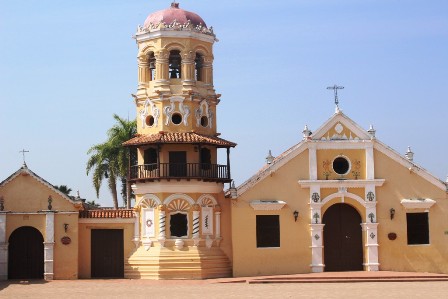
So, Mompox has to have something going for it to make the
journey worthwhile. It does. Founded in 1540 by Alonso de Heredia, the brother
of Cartagena’s founder, it rose to prominence as a trading center. Boats from
the Cartagena would sail up a canal to the Magdalena River and continue to
Mompox with supplies for settlements farther into the interior and would return
with gold and emeralds obtained from the indigenous tribes. Many of the
wealthier citizens of Cartagena escaped the marauding hordes attacking the city
in the early days by moving to Mompox. The prosperity lasted until the early
20th C when the Magdalena silted up and alternate routes were found to the
interior. Mompox was left with elegant houses and churches that earned it UNESCO
rating and a reason to encourage the tourist trade.
Our home for three nights was the lovely Casa Amarilla, a
nicely renovated Spanish villa facing the Magdalena River. Additional draws for
us included silver filigree jewelry made by skilled artisans at prices that made
it an irresistible purchase. We also found a good Italian restaurant, El Fuerte
San Anselmo, run by an Austrian man, just a block from Casa Amarilla and a good
lunch spot on a patio over the river.
Our last day in town, we went searching for the Botanical
Garden, which was supposed to be just a block from our hotel. There was no sign
indicating a Botanical Garden, so we walked another block. Several locals saw us
with our guide book and pointed the way to the open door in the wall that we had
looked through but rejected. That was it. We looked around until an old man
appeared and proceeded to point out the different plants and their medicinal
uses. There were also several birds around, including several Roadside Hawks,
and a family of Venezuelan Red Howler monkeys, with long prehensile tails they
used to swing from limb to limb while they ate leaves off the trees. Our guide
put some cornmeal on the concrete edge of a tank filled with water lilies to
entice the hawks. They swooped down several times to feed. Eventually the whole
family of a big male, a female and a young male came off the trees limbs on
which they were resting and descended quite close to us. The garden looks
completely unkempt, and it is, but I think that encourages the birds and animals
to make it their home. If it were a typical English botanical garden there
wouldn’t be as many hiding places for birds and animals. Perhaps the garden will
one day get a sign indicating it is there and open to visitors. In the meantime,
you may visit and have the place to yourselves, as we did.
If you visit Mompox before new roads are finished linking
the town to the outside world, you too will enjoy the laid back feel and the
many other attractions of Mompox before it is inundated with more tourists than
it can handle.
Return to
Travels
Return to
Introduction