February 2012
Read previous episode
Baracoa,
Don Lino
On the road to Ciego de Avila
Sunday 14
February 2012
As often happens, the Casa Particular we phoned
and reserved was full but we were sent to a friend, who had a nice private
apartment opening onto a patio for us. It suited us well for our short one
night stay. Saturday night is music and dancing night on the Pedestrian
shopping street in Ciego. We walked down to see equipment being set up for
later in the evening but decided going to bed early was the better option.
We saved more wanderings for the next morning.
Long bus trips can be an opportunity to meet fellow
travellers, trade travel stories and get recommendations for towns and Casa
Particulars. The 6 hour bus ride from Holguin to Ciego de Avila passed a lot
more pleasantly and quickly as we got to know an American man from Colorado
and a Canadian woman who has lived in Australia for the past 25 years. Both
were doing bicycle trips and of course we are always interested in their
experiences bicycling on Cuban roads. The woman was travelling to Santa
Clara to join a two week tour run by a Canadian company from Prince Edward
Island.
The American was ending a month of solo travelling by
bicycle, with occasional bus trips to bridge the longer gaps. When he
admitted that he had bicycled the infamous La Farola (the lighthouse)road,
55 km of steep hills from the Atlantic coast in the south to Baracoa, we
knew he was a hard core bicyclist. He said the hardest part was that the
uphill is in two stages and the 10 km of relative flatness in the middle
made him forget there was still a steep pitch to come. He said he took day
trips out of Baracoa with pitches so steep he had to sit far back on the
bike to avoid going over the handlebars. As you all know, I like downhills,
not climbs, and downhills where braking is required are very disappointing.
We even discussed the American
Medical coverage (he doesn’t like the
power wielded by Insurance companies) and politics. He thinks Romney will
win the Republican nomination. He hopes the fact that many of the far right
wing of the Republican Party think Romney is a bit too liberal will give
Obama an advantage.
Sunday was family day, first shopping on the pedestrian streets and
later, visiting the City Park, built at one end of an artificial lake. There
were rides for the children, pedal boats to take on the lake and a train to
take a scenic tour around the park and into the downtown area. The train was
a highlight. Every seat was occupied by families and the line-ups were long
to get on at the stops about town.
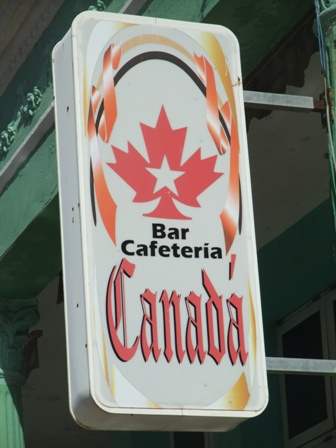
Cafe named Canada
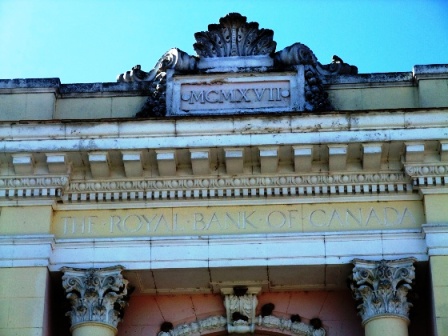
Former Royal Bank of Canada Building
Cuba has an unusual two tier money
system. Government and non-tourist industry workers are paid in Moneda
National Pesos (MN). In 1993, Cuba legalized the American Dollar, and later
introduced the Convertible Peso (CUC) to take the place of the now banned
American Dollar. Roughly equivalent to $1 US or $1 CAD, $1 CUC is equal to
25 MN. Restaurants and Hotels frequented by tourists price everything in
CUC. Smaller, less touristy towns deal in MN and hardly ever use the CUC. If
you want to buy a bun in a bakery or fruit from a street stand, you have to
pay in MN. A meal in an MN restaurant is far less expensive than a tourist
restaurant. Workers in tourist establishments are happy to get CUCs for tips
and salary. It allows them to use the greater buying power of the CUC and
shop in stores with far greater selection than MN stores.
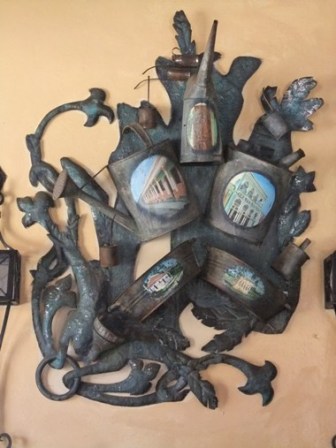
Interesting sculpture in a restaurant
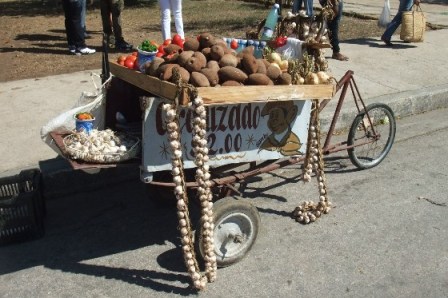
Cart selling fresh veggies at end of park
Sometimes
an establishment will give you the equivalent price in CUC and sometimes
they may not want your business. It gets somewhat confusing. I had a
pedicure from a lady in her private home. She quoted me about 10 MN. I
didn’t have any MN so I offered $1 CUC. We both got a good deal. Our tourist
bus stopped for a short break in a small town, right beside a bakery. Ray
almost didn’t get the cookies he had chosen as the clerk didn’t want CUC.
She finally relented and accepted his tourist money. The solution would have
been to exchange $10 CUC into MN at the bank. We didn’t do that, but after a
few transactions, we now have a little change to spend in MN stores.
Mellow Matanzas, Beach time in Varadero
Varadero, Cuba
Sunday 19
February 2012
We are getting lazy at the end of our trip. Yes, the
tourist buses, Viazul and Transtur, are comfortable but a taxi is more
convenient. You don’t have to take a taxi to and from the bus station, which
is almost always beyond walking distance and you can specify the time you
leave. It is often only a few dollars more to take a taxi and that is what
we have been doing the last few times. The taxi driver who offered his
services to take us to our Casa Particular in Ciego de Avila also offered to
drive us to Santa Clara for $15 CUC each. We accepted and had a comfortable
ride straight to our chosen Casa. We haven’t taken the bus since. Matanzas
isn’t on the direct Viazul bus line. The choice was taking a bus to Varadero
and making a connection on another bus to Matanzas. We choice the taxi again
and cut 1-2 hours off the trip.
Matanzas is a relatively small town
with fewer sights on the ‘must see’ list. The city curves around Matanzas
Bay and is split by two rivers. Matanzas is called ‘The city of Bridges’
because of the 21 bridges over the rivers. There are a few lovely Colonial
buildings around the central Parque Libertad. It didn’t take long for us to
find them all, walking from our very good Casa Particular in the block next
to the park. Our room in Hostal Alma on the second floor of an old Colonial
house had comfortable patio furniture in which to rest after our walks and
was thankfully sheltered from the traffic noise that echoed between the
buildings on either side of the narrow street.
We ate breakfast at Casa Alma
and our dinners next door at Hostal Azul, run by the son and family of
Hostal Alma. We totally agree with the recommendation given by Lonely Planet
for the dinners prepared by a genial woman trained as a chef in Varadero. In
fact, our dinners prepared at the various Casa Particulars we chose in Cuba
were better than the meals we ate at any of the resorts.
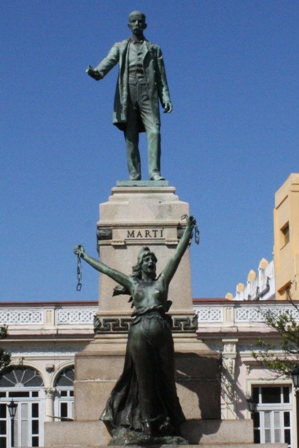
Jose Marti Victory monument
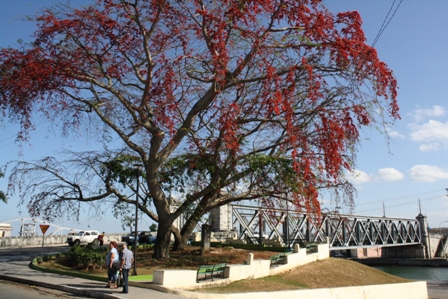
One of many bridges
After
missing out on snorkelling trips in both Playa Santa Lucia and Villa Don
Lino, we tried again. We booked a taxi to take us to Playa Coral, on the
coast half way between Matanzas and Varadero. This is the best spot for
snorkelling from Varadero as well and wave after wave of tour bus arrived
bringing tourists for a snorkel excursion. We were rather concerned at the
number of people in the water, but we didn’t need to be. We hired a guide to
lead the two of us through the corals that begin right at the shoreline and
avoided the areas where the large groups were swimming behind their leader
in a long curved line. The corals were grey and uninteresting but the water
was clear and the fish were there in profusion. The guide made sure we saw
lots of fish by feeding them small bits of banana from a plastic water
bottle. The fish loved it and so did we. Once the tour groups had finished
their ½ hour in the water, they were on their way again and we had the beach
almost to ourselves. We had our own masks and snorkels and had the use of
flippers for the duration of our stay. All the groups come in the morning
before the afternoon winds pick up making the waves over the shallow corals
a bit dangerous. We had our second swim on our own before it got too windy
and discovered more of the area.
One of the hazards of moving from
place to place is leaving belongings behind. We did that twice on this trip
and both times we were lucky. I didn’t discover that my favourite travel
night gown had been left in the room we vacated when we changed rooms at the
Playa Santa Lucia Resort. Inquiries the next morning led to the chamber maid
who had found it and locked it in safekeeping waiting for the owner to
retrieve it. She was as happy to return it to me as I was to get it back.
The second time was the discovery that our masks and snorkels had
been left hanging on an arm of our Palapa sunshade at Playa Coral. We were
planning to take the bus from Matanzas to Varadero the next morning but it
was time again for a taxi ride. We stopped in to Playa Coral on the way and
were met by the beach staff who all knew exactly why we were back so soon.
Sure enough they had discovered our masks and snorkels and locked them up
for the night. Again, our belongings were returned to us in perfect
condition. These incidentsjust confirmed our belief in the honesty of the
Cuban people.
Varadero does have the best beach we
visited in Cuba. The white sand beach stretches for about 20 km along a thin
island connected by a causeway to the mainland on the north coast east of
Havana. The waters off Varadero Beach are clear and warm and perfect for
swimming. Included in our three day package was a ticket for the Varadero
Beach Tour bus which we made use of on Saturday afternoon. We stayed on for
the whole two hour circuit which takes you past all the resorts on the
peninsula. There are more than 50 resorts from simple ones like ours to
super deluxe ones. It is a big development.
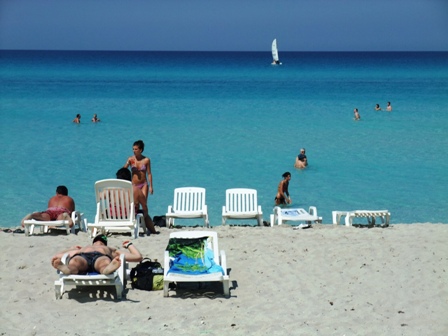
Varadero Beach
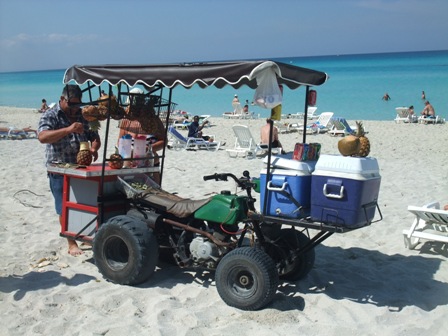
Buy your drinks on the beach
We had chosen Sun Beach
Hotel in Varadero, a moderate sized resort in Varadero town, mostly because
of the price. We had considered two other more expensive options but neither
had rooms available for our last weekend in Cuba. The resort suited our
purpose. It had a nice, small pool area, which we didn’t use, and a good
section of beach across the street from the resort. Our room was fine and
most of the food edible, although hardly gourmet. We ate one night in the
spearate dining room where you reserve and choose from their Italian menu.
The service was good and it was nice to be served but it wasn’t much better
than the regular buffet selections. All of the three resorts we visited seem
to have the same dining room buffet setup and the same menus. At least we
have learned which foods to choose and which to avoid, to go easy on the
drinks, not to load too much food on our plate and to forgo second helpings.
That is the only way we have a hope of returning home without gaining lots
of unneeded weight. Lonely Planet said that 25% of the tourists in Cuba in
2009 were from Canada. The percentage is much higher at the resorts. We have
met people from all over Canada and have enjoyed talking to them.
Would we come to Cuba again? Yes we would. We preferred the simple Casa
Particular accommodation and food over the resorts, but the resorts give the
best access to the beaches. For us, the combination of meeting the people,
enjoying the culture, hiking in the hills and swimming in the oceans was
possible only by making our own way around the island. We are glad we chose
the independent route.
Return to
Cuba Intro
to read about our other trips to Cuba
Return to
Travels
Return to
Introduction