Episode 1: Riding the Chicken Bus Route
Chicken Bus
Click the photo above
to see an album of Guatemala photos. Close the window to return to this
page
Read the next episode
Crossing Borders
Page 1 of 2
Saturday 5
February 2005, Antigua, Guatemala I hear that the
weather back in Ottawa is moderating and temperatures are
even above zero. I think we stayed in Ottawa long enough
to experience the very worst of Canadian cold, for the
first time in five years. Guatemala has provided us with
warm, sunny day’s and cool nights. In fact with
temperatures hovering around 12 C in our bedroom in the
morning in Xela, we miss our warm central heating. Thank
goodness we had enough covers.
That said we are doing very well, despite the usual
minor incidents. I am certainly glad we had insisted on a
minimum of two hours between flights when we flew to
Guatemala on January 20. All three flights were delayed.
Ottawa and Chicago were in the midst of freezing
temperatures and the planes had to be de-iced. The Miami
to Guatemala City plane was delayed while luggage was
removed from the plane and our luggage put on. I assume
that was because all other flights had been delayed. It
was amazing that we arrived only one hour late in
Guatemala City. Our prearranged driver was waiting to
take us to our first Hostal and we unpacked and settled
in for the night. I ripped the flight tickets off our
bags and had a second look at Ray’s. It was a rerouting
tag that indicated his original tags had been lost before
reaching Chicago. American Airlines, despite being a no-frills
airline, had come through for us. The bag had been
carefully routed via Miami on another flight and probably
because of the delay in Miami, made our flight to
Guatemala. We were taking a shuttle bus first thing the
next morning for Antigua so we had not planned on staying
around Guatemala waiting for lost baggage. A minor
disaster was averted.
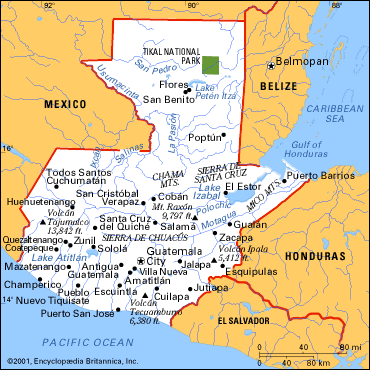
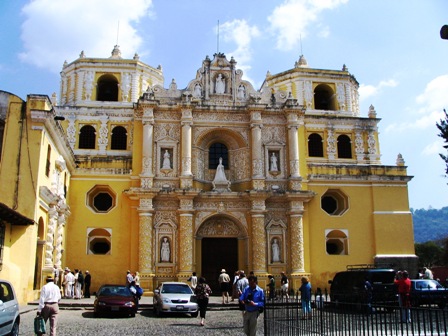 Antigua is a
pleasant town of 40,000 with World Heritage status
because of its Colonial architecture. It reminds me of
our favourite South American towns of Cuenca, Ecuador and
Arequipa, Peru, but before any restoration has taken
place. Antigua is in a valley surrounded by volcanoes.
The city was almost destroyed by an earthquake in 1736
and was never fully rebuilt. On top of that Guatemala
experienced civil unrest and wars from 1960 to 1996 when
peace treaties were finally signed. That means they have
not had very much time and little money for restorations
of their heritage buildings. The streets are quaint,
bumpy cobblestones, the buildings are in need of paint
and several large churches are shells waiting to be
rebuilt. Nevertheless the people are friendly, the basics
are there and eventually Antigua will be even more filled
with tourists than it is now.
It is very
popular now with students coming to take Spanish lessons
in one of the many schools. Most students stay with
families who provide inexpensive room and board, but
there are lots of hostal choices and good restaurants to
choose from. Our first time here we had a nice, basic
room with a bathroom next door, set around a nice inner
patio. The Spanish adopted the Moorish style of
undistinguished exteriors and lovely, cool inner
courtyards and continued this style in Central and South
America. You would never guess how pleasant the houses
are by their blank walls facing the street. Antigua has a
pleasant central plaza with a fountain famous for its
circle of topless women conveniently spouting water from
their breasts; Mother Earth providing the essentials of
life.
The active Volcan
Pacaya is just outside town. We took advantage of a
popular guided hike to its summit. We started out
Saturday afternoon in a bus with 28 others for an hour
and a half ride to the base. We had just started up a
steep incline outside Antigua when the bus groaned and
grinded gears and stopped dead. The bus driver got out,
looked under the hood and announced that another bus
would be coming to pick us up. Like most other
Guatemaltecos, he had a cell phone for communication. We
all piled out of the bus and lay around in the sun until
our replacement bus appeared.
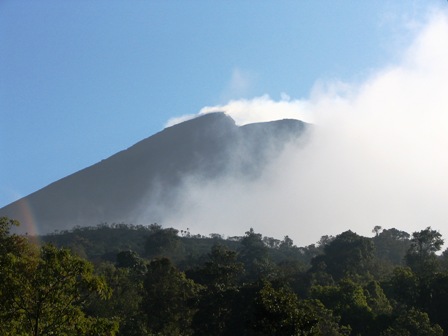 We were rather late starting our hike, but once at
Pacaya, the group hustled up the steep path. We had been
warned that we might not be able to make it all the way
to the top as the volcano had b een very active lately.
There are police wardens at the volcano site who monitor
activity and have the final say as to whether it is safe
to summit. We had heard that others had not been able to
summit the previous day so we were not surprised when we
wer e told we could go no further than half way up. It
did not really matter. It was still a pleasant, somewhat
challenging, walk of over an hour and the volcanic cone
above us was spectacular. The volcano last erupted
violently in 2000 and a vast river of blac k rock was
right below where we stood. The last section of the climb
was over loose black volcanic dust, not an easy climb. We
walked around the olcano getting other views, then
followed our guide slaloming down the soft dust about 100
M. He led us up a g
rassy slope for an excellent view of a spectacular sunset
over the mountains. We waited as the sky grew dark and
watched in wonder as Pacaya sent plumes of flame into the
sky. It was a great fireworks display, but we were
assured there was no danger of a full eruption. Our guide
had a hard time getting everyone to leave when the police
wardens had called an end to the day. We walked down in
the dark, thankful for a well marked trail and our
flashlights, and returned to town.
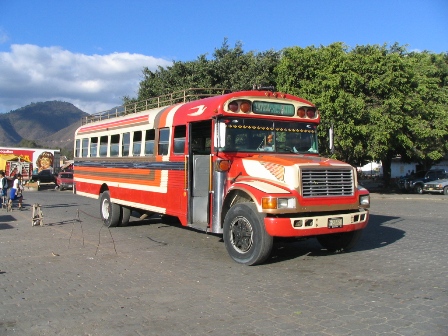
The next day we took the chicken bus to Quetzaltenango
(Xela – pronounced Shayla – in the local dialect).
Retired Blue Bird school buses find new life as public
transportation in Central America. They are designed for
two or three children to a seat and here accommodate the
same number of adult bottoms plus extra children sitting
on laps and people standing in the narrow aisle. Luggage,
bags of produce and live chickens or pigs are strapped to
the roof. The driver careens up the steep winding roads
while his assistant squeezes through t he bus collecting
fares from the passengers. We survived several such
trips, sharing smiles and conversations with fellow
passengers.
We loved seeing the colourful clothing of the mostly
indigenous people. Each community has its own style.
Nearly all the women and young girls wear a wrap skirt of
colourful stripes, or black with appliqued stripes, tied
with a beautifully embroidered belt. Their huipil, a
blouse of variously coloured hand woven cotton, is often
entirely covered with additional embroidery. The younger
men and young boys wear western garb, with a straw
sombrero, but the older hill tribe men prefer the
traditional garb. Some wore cropped pants of red, multi
stripes, with a western or an embroidered shirt. Around
their waist they secured a black and white polka-dotted
blanket that fell just below their knees. In other areas
the men favoured white cropped pants with narrow black
stripes held up with the same kind of wrap belt the women
used around their skirts. Some of these pants had been
colour fully embroidered as well. I would have loved to
take pictures of all of them but they do not pose
willingly.
Seasoned travelers that we are, we still have to learn
to be more cautious in underdeveloped countries. For many
people, we are the rich tourists and we learned the
consequences on our trip to Xela. The bus stopped for a
driver lunch break at a crossroads and a stream of
vendors got on the bus selling food to the passengers.
Ray got off to find a toilet and I didn’t pay enough
attention to what was going on. Ray returned and looked
at his daypack stored in the upper rack. A zipper was
open, his wallet was missing and the vendors were long
gone. When we reached Xela, we notified Visa that our
credit card had been stolen. They were not surprised as
over$1000 CDN had already been charged for cell phones
and other goods. We had to find the local police and
formally report the loss. They dutifully typed up a
report on an ancient typewriter and gave us a copy.
Thankfully our loss was limited to $100 CDN Ray had in
the wallet and his driver’s license and health card. We
have learned to be extra careful of bags left on racks
and we always make sure all zippers are well out of
temptations reach.
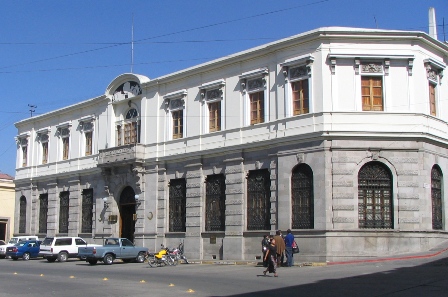 I chose Xela for my Spanish
lessons on the recommendation of my niece Nadia. She
attended six weeks of lessons in Xela, at a different
school, about three years ago. Most students spend one to
three months at these schools. Nadia recommended Xela
over Antigua because of the predominance of indigenous
people and the l ack of tourists. I had arranged to take
Spanish lessons for one week in Xela at Escuela Minerva.
The school arranged a homestay with familia Velarde.
Guillermo (70) and Alma Lily (71) brought up three
daughters and two sons in this multi-roomed house. The
rooms are set around a courtyard that is mainly used as a
houseplant and laundry center. Their oldest daughter
Liliana, a teacher at a local school, and her daughter
Michelle (20) live with them. While we were there we met
another daughter Evelina, who was visiting from Cologne,
Germany where she has been working for several years. We
had meals prepared by Alma Lily in a tiny kitchen next to
their large dining room. We ate the main meal of the day
with the family as soon as I returned from school at 1 PM.
As we were warned, the meals were heavy on carbs and
beans, light on veggies, but always included fresh fruit.
Breakfast was our choice of ‘mush’ , which is oatmeal,
with milk and fresh fruit. A light supper was often eggs
and fresh, mild cheese and some refried beans. The family
spoke Spanish to us, slowly and clearly, and were always
patiently willing to correct my atrocious grammar and
teach us new phrases. We learned that Buen Proveche is
the Spanish for ‘enjoy your meal’.
I attended school Monday to Friday from 8 AM to 1 PM
while Ray tooled around town. Xela is a commercial city
of 100,000 set amongst volcanic mountains at an elevation
of 2335 M. The downtown is centered on a plaza in the
midst of reconstruction with the main commercial
buildings around the plaza waitin g their turn for
restoration. It was an easy 15 minute walk from our place
to downtown and the city was well served by chicken buses
going wherever you wished. Ray seemed quite happy doing
his own thing without my helpful suggestions. I could
have stayed a nother week consolidating my knowledge, but
Xela’s charms only extended to one week for Ray.
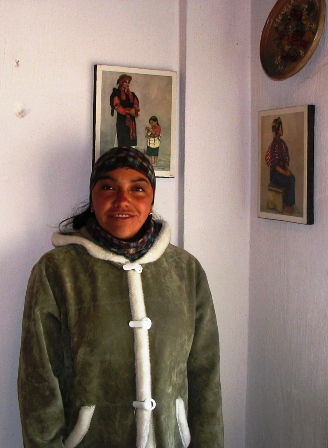 Flor,
Flor,
a young lady of about 30, was my excellent teacher for
the week. She and I shared a tiny room with a table and
two chairs, while another 11 students each shared similar
quarters with their teachers. We had a half hour break at
10:30 when we all piled outside for chats in halting
Spanish, more frequently reverting to familiar English.
Most of the students were 20-somethings preparing for
long travels in Spanish speaking countries. One of the
few middle aged students was was Jane Gittens, who lives
in Victoria. She was at a higher level of Spanish than me
after taking several extension courses in Spanish at
Bishop’s University when she lived in Tomofobia, near the
Vermont border. Despite the intensive one-on-one teaching
method, it was a relaxed and friendly atmosphere.
The first few days were good review for me as they
covered much of the grammar I supposedly already knew and
covered the present tense. Next we tackled the past and
future tenses and I had to work hard to commit all this
new knowled ge to memory, let alone dredge it up while
speaking. At the end of the week, all departing students,
about half of us, were presented with diplomas indicating
our successful completion of whatever level we had
attained. I got a Basic level diploma, one up from
Beginner. I was pleased with my progress and I am trying
to continue doing a little homework each day as well as
speaking Spanish frequently.
In addition to our daily lessons, the school, like
most of the others, introduced us to the local culture wi
th small lectures and trips to points of interest in the
surrounding countryside. Tuesday afternoon, Julio, the
director of the school, gave us a short lecture on the
political and economic situation of Guatemala. Ray
attended with me and was easily able to understand all
the bad news Julio gave us concerning his country. The
main industry, at 60% of the GNP, is agriculture, but 80
% of the land is controlled by large corporations that
still treat their employees as indentured workers. The
service industries, including tourism is next at 25% and
Industry provides just 15% of GNP. With 40% unemployment,
and an unstable government providing almost no social
benefits, Guatemala is still a poverty stricken country.
We visited two hot spring areas outside Xela. One day
we took the local bus to Almolonga 6 km out of town. A
highlight was the ride through the hills to this market
garden town. Small allotment plots, watered by the
underground springs, cover a narrow valley beside the
town and provide most of the fresh vegetables for the
area. We discreetly admired the colourful clothing of the
local women as they got on and off the bus with their
babies tied in slings on their backs.
The Thermal baths
we attended in Los Banos, outside Almolonga consisted of
20 small r ooms in a low concrete building. For Q15 ($2
CDN), a maximum of four people rent a room for up to an
hour. Each room is furnished with a wooden bench and
hooks for your clothes and four concrete steps leading to
a two part sunken bath area. You fill the larger of the
sections with hot natural mineral waters, adding cold to
your liking. The water overflows into the second, smaller
section where you are supposed to soap and rinse yourself
before the final hot soak in the large section. The hot
water is relaxing and the minerals are supposed to do
wonders for your skin.
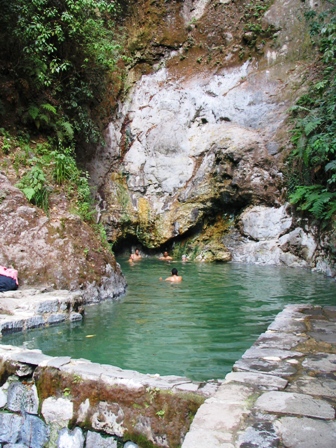 We arranged a second trip to
Fuentes Georgina, an outdoor thermal bath area beyond
Almolonga. This time we chartered a mini bus to take 10
of us to the springs. We stopped in the mountain town of
Zunil on the way to admire their pretty church and visit
the Women’s cooperative selling articles of clothing and
other hand woven textiles. Like areas all over Guatemala,
the handwork is excellent and the prices are low, so we
couldn’t resist buying some of their products.
Fuentes Georgina
was farther up in the hills with several natural pools
set amongst a restaurant and cottages where you can spend
the night. We had left directly from our classes without
lunch so we all headed first to the restaurant. Here we
got a first hand view of workers rebuilding the largest
of several outdoor pools. A major mudslide a few years
ago has finally forced the reconstruction of all but one
of the pools. There was only one open that we did get to
swim in later. It wasn’t very hot except for a small area
where steaming waters trickled over rocks into the pool.
It was fun anyway.
Our guide book talked about a hiking trail to a
viewpoint on top of a hill so before our swim, most of us
headed up a steep narrow trail. It was steeper and
rougher than we anticipated and as we had limited time,
Ray and I decided we would be better off not killing
ourselves and turned around. As it turned out, only one
person managed to reach the top. He said there were
flowering orchids and lots of birds around, so he
considered it worthwhile. I liked the swim.
Our last day in Xela, a group of us were led by a
young local boy on the local bus to a spot outside town
for a walk up to a good viewpoint. The first part was up
a steep paved road past an ambitious start for an
expensive housing project. So far it appears
most of the money has been spent on high walls and a gate
house to keep out the riffraff. We turned off at signs
pointing to a rather remote soccer football field and our
destination, the Chicua, which means a spot sacred to
the local Mayas. The last section was a scramble over
steep rocks to a lookout. The tranquility of the location
was spoiled by very loud lamentations in Spanish. It was
a meld of North American Evangelical religion and a
celebration of a special day according to the Maya
calendar. Our guide said they chose this spot because it
is high and therefore closer to God. It was an
interesting ceremony with a flower festooned altar and
women in local dress with lace manti llas on their heads.
Some of the Maya group continued even farther up the hill
to continue their ceremonies. We didn’t follow.
Next: Episode 1: Page 2
Return to
Travels
Return to
Introduction