May 2012
Click
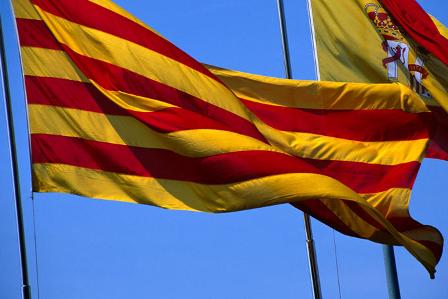
thephoto of the Catalonian flagabove
to see an album of photos
To return to our
website, close the window
Read
Barcelona
2012
Catalonia, Spain May 7-17 2012
“We have time,” I said, “let’s follow that green,
squiggly road on the map up the coast. It looks much more fun than the
red roads.” Thus began our drive through the northern section of
Catalonia on the scenic roads.
Catalonia is
an autonomous region of
Spain in the north-east of the Iberian Peninsula, with the official
status of a “nationality”. We confined our trip to two of the four
provinces of Catalonia, Barcelona and Girona , in the area that borders
France and Andorra to the north, and the Mediterranean Sea to the east.
All the signs we saw were in two languages, Catalan, and Spanish and
sometimes in Occitan as well. We got along well with English and
my tourist Spanish.
We had picked up our VW Polo rented car in
Barcelona and headed north. Yes, there were narrow roads that hugged the
coastline and traversed the tops of mountains, and sometimes I was
tempted to close my eyes rather than look over the side into an abyss,
but the traffic was light and we got what we were looking for. We did
stop whenever we could find a lookout to enjoy the view and we did get
photos just like the guide books show of mountainous Spain.
We made it to Blanes, a resort town with the
longest stretch of sandy beach on the Costa Brava (wild coast), before
lunch. We wandered around the old town and finally made our way to the
long promenade beside the sea. A seafood restaurant right on the
promenade with a Menu del Dia caught our eye. It was a good choice and I
got to practise my skill in deboning a whole fish. I got better at it as
the fresh fish served often came whole.
There are two botanical gardens of note in
Blanes. We chose the Mar i Mares for an afternoon visit. Founded by Carl
Faust, German amateur biologist, in the 1920s, it covers 4 hectares with
spectacular views from its Cliffside location overlooking the
Mediterranean. The variety of plants was mind boggling. There are well
over 3000+ species of plants, both native plants plus from five
continents. It was certainly worth a visit.
Tossa de Mar, a little farther up the coast, was
our overnight stop. We had booked a room on the internet and had written
down all the instructions from Google maps to our hotel. This was the
first of many times we had trouble finding our hotel. We didn’t have
access to a printer to give us a detailed map of the town, we didn’t
have GPS in the car and there was a distinct lack of street signs. We
ended up driving down very narrow streets, dodging tourists who wondered
why we hadn’t read the signs limiting cars to delivery vehicles in the
entire old section of Tossa. We finally found the tourist bureau and got
a good map on which the helpful attendant marked the only way to get to
our hotel. We found the hotel, parked and didn’t drive again until we
left for the next destination. That was the way we operated in most of
the towns on our trip.
Tossa, settled by the Romans, was a pretty town
with a working port protected by towering cliffs on each side of the
village. We had time to visit recently excavated 1st century
Roman ruins and to walk up the hill to enter Vila Vella,
the only example of a
fortified medieval town still standing on the Catalan coast. It
made for a good walk uphill, past old cannons and the ruins of a church,
to a lighthouse, built on the site of a 12th C castle. Of
course, hill walks always include lookouts for photo ops of the wild
coastline.
Girona has one of the largest old town centers in
northern Spain, outside Barcelona. The city, which
has undergone twenty-five
sieges and been captured seven times, now supports a healthy tourist
industry. There are medieval churches to visit, ancient city walls to
walk and lots of restaurants and shops. There was enough to keep us
interested for three days.
Girona Cathedral stands on the site of an ancient cathedral, which was
used by the Moors as a mosque, and after their final expulsion was
either entirely remodeled or rebuilt. The broad eighty-six steps leading
to the main entrance were in the process of being covered with grass
carpeting and flowers for the annual festival of Flowers, due to start
the next weekend. Unfortunately, we were leaving the day before the
festival started so we only saw the activity of the florists decorating
every historical building in the old town. The interior of the Cathedral
was impressive, and includes the nave, built in 1416, has the widest
Gothic span in the world. The cathedral museum, included with our entry
ticket, had an interesting collection of 11th- to 12th
C tapestries and altar pieces, elaborately worked in gold and silver .
Outside another church, Sant Feliu, was a group of young Dutch women,
all volunteers, busily weaving straw onto frames to be used as
backgrounds for Flower Festival displays. Not as large as the cathedral,
the 14th C Gothic church is the most popular church for
Girona parishoners.
The
old fortifications are another popular sight. Historically, these have
played a vital role in protecting Girona from invaders for hundreds of
years. Originally constructed by the Romans in the 1st century BC they
were rebuilt many times and gradually absorbed into the city. Enough of
the walls have been restored that it is possible to walk on the walls
and climb some of the towers.
The
Benedictine church of Sant Pere de Galligants now houses the
archaeological museum. Displays traced the settlement of Catalonia from
pre-historic to medieval times, illustrating each era with artifacts
discovered in many sites in Catalonia.
We discovered that one of Salvador Dalí’s
homes was in Púbol,
a small village a short drive from Girona. Proclaimed the
leader of the Surrealist
movement in 1929, Dalí found the perfect retreat for himself and his
wife Gala in the Castle of Púbol. He moved to the castle in 1930 and
lived there at least six months of the year until his death in 1989. In
1982 he was named “Marquis of Dalí of Pubol” and his wife Gala is buried
at the castle. Dalí restored the castle, adding rooms inside and
terraces outside to showcase his imaginative art works. Casa-Museu
Castell Gala Dalí was the first of three Dalí museums we visited. We
never got tired of his collections.
Our destination after Girona was Figueres, the
birthplace of Dalí.
We made a change in our driving route to detour to Port Lligat, on a
small bay next to Cadaqués.
Dalí often visited
Cadaqués in his childhood, and later kept a home in Port Lligat,
where he and Gala lived when they were not in
Púbol. We arrived to
find that we needed a reservation to visit Casa-Museu Salvador Dalí
and the next available time was three hours from then. We decided our
only alternative was to backtrack to
Cadaqués, just a few km
away for lunch. This pretty resort
town on a bay in the middle of the Cap de Creus peninsula was
called the St Tropez of Spain in the 1960s because of the crowd who
flocked to the village every summer hoping to catch a glimpse of Dalí.
It was a pleasant detour, made more so by finding a restaurant serving
one of the best meals we had eaten in Spain, for a very reasonable
price.
We found out why reservations were needed at
Casa-Museu Salvador Dalí.
The house has a
labyrinthine of small rooms, none large enough to hold more than ten
tourists and a guide, who led us through a succession of rooms, linked
by narrow corridors and changes of level. Windows in each room were
designed for maximum natural light and to give a view of Port Lligat bay
below the house. Art covered the
walls in every room and sculptures decorated exterior terraces and a
swimming pool area. We took lots of photos but unfortunately they were
on the memory card in Ray’s stolen camera. You will have to visit
yourself to see an imagination run wild.
Figueres, the Catalan for Fig trees, is notable
mainly for Teatre-Museu
Gala Salvador Dalí, a large museum designed by Dalí himself. The 19th
century theatre, bombed in the Spanish Civil War, remained in a state of
ruin for decades until Dalí and the mayor of Figueres decided to rebuild
it as a museum. The museum,
opened in 1974, also occupies buildings and courtyards adjacent to the
old theater building. A wild, eclectic collection of Dalí’s art still
leaves room for works by other artists, including a small gallery
devoted to fellow Catalan artist Antoni Pitxot, who became director of
the museum after Dalí’s death. We hadn’t seen such a large crowd
of tourists since we left Barcelona, but we were able to avoid the worst
of the congestion by exploring the museum in the opposite direction as
the big tour groups. Some of the most interesting exhibits were
works carried out by the
artist expressly for the Theater-Museum, including a Mae West Room, best
viewed by lining up for a look on a raised platform, and the Rainy
Cadillac; a car with a
Botticelli type nude standing on the hood and gruesome figures seated
inside. A side gallery, inaugurated in 2001, contained a fabulous
display of opulent jewels designed by Dalí. We loved the
ruby lips with pearl teeth and the gold spider pin, amongst others.
It was time to move on. We reserved a room in a
B&B near Puigcerdà in
the Pyrenees, right on the border with France and only 67 km from
Andorra, for our last three nights, hoping to hike in the mountains
before heading to Barcelona airport. To get to Puigcerdà
we made a tour with stops in three medieval villages on the way. Besalu
gave us more than we anticipated. We arrived early to vendors just
setting up sales table of books and other goods for the day in front of
the church of Sant Pere,
consecrated in 1003. We thought there were far too many
restaurants for the size of the town, but we were early. The buses only
pulled in as we were leaving. We had the old streets to explore by
ourselves. We walked across a
12th-century Romanesque bridge over the Fluvià river, passing through a
tower gateway at its mid-point.
Sant Joan
de les Abadesses sounded
interesting for its monastery, founded by Wilfred the Hairy, first count
of Barcelona, in 887. This was one of the first nunneries founded in
Catalonia, and its first abbess was Emma of Barcelona, daughter of
Wilfred, who directed the convent from 898 – 942. We arrived in the
municipal building next to the abbey for the opening of a photographic
exhibit of abandoned workshops. We were disappointed they did not offer
us a glass of champagne the others were enjoying. There was also an
interesting exhibit of scale models of Romanesque churches in the
area. By the numbers displayed, you could spend a whole trip just
seeking the churches out.
It was Sunday, the worst day of the week to find
a decent meal. Ripoll, the largest town in the region was no exception.
We were lucky to get souvlaki sandwiches to eat in the plaza in front of
Santa Maria de Ripoll, a
Benedictine monastery founded by the count Wilfred the Hairy in 879, who
is buried in the monastery. We had hoped to visit the monastery but it
was on its long lunch hour. We moved on.
It was another scenic drive through the mountains
to Puigcerdà; a green
marked road all the way. We climbed up into the clouds, hoping that
there would not be many cars passing on the way; there weren’t. It
started to rain, and then poured. Could this be our fate for the end of
our trip? We came down out of the clouds to spectacular views of the
snowy peaks of the Pyrenees and arrived in Puigcerda just as the skies
opened again. We stopped at the tourist bureau to get better directions
to our hotel than the ones Google provided and had to wait in the car
until the deluge ended.
We did manage to get good directions and found
our rural hotel in Age, a tiny village 2 km outside Puigcerdà. We were in Cerdanya, an historical region in the Eastern
Pyrenees, divided equally between France and Spain. The area is the
largest valley in the Pyrenees and with lots of sun, supports both a
large market garden region and a resort area aimed at skiers in the
winter and golfers, horse riders and walkers in the summer. This
accounted for the great number of new holiday homes and condos built
throughout the valley. No one was around but a note on the front desk
directed us to our room. Cal Marrufès
B&B was a renovated farmhouse with 14 comfortable rooms, only two of
which were occupied at this time of year, and nice seating areas outside
in the yard. The rain had stopped. We left our luggage in our room and
headed to Puigcerdà, in search of an evening meal. The town, founded in 1178, is
built on a steep hill, all the better to see your enemies before they
attack, with streets twisting every which way to the center of the town
at its apex. Of course we got lost, discovered new territory and with No
Parking signs all over, we got out and walked to
Torre del Campanar, a 12th
C bell tower, all that remains of a parish church destroyed in the 1936
Civil War. A few
locals were still enjoying the return of the sun in a nearby plaza but
all the restaurants had closed their kitchens for the day. We finally
found one serving tapas and sat down to enjoy a variety of snacks with a
half bottle of wine.
We met our host, Lluis Bosom, in the morning.
Besides Cal Marrufès,
he runs several other self-contained holiday homes in the area. He
suggested a good walk for the day would be to the Col de Cadí.
To get to the start of the walk we had to drive west towards Andorra and
get to Estana, a remote mountain village. This was the narrowest and
steepest road yet. There were few turnoffs should we meet another car on
the road. The one time we did, the other car backed up to let us go
ahead. Perhaps they recognized a tourist and knew to get out of the way.
It took us about an hour to hike up the path from the village to an open
meadow. The day was warm and sunny and the views were spectacular but we
realized this was not quite our destination. It wasn’t much further but
it was worth the walk. Another meadow ended at the base of towering
cliffs with small glaciers between the peaks. We returned to our car and
drove back towards our B&B, turning off to a restaurant recommended by
Lluis in an old train station just south of Puigcerdà.
We relied on Lluis again for another walk the
next day. He directed us to Brangoli, another mountain town a little
east of Puigcerdà, in the
French section of Cerdanya. From there we followed a well marked path
through the woods and up almost past the tree line, where we saw
the little stone
Santa Maria de Bell-lloc
Church. Dating from the 13th C, it was at one time on one of
the routes of Saint James to Compostella. Restored by the local
community, it is still used for special occasions. Our eyes had to get
used to the dark interior before we could see the tiny altar in an
alcove and a cross help up by a wood stump with two branch ends carved
in the shape of upturned hands. We enjoyed the 360˚ view of the Massella resort ski hills and the mountains surrounding
Puigcerdà.
Lluis
had warned us to watch carefully on our drive down the mountain from
Brangoli and not miss the sign for the Dolmen, also known as a portal
tomb, most date from the
Neolithic period (4000 to
3000 BC) although there were no signs authenticating the age of this
one.
We found the Dolmen. The huge stones were in place guarding this
ancient burial site but there were no bodies or urns that we could see
inside.
Lluis also suggested another restaurant for lunch
in the village of Meranges, high in the mountains west of Puigcerdà.
We found the town and the restaurant but it was closed for the day. At
least we had enjoyed seeing more of the Pyrenees. We decided the best
option was to return to the Station Restaurant where we had eaten the
day before. The staff was glad to see us and we enjoyed the meal. They
told us that the next day, Wednesday was their day to close, but it
didn’t matter. We were heading south towards Barcelona the next morning.
We took the quickest route south, still very
scenic. There were several tunnels through the mountains including one
that was 5 km long. We found the route to Montserrat Monastery, where we
planned to spend most of the day. It was another drive up a steep hill
to reach the monastery, perched in the serrated hills at 1,236 M. We
hadn’t passed or been passed by many cars on the way up, so we were
surprised to see the parking lots filled with tour buses and private
cars. Access to the monastery is by road or cable car, or by train from
Barcelona. Most people came in a tour bus.
Catalonia’s holiest place, it is surrounded by
chapels and hermit’s caves. The first chapel was first mentioned in 9th
C, and the monastery, Santa Maria of Montserrat was founded in the 11th
C. Destroyed in 1811 when the French attacked Catalonia in the War of
Independence, it was rebuilt and repopulated in 1844 and became a beacon
of Catalan culture during the Franco years. Benedictine monks still live
there but 99% of the people we saw were tourists.
People were lined up outside the courtyard
leading to the basilica, one line led to the interior of the church. The
other line was waiting to view the small wooden statue, La Morenata
(Black Virgin), carved in the 12th C, she has been adopted as
the Patroness of Catalonia. We decided the wait to stand in front of La
Morenata for five seconds wasn’t justified. A service was in progress in
the Basilica but we were able to walk around quietly viewing some of the
side chapels.
There are a multitude of walks in the hills
around the Monastery, some very difficult. Funiculars can whisk you up
to visit chapels and caves on top of the mountains. We had time only to
take a short walk past memorials to people important for their works in
Catalonia, including one to Pablo Casals, the revered cellist. We made
it up to a cross overlooking a cliff and visited a small chapel in a
quiet place in the hills.
Leaving Montserrat we drove to Barcelona airport
to return our rental car and caught a shuttle bus to our hotel near the
airport next to a shopping center. The restaurant choice wasn’t great
but we found a newly opened Chinese buffet that wasn’t bad.
Our early morning shuttle bus was there on time
to take us to the airport for our flights back to Ottawa. Except for the
robbery of Ray’s day pack in the airport, our visit to Spain and France
went very well. We look forward to our next adventure, whatever that may
be.
Read
Barcelona 2012
Return to
Return to
Spain Intro
Return to
Return to
Introduction