May 2012
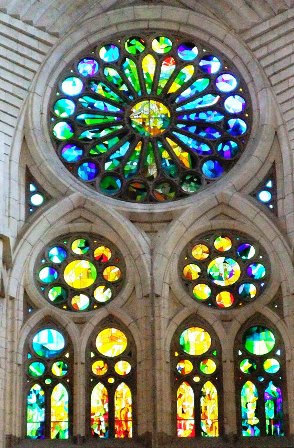
Click
the photo of a Sagrada Familia window above
to see an album of photos
To return to our
website, close the window
Read Catalonia: On
the Trail for Dali and the Pyrenees
Barcelona Spain May 2 – 7 2012
Thank goodness for suitcases with wheels. We
don’t have to carry everything on our backs any more. We had a quick and
comfortable ride from the airport to Plaça
Catalunya, right in the center of Barcelona. The walk to our
simple hotel in the oldest part of the city is easy. We have good
walking instructions and we even have time to stop in the plaza beside
Barcelona Cathedral and take some photos. We will get to know all these
narrow, winding streets with its numerous, interesting plazas well in
the next four days.
As soon as we have checked into our room we are
off again exploring. The place to be on this sunny afternoon is La
Rambla, a wide pedestrian walkway in the middle of the road leading from
Plaça Catalunya right
to the port on the Mediterranean. Everyone else has the same idea. We
have never seen so many tourists in one place, but everyone is polite
and friendly. Every corner has flower shops, souvenir shops and a Living
Statue, busking for a living. There are large historic buildings to
admire and the Central market with tempting displays of foodstuffs,
Tapas (Spanish snacks) restaurants and booths selling fresh squeezed
fruit juices.
We stopped at a booth on La Rambla advertising
various entertainments and bought tickets for a guitar concert scheduled
for the next evening in a local church. That was a great choice.
Barcelona 4 Guitars were not only accomplished musicians; the two men
and two women proved to have a sense of humour, to the delight of the
audience. There was a running gag about a worker wandering past the
musicians, disturbing their play and contests between the musicians as
to who could play the most unusual instrument. The performance ended
with an unexpected piano solo by one guitarist and an operatic aria by
another. They got a standing ovation.
We ate well in Barcelona. We decided to follow
Spanish tradition and have our main meal in the middle of the day. The
well-priced Menu del Dia usually includes three courses and a glass of
wine. How could we resist. Our evening meal was either Tapas in a
restaurant or a crusty bun with a piece of cheese, a tomato, sometimes
an avocado, eaten in our room and washed down with a bottle of wine. We
never did make it to late night dinner, which doesn’t start until after
9 PM.
Antoni Gaudí
brought architecture to the forefront in the early part of the 20th
Century. We visited most of the buildings, now UNESCO World Heritage
Sites that Gaudí
designed in Barcelona and were amazed by his imagination and engineering
expertise. Most were within an easy walk from our hotel. We found we
liked using the audio guides available in most of the Barcelona
buildings we visited. We could take our time wandering in and outside
the buildings and understand much more of the significance of the
features.
Casa Batlló
has probably the most photographed facade of Gaudí’s
houses. Gaudí was
commissioned by Batlló,
a wealthy textile industrialist, to remodel his existing building to be
unlike any other house owned by his family. He got his wish. Finished in
1906, the design of the house is said to symbolize St George, the patron
saint of Catalonia, killing the dragon. It isn’t hard to imagine that
dragon coiled over the roof, the ceramic roof tiles forming the dragon’s
scales, with the white ceramic cross on a rooftop turret plunged into
its back. The chimneys on the roof were not just utilitarian, they are
each a work of art. As in all his houses, Gaudí
designed all the interior decorations, from banisters, to windows and
doors, to the smallest bolt. We found the house fascinating, with its
many room, exterior terrasses and parabolic arches in the attic.
Just
north of Casa Batlló
is Casa Milà,
Gaudí’s eight story
apartment building. Like most of his buildings, there are no straight
lines. Every surface undulates. Even the intricate wrought iron
balconies hug the curves of the building. On the roof are more of those
fantastic chimneys.
A few blocks to the east of Casa Milà
sits Gaudí’s last
masterpiece, the still unfinished Sagrada Família
Basilica. A lot of work is going on, starting and finishing a third
facade, spires and parts of the interior. Even this work in progress is
fascinating. There was so much to see; the Passion and Nativity facades
were covered with sculptures, the pillars inside the church made the
area more like a forest of trees than a mere church, the use of windows
for natural light was mind boggling. No wonder when we think of
Barcelona we think of this wonderful church.
Eusebi Güell,
another wealthy industrialist, whose father became rich with his Cuban
enterprises, was the revered patron of Gaudí.
His home, Palau Güell,
was Gaudí’s first
major commission and made his reputation. Gaudí
was told to spare no expense and he didn’t using the finest woods,
materials and skilled workmen available. It was built in the time of
horses and carriages, so the main entrance leads to a spiral ramp
bringing horses down to the elegant brick livery stables. Those were the
days of grand living. Visitors were invited to the house to hear
concerts performed by an orchestra with choral accompaniment or enjoy a
recital on their elaborate organ. The house had deteriorated over the
years and required restoration that just finished last year. I was
impressed by the care taken to ensure that all work was done to original
plans and using authentic materials.
There
is more to see in Barcelona besides Gaudí
designed buildings. We didn’t have time for everything but we did see
the beautiful Barcelona cathedral, with its carvings and St George
slaying the dragon fountain. We admired many of the other mansions and
public buildings. It is no wonder that tourists throng to Barcelona.
Montjuïc,
named for a Jewish Cemetery once located on the hilltop, is now parkland
and home to both the Olympic Stadium and the National Museum of Catalan
Art (MNAC). It made a good day’s outing for us. We reached the top via a
funicular railroad that starts at one of the Metro stops a short walk
from our hotel. Our first stop after arriving on the hill was the Fondacío
Joan Miró, an art
gallery conceived by Miró
and opened in 1975. Much of the permanent collection was donated by Miró
but works by other artists and temporary exhibits are also encouraged.
One of our favourites was a fountain by Alexander Calder, a friend of
Miró, which runs not
on water, but on mercury. There
was an interesting exhibit of photography from one of the first people
to take the bird’s eye or worm’s eye view of objects, especially
buildings and nature. Once again we were amazed at the breadth and
variation of Miró’s works. I
couldn’t resist buying a T-shirt screen printed with one of his more
famous paintings, “Tear with Nude Woman”. Cameras were not allowed
inside the building so we were limited to pictures of his sculptures on
the roof and exterior of the gallery.
Nearby was the Olympic Stadium, built for the
1936 Olympics, which were subsequently cancelled, and refurbished for
the 1992 Olympics in Barcelona. We had a look around the huge arena and
had lunch in the cafeteria before moving on to the National Museum of
Catalan Art (MNAC). We had been taking advantage of Senior’s entrance
rates in all the public buildings and were pleased to find the Museum
was free for us. We didn’t try to see all the collections; we can only
take in so much in one day. We did view the special exhibit of Gothic
art from the 14th C, interesting for its detail, colour and
technical skill.
We finished with the modern Catalan Art
collection, which included many works by artists of renown.
The front entrance of the MNAC gives a sweeping
view of fountains at the base of the museum, Plaça
d’Espanya with its own grand fountain, built for the 1929 International
Exhibition, and Las Arenas Bullring, now a shopping and entertainment
center. The stairway below the museum is a favourite location for
wedding photos, such as the wedding party we witnessed posing in the
sun.
Eusebi Güell
had grander ideas than just his mansion, which was right next to the
fashionable La Rambla. He proposed that Gaudí
design an upscale housing development on a rocky hill with beautiful
views and none of the noxious fumes of the city center a short distance
to the south. Unfortunately not enough people were ready for Gaudí’s
modern styles and the development was not a success. Besides the Güell
home, only two others were built, neither designed by Gaudí, and because
one of the houses could not be sold, Gaudí moved in himself. The failed
project became a public park with walkways and pavilions designed by
Gaudí. It remains popular to this day, especially on warm, sunny
Sundays, when we took the metro north and walked up the hill to one of
the entrances. There were numerous paths to follow, leading to lookouts
with views of the city and neighbouring hills. The stonework still spoke
of Gaudí’s
imagination. The brick and stone walkways were supported by pillars,
each of which was topped with plantings. Entrance pavilions, looking
like Gingerbread houses sat next to an elaborate wrought iron gate.
Broad stairways led up to a colourful dragon fountain, where everybody
takes turns posing for a photograph. Benches with curved backrests
decorated with broken ceramic mosaics snaked across a slope above the
main entrance. Even the support pillars and the ceiling below the curved
benches had elaborate decorations.
We still had time our last day to explore the
Barcelona Port Vell (Old Port). We walked the broad promenade, Rambla de
Mar, past the old Customs house and the Monument to Christopher Columbus
that marks the spot where Columbus came ashore in 1493 after returning
from his voyage to the Caribbean. He brought with him six Caribbean
natives who were baptized as Christians in the Barcelona cathedral,
amidst much pomp and ceremony. You can visit the largest aquarium in
Europe in Port Vell, watch an Imax film, visit a maritime Museum or
learn more about Catalan history, but we were content to just walk along
the shoreline, enjoying the sunshine. It was a pleasant way to end our
visit to Barcelona.
Read
Catalonia: On the Trail
for Dali and the Pyrenees
Return to
Return to
Spain Intro
Return to
Travels
Return to
Introduction