Ray and Jeanne in Oz
Episode 4: Westward Ho
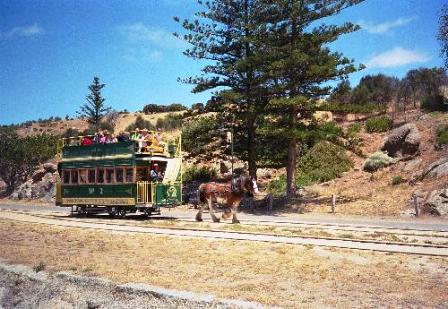
Trolley ride to Granite Island at Victor Harbour
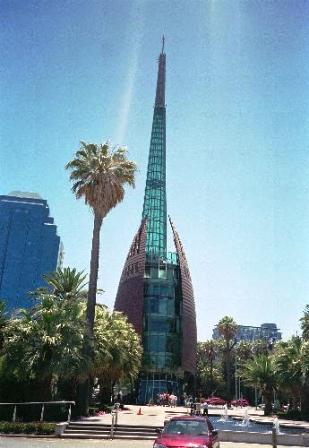
Swan Belltower in Perth
Read Previous
Roads and Rocks
or next
Of Mice and More Kms
Tuesday, January
20, 2004, Adelaide, South Australia
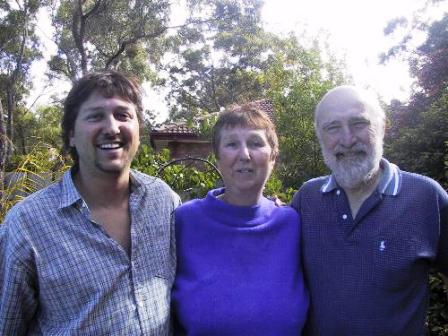
Dan with parents Carol and Eric Hobson
We are well and
nicely tanned at this point in our journey. Now that we
are back in Adelaide and enjoying the hospitality, not to
mention the computer, of Carol and Eric Hobson, friends
of Neil and Claudia Carver, it is time to start writing
again.
We left Adelaide in early December to take up
residence in an RCI exchange condo in Goolwa, a beach
resort town on the Fleurieu peninsula south of Adelaide.
Our drive there was trough the McClaren Vale wine
district, necessitating regular stops to sample the local
produce. One of the highlights was a visit to McClaren
Vale Olive Grove. They are a small operation specializing
in delicious hand picked and marinated olives and top
quality olive oil. The few bottles I bought were enjoyed
for special occasions later in our trip.
We had a good, relaxing visit in Goolwa, even though
we only had one hot, sunny day. Instead, we enjoyed long
walks on the beach, swims in the resort pool and short
drives through the surrounding countryside. The two-bedroom
condo was a perfect size to share for a few days with
Janet and Bob Trotter, our friends from Ottawa. Bob is an
Ottawa Bicycle Club friend of Ray and you may remember
that Janet is the keen birder who was in Oz for a three
week birding excursion. We couldn’t offer them a huge
assortment of exotic birds, but we did have penguins. The
tiny fairy penguins, also known as blue penguins, the
same species we saw in New Zealand, come ashore each
night in nearby Victor Harbour. The penguins nest on
small rocky Granite Island connected by a causeway to the
mainland. People are free to visit the island during the
day, but for the penguins’ protection, you must be in a
guided tour to see them in the evening. We arrived at
dusk and after viewing a film about the penguins in this
colony, we went outside to await their arrival. At first
we didn’t think they were coming, but then we heard them
calling to each other and small groups of birds were
waddling their way to their nests and being greeted by
their mates. They are funny social little birds and we
have never tired of watching their antics.
Janet and Bob left us after a few days to visit
Kangaroo Island, a 45 minute ferry ride from the tip of
the Fleurieu peninsula, and we followed them shortly
after. We crossed paths once more at the ferry on the
island and were pleased to find they had enjoyed their
stay as much as we later did. At least half of the island
is National Park land and being far from the mainland,
the animals and birds have thrived. We had kangaroos
and wallabies wandering around our Caravan Park and
resident koalas in the trees. Yes, koalas are cute fuzzy,
non-threatening little bears, but they can be noisy at
night. They sound like snuffling, grumpy old men when
they decide to trade one roost in a Eucalyptus tree for
another tree.
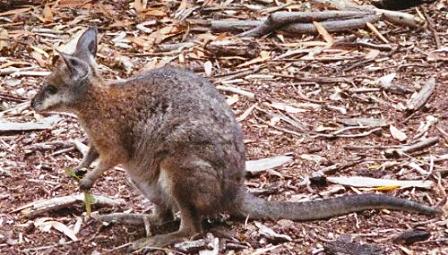
Wallaby
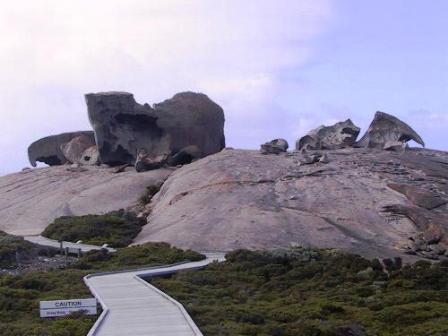
Remarkable Rocks, Kangaroo Island
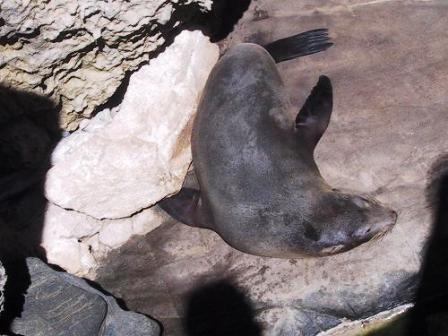
sleepy seal
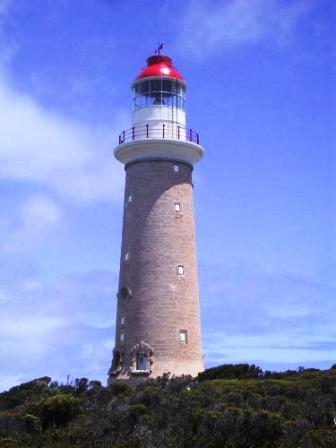
Kangaroo Island lighthouse
Kangaroo Island was great for us walkers. We followed
trails in the Flinders Chase National Park next to our
Caravan Park to view the Remarkable Rocks, a collection
of huge granite boulders, termed Inselbergs, on cliffs
overlooking the sea. At the nearby Admiral’s Arch we saw
a colony of New Zealand fur seals frolicking on the rocks
below this huge rocky archway. Another day we
walked through Eucalypt forests to a narrow cove on the
ocean to explore small caves in the limestone cliffs. We also visited a
few of the lighthouses on the island. Near Cape Borda
lighthouse we walked down an extremely steep path to a
rocky cove where ships would drop off supplies for the
lighthouse keepers every three months. The keepers had to
hand haul the supplies back up the path we had trouble
walking down. Eventually they built a rail track and used
a horse to haul their goods up, but even that must have
been challenging.
Platypus have been introduced to the island and have
thrived without any natural predators. From our Atherton
Tableland experience, we knew that the best viewing time
was at dawn or dusk. We chose dusk. We left our campsite
after an early supper and drove 16 km into the deserted
park to the pools where the platypus live. We followed a
5 km trail around several likely pools but there was nary
a ripple to suggest anything lived there. We finally gave
up, as it became dark only to experience the most hair-raising
trip back to our campsite. All the Roos come out at night
just to scare tourists. They line up along the road and
then dare each other to play chicken with any passing
vehicle. At one spot we could have hit 6 in one blow, if
we had wanted too. Needless to say it was a slow trip
back.
Of course, Kangaroo Island is a birder’s paradise as
well. We visited one of the wetland areas on the island
to view Cape Barren geese, but I am sure what we saw was
no comparison to what Janet and Bob identified.
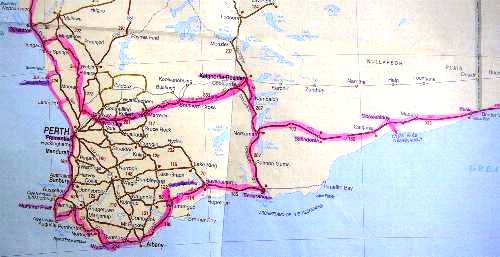
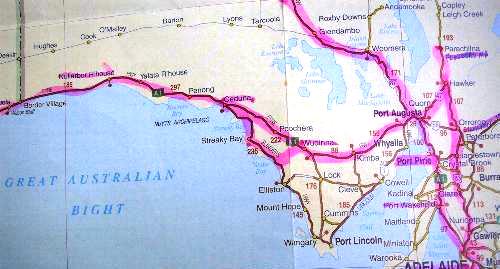
Finally, it was time to leave the tranquility of
Kangaroo Island and head west. We had the infamous
Nullarbor drive ahead of us, but we found the crossing
easier than the road from Cairns to Alice Springs. The
roads were paved, two lane all the way, and there was
more traffic. Instead of seeing other vehicles every half
hour, we met others every five or ten minutes; positively
crowded! The roadhouses were also more frequent and a
little more elaborate. We made good time on the roads,
although we didn’t push it. We got off the ferry from
Kangaroo Island in mid-afternoon Monday and reached
Esperance in Western Australia at noon the next Friday.
In case you were wondering, Nullarbor is a bad
translation of the Latin meaning No Trees, and for a great
portion of the road, it is true. The Nullarbor Plain is a
vast limestone shelf that was once part of the ocean
floor. The soil is almost non-existent on most of it,
hence just small bushes dot the landscape, no trees.
Because it is so flat and barren, the winds have free
rein. It was so windy when we stopped overnight at some
of the roadhouses that we resorted to staying in a cabin.
We didn’t relish being blown away in our tent.
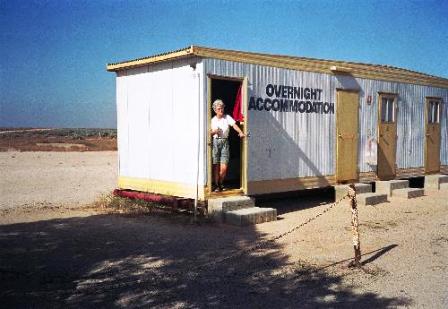
Cabin motel on the Nullabor
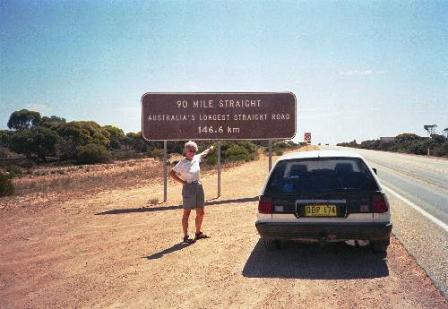
90 Miles of Straight Road
A section of the road
includes the longest stretch of straight road in Oz,
possible the world. It is 146 Km, (90 miles) without a
bend; very good for making time, although Priscilla’s top
speed was the posted limit of 110 km/hr. There is a sign
at one end of the Nullarbor cautioning drivers to beware
of crossing Roos, Emus and Wombats (a weird cross between
a koala and a ground hog) for the next 1152 km! There
were even sections that warned of stray camels. We saw a
few emus but we managed to avoid hitting them.
Both Western Australia (WA) and South Australia (SA)
are very protective of their farming industry. At the
border going west between the two states is a checkpoint.
You cannot bring any fresh fruit or vegetables across the
border. This necessitates calculating carefully how much
food to bring with you on the drive and furious eating of
the last apple and orange before reaching the border. WA
also listed nuts on their forbidden list so I went around
to other campers at our last caravan park offering
handfuls of our nut and raisin snack mixture. The trip
from west to east is a bit easier as the checkpoint is
right before the town of Ceduna, which has a well stocked
supermarket. It was still another 1000 km to the nearest
supermarket on the westward trip. Luckily we were
prepared with freeze dried dinners, because the roadhouse
food was overpriced and not gourmet.
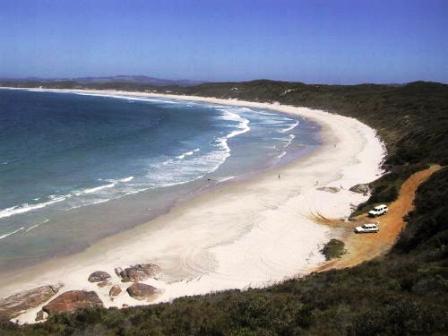
Esperance Beach
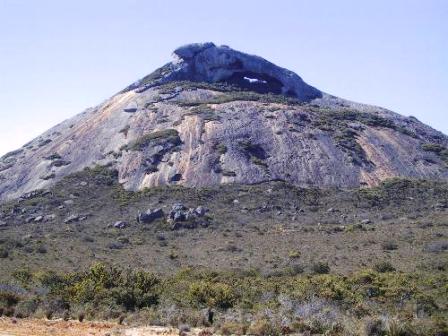
Frenchman’s Peak
Our first stop in
WA after the Nullarbor was Esperance, a pleasant
community of 6000 on the coast. After sitting in a car
for so many days we were glad to take advantage of the
walks in the area. The coast is lined with hard packed
white sand beaches, the favourite for 4WD vehicles, but
not Priscilla. We walked instead, along the beach, over
the rocky outcrops in Cape Le Grand National Park, and
hiked to the top of Frenchman’s Peak to enjoy the
view. Many of the place names in the area honour of
Captain Baudin of the French ship Geographe which met up
in 1802 with the English Ship, the Investigator, under
Matthew Flinders in Encounter Bay, near Goolwa is SA. The
story goes that but for the fast thinking of Flinders, Oz
would have been a French rather than an English colony.
The French ship charted much of the south coast and their
contributions lives on in the names given to the towns
and parks.
Australian towns have a Christmas tradition that Ray
and I was happy to participate in. The Sunday before
Christmas the whole community meets, usually in an
outdoor location since it is Oz summer, to sing Christmas
Carols. We were given candles and songbooks when we
joined other Esperants in an outdoor amphitheatre Sunday
evening. Accompanied by a local brass band, a soloist and
a quartet, we sang many of the familiar carols along with
Aussie versions of old chestnuts. I especially liked Six
White Boomers (kangaroos) and beach versions of dashing
through the snow. It actually got to feel a little like a
northern Christmas as the temperature dropped that
evening. We needed all our fleece and Gortex jackets to
ward off the wind and cold.
We took a detour inland from Esperance to visit the
hill regions of WA. The Stirling Ranges and Porongurup
National Park looked inviting to hikers. On the way there
we stopped for a coffee break in the small town of
Ravensthorpe. We started talking to two women and
discovered one of them had painted a mural on the wall of
the local grocery store. We were impressed by the
depiction of the history of the town, painted when our
acquaintance was 70 years old.
Porongurup
National Park was our choice for hiking. There were few
people around as we followed two different trails to
rocky outcrops with views of the nearby Stirling Ranges.
A steel ladder firmly anchored to the side of a bald rock
reached one summit. It even had a protective screen
around the ladder to prevent possible falls. Even Ray,
who doesn’t like heights, liked climbing that ladder.
From Porongurup NP we headed for Walpole, where we had
reserved a room in a hostel for Christmas. On the way we
detoured to Frenchmen’s Bay, in Albany, to explore their
versions of natural stone arches in the sea cliffs and to
witness crashing waves send steamy spumes through
blowholes in the cliffs, like the whales that cruise
those coasts in the Oz winter.
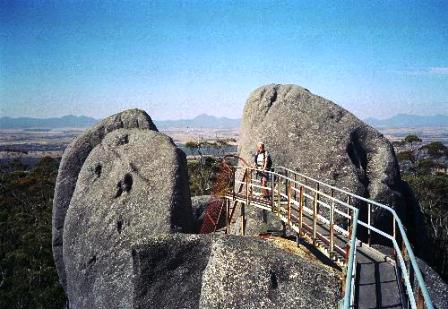
hikinng in Porongurop NP
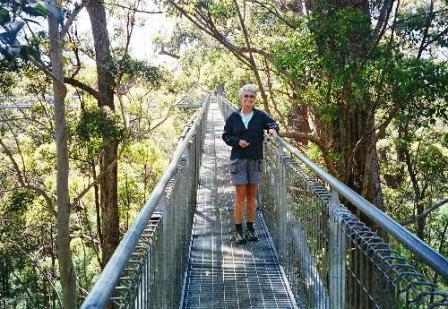
Valley of Giants bridge
Walpole
is another small town along the southern coast of WA,
this time in the most heavily forested region of the
state. We took a walk in the Valley of the Giants on a
suspended bridge amongst giant Karri and Tingle, a
Eucalypt variety, trees. The bridge was constructed to
lead up more than 50 meters to the tops of the trees. It
was really a very safe construction although it did sway
considerably. Some people preferred to view the trees
from the safety of the forest floor instead.
We had a great Christmas dinner at the hostel. We
suggested to the other guests that we all cook our meals
and join together for a communal dinner. After more than
a little wine and lots of good food, but no turkey, we
all had a great evening in what was for us a strange land
far from home. We were reminded of how small the world is
becoming when we phoned our families the next morning (we
were 12 and 13 hours ahead of Canada) to wish them Merry
Christmas. Thank goodness the phone systems work so well,
after we managed to figure out the phone card system.
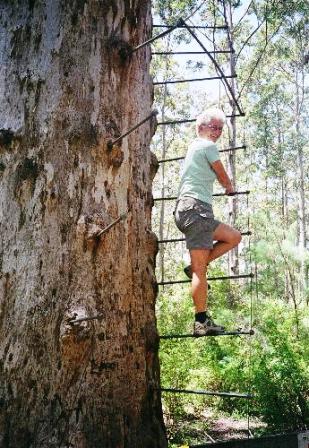
Gloucester Fire Tower Tree
Heading
west again we made a stop in the Pemberton area to see
their giant Karri trees. This is a logging area and
forest fires are always a real danger. In the 1930s,
instead of building fire towers, they took advantage of
the tallest trees and the loggers’ expertise. Spikes were
hammered into the trunks of some of the tallest trees,
spiraling to the top where wooden platform shelters were
constructed. At one point there were 13 of these fire
tower trees, but today there are three that survive for
tourists to climb to see the view. Ray refused to have
anything to do with climbing up 60 M, but I went up two;
the Gloucester and the Bicentennial trees. It was fun and
once you got used to climbing up on steel spikes with no
safety net below, it was fine. There was a protective
screen at the end of the spikes and the spikes were long
enough to enable passing a descending climber as you were
going up. It was a great view over the tree tops from the
top. My only problem was small blisters on my hands from
the rough surface of the spikes. Ray says I was holding
on too tightly.
We were heading for the Margaret River, a wine
district and favourite windsurfing spot on the south west
coast of WA. We finally caught up with all those holiday
travelers we had been warned about as the Caravan Park in
Margaret River was packed. At least there is always room
to put a tent and everything was very orderly and
friendly.
We signed up for a guided trip in canoes at the mouth
of the Margaret River. Being Canadians, we had no trouble
with the wind on the river, but a group of four young men
from Melbourne met their match. I don’t think three of
them had been in a canoe before as they kept paddling in
a circle and bumping into the banks of the river. They
were finally rescued by our comely guide, Mary Clare, who
took the stern of one canoe with two of the fellows as
passengers. They did not mind at all.
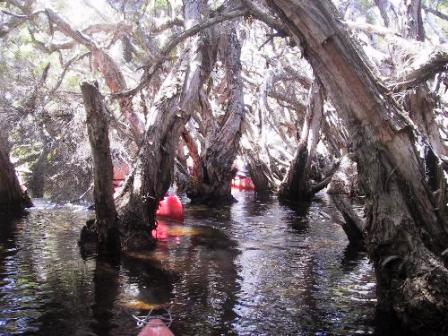
Canoeing on Margaret River
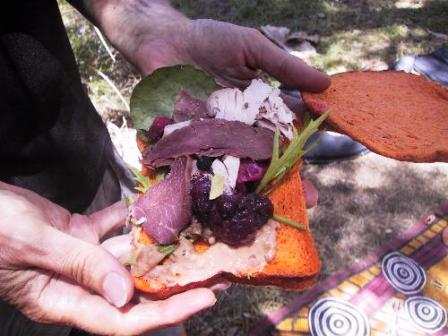
lunch on Margaret River
Once
we were all paddling in the same direction we floated
through a grove of melaleuca trees to the upper river.
The trees, also known as tea trees, release a die that
colours the waters a dark brown that is actually good for
your skin. We stopped to visit a cave along the shore and
again to have a bush tucker picnic lunch on the shore.
Some of the wild
foods that Mary Clare offered us were familiar from our
Tennant Creek experience on the way to Alice Springs, but
many were new. We made our own sandwiches with wild
smoked emu, kangaroo and turkey and flavoured them with
wild herbs and chutneys made from the fruits. We even had
a pate made from the local version of the Witchitty grub.
It was very tasty and didn’t have any buggy or slimy
texture.
Another day we drove to see a lighthouse situated at
Cape Leuwen on the coast, stopping on the way back to
taste several of the local wines.
We had reservation in Freemantle (Freo), an adjoining
city to Perth, for New Years. Bunbury seemed like a good
lunch stop and the big draw there was dolphins. They come
right into shore every day to see the tourists and pick
up a fishy treat as a reward. We arrived to a blustery
wind that kept the dolphins farther out in the bay that
day. They don’t like to get sand on their noses, so we
were told. We did manage a nice swim on the beach anyhow
before moving on.
We stayed in a YHA hostel in Freo and visited downtown
Perth by train. There is an excellent commuter train
serving the outlying suburbs, so rather that try to find
a scarce parking space, we took the half hour ride.
Downtown Perth was quite compact and very attractive with
green parks lining the banks of the Swan River.
Freo has an active bistro scene so celebrating our
anniversary on December 30 was fun, once we got a
reservation in the busy sidewalk cafes. New Years Eve, on
the other hand, was disappointing. We had looked forward
to joining in on some public celebrations and watching
fireworks. This does not happen in many places in Oz
besides Sydney. We didn’t want to be in an overcrowded
bar and the streets were quiet, so we were asleep before
midnight. Next year we will have to organize our own
party.
Return to
Australia Into
Return to
Travels
Return to
Introduction