October 10-19 2016
Who wouldn’t want to visit the “Prettiest Towns in
France”? Alsace has several, with flowers from every window and floral displays
in front of several of the medieval buildings. Besides, the towns are just a
short drive or train ride from Strasbourg.
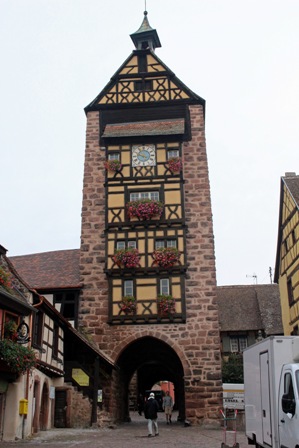
Click the photo above to see
an album for the Riquewihr. Close the window to return to this
page.
We rented a car twice and took a train another day, to
visit towns south of Strasbourg along the Alsace Wine Route. Our first car
exploration of the Alsace region began in Riquewihr, a favourite of tourists with its flower bedecked
half-timbered houses surrounded by vineyards. We bought three bottles of local
wine and had them with our meals back in Strasbourg.
Hunawihr, our second stop, was
founded in the 7th
C by Hunon, whose wife, Hune, is the saint of washerwomen. The small church,
surrounded by fortified walls, had old murals on the walls of a small side
chapel.
We made it to Ribeauvillé for
lunch in an old wine cave. I had good rabbit stew. In the Middle Ages,
Ribeauvillé was the seat of the Seigneurs de Ribeaupierre who built 3 castles,
the largest, Saint Ulrich, can be seen from the main street in town.
After lunch, it was up into the
hills to visit Chateau Haut-Konigsburg. The castle is first mentioned in 1147
documents when the monks complained to King Louis VII of France about its
unlawful construction by the Hohenstaufen duke. By the middle of the 17th
C the castle was left in ruins after changing hands and being burnt several
times. The castle came into the hands of the Germans as a result of the
Franco-Prussian war in the 19th
C and the German Emperor Willhem II contracted to restore the castle to its
Alsatian grandeur of the Middle Ages. He completed the restoration in 1908 and
it is now a popular tourist location. The site, at the top of high pinnacle
overlooking the villages below, is spectacular, even shrouded in mist as it was
the day we were there. We spent quite a long time exploring the many rooms and
views.
Our last stop on the route back to Strasbourg was
Dambach-la-ville, another pretty Alsatian town.
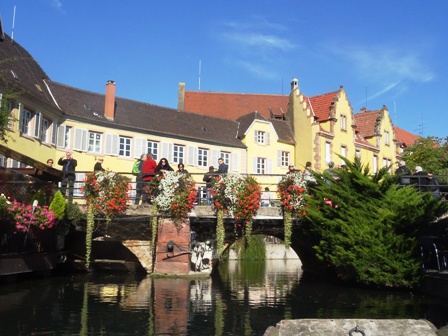
Click
the photo above to
see an album for Colmar. Close the window to return to this page.
Colmar, one of the largest and prettiest towns in the
area, is a direct train ride from Strasbourg. We planned to spend the day
exploring just one town so we wouldn’t need a car. It was an easy half-hour that
landed us within a short walk to the center of the historic town. We wandered
the streets, admiring the many large Alsatian buildings, churches and museums. A
band from another town arrived and set up a corner in the center and treated us
to a selection of marching and waltz tunes. Other musicians entertained us on a
corner by the canal and beside an outdoor patio where we were enjoyed our
afternoon refreshment. Boat tours are always fun and the canal running through
Colmar was no exception. The slow ride along the waterway gave us a different
view of the towns many half-timbered Medieval and Early Renaissance buildings.
We skipped the museums but did visit the interior of some of the many churches,
each with something unique to entice us in.
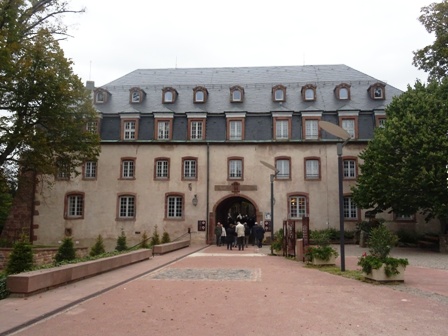
Click
the photo above
to see an album of our second day. Close the window to return
to this page
Our second car trip started in Mittlebergheim, which
claims to have been wine producers for 4 centuries. We had our only wine tasting
and ended up buying a bottle to drink that night in our apartment and two
bottles of the local Cremant, their version of Champagne to bring back to Paris.
The architecture was different. Instead of half-timbering, many houses a high
steep pitched roof and gateways opening to central courtyards.
Andlau, not far away, was the home of Andlau Abbey,
founded in 880 AD for women after Richardis, later Saint Richardis, saw a
she-bear scratching at the soil; a bear is one of her emblems in reference to
this. The former abbey church survives as the parish church of Saints
Peterand Paul. There are several carvings dating from the 12th
C next to one of the entrances to the church.
As we did on our first drive a few days before, we headed
up into the hills, on our way to Mont Ste Odile. It was lunch time when we
reached a small village, more popular as a ski resort. We lucked out as the only
restaurant open in town provided an excellent three course meal, one of the best
we had.
Mont Ste Odile Abbey, also
known as Hohenburg Abbey,is a popular pilgrimage spot, built on a 760M high peak
in the Vosges mountains. The abbey was founded about 690 by Saint Odile,
daughter of the Frankish Duke Adalrich of Alsace at Obernai,
who was its first abbess. On the eastern slope of the
Mont Sainte-Odile she built a hospice called Niedermünster or
Nieder-Hohenburg, which afterwards became a house for ladies of nobility until
it was destroyed by lightning in 1572.
We parked and took a path at the base of cliffs beneath
the main building. Stations of the Cross were carved into the cliffs, along with
a grotto commemorating Saint Odile. At the last station we followed a path up to
the gardens of the abbey. Two small chapels had beautiful mosaics on the ceiling
and walls. The Abbey itself is very large and as well as accommodation for the
few remaining nuns, includes a restaurant and rooms for pilgrims to stay.
Down the narrow twisting road we drove to the town of
Obernai, the birthplace of Ste Odile, who would become the Patron Saint of
Alsace. Obernai is in an importance wine district and the town is full of
half-timbered houses festooned with flowers. There were nice walking paths
alongside the old walls of the city. On our way back to Strasbourg we stopped
briefly to admire yet another “prettiest towns” Rosheim.
Read about our visit to
Strasbourg
Return to
France Intro
Return to
Travels
Return to
Introduction