Medellin Colombia
Click the photo
above to see a Medellin album. Close the window to return.
Read Previous Episode:
Mompox
or Next Episode:
Cali
January 19-22 2016
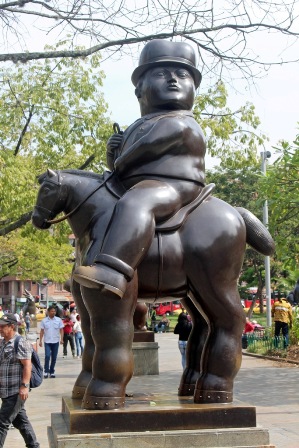
Wow, the whole plaza is full of chubbies! Oh, yes,
Medellin (pronounced Made-a-jean) is the birthplace of Fernando Botero. All
these sculptures in the Plazoleta de las Esculturas park, AKA Plaza Botero, in
front of the art deco Museo de Antioquia, were donated by the artist, just as he
did in Bogota for the Museo Botero. The artist certainly has a sense of humour.
All these sculptures lend an air of fun and hopefulness to a city with a violent
past. Ray and I busied ourselves snapping photos of several of the sculptures,
trying to decide which ones were our favourites.
We had flown to Medellin, blessed with a climate called
“eternal spring”, situated in a narrow valley, surrounded by jagged peaks, from
Cartagena the day before. We stayed in a nice small hotel, called In House the
Hotel, in the tourist friendly area of El Poblado, where restaurants vied for
places with hostels and small hotels. Our Hotel was a 15 to 20 minute walk
downhill to the Metro, which conveniently whisked us right to Parque Berrio,
just steps from Plaza Botero, museums and the Colonial churches we wanted to
visit.
After the Botero’s sculptures, our destination was the
Museo de Antiquia, named for the district of Antioquia, it housed a collection
of pre-Colombian and colonial art with the main emphasis on modern art. Yes,
there was a large collection of Fernando Botero’s, but there was more. I
especially appreciated the murals on the stairways, the work of Pedro Nel Gómez
Agudelo, a contemporary of Diego Rivera. A special exhibit of installations by
the new generation of Colombian artists, investigating themes of violence and
emigration. tHere were good explanations of the artist’s intent and films to go
along with their installation. We were both impressed and spent the rest of the
morning in the museum.
We emerged from the museum at lunch time to find the
streets lined with food and souvenir carts and more people in one place than we
had encountered in Colombia so far. It was a colourful, happening place. We had
lunch in a really good value vegetarian restaurant, Govinda, the haunt of many
Colombian Hare Krishna types and lots of business people who know a good deal
when they see one.
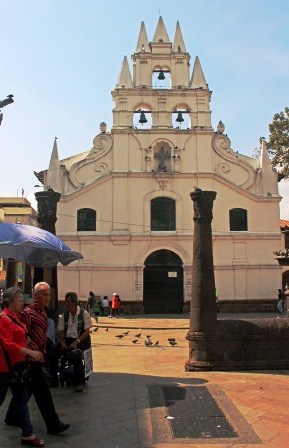
That set us up to visit several colonial churches in the
area. The most attractive for us was the small Ermita de la Veracruz, a colonial
church constructed in 1803 on the grounds of the original 1682 church, right
next to the Museo de Antiquia. A few blocks farther north was the red Adobe
brick Metropolitan Cathedral of Medellin, in front of Bolivar Park,
constructed over a 50 year period from 1875 to the 1920s. It was not open when
we visited so we just admired the outside and the park. Our last stop was the
Basilica de la Candelaria, which dates from 1863. We still preferred the
simpler Ermita church..
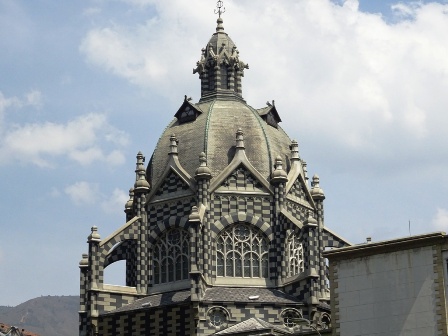
The Rafael Uribe Palace of Culture, in front of the
museum, was so fascinating with its striped façade of red and cream brick, that
we had to visit. It mostly houses municipal offices but there was a great view
from a terrace on the top floor and a good exhibit of new artist’s work and the
history of the building’s construction in the 1920s and 1930s.
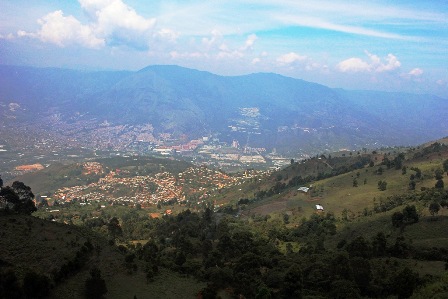
If you want to see the best view of Medellin, take one of
the two cable cars, that are transfers from the Metro system. We took the
Metrocable branch towards the barrio Santo Domingo, then transferred to the line
that services Arvi park. Yes the views were great, both going up and coming back
down. Popular Arvi is both an ecological nature preserve and Pre-Hispanic
archeological site on the eastern slopes of Aburrá Valley. The park covers
16,000 hectares, 1,760 of which are in the state of natural forests with 54
miles of walkable trails. We met a young Spanish woman on the cable car whom I
had noticed getting on the same metro station as us in Poblado. Irma was
travelling alone and was glad for the chance to speak some English. She became
our unofficial translator for a Spanish only guided walk on one trail. Our
guide, Daisy, kept our group of 30 visitors, all but us Spanish speakers,
interested by talking about the history of the park and the flora and fauna. At
the end of the walk we had a choice of continuing on to another section called
the Piedras Blanca (white rocks) or going back to the park headquarters. It was
lunchtime and the food vendors at the park headquarters beckoned.
We bought a sandwich, water and a bowl of soup to share
for our lunch, just enough to set us up for an afternoon at the 14-hectacre
Botanical Garden, conveniently located on the Metro line. The botanical garden
has more than 1,000 living species and 4,500 flowers. We walked around most of
the paths, through a rain forest area, around a pond and the orchidarium, where
several of the collection of orchids were in bloom. A favourite section was the
butterfly house, with several varieties, including Monarchs, flitted from flower
to flower and stopping at the feeding stations offering tropical fruits suited
to butterfly tastes.
The Medellin airport is one hour from the city, reached
by driving up switch backs over one mountain and down into another, wider
valley. Our plane for Cali was scheduled for 8:35 so the taxi was ordered for
5:30 AM to be at the airport 2 hours prior to takeoff. It was still dark when we
started off. We kept passing bicyclists, with full gear and lots of lights, on
the paved shoulder pumping up the hill. There were more than 20, strung out up
the hill, a few with a motorcycle escort. They must be part of a bicycle club,
hill training before the traffic and heat got worse.
We got to the terminal in plenty of time to find the
flight had been delayed 20 minutes. We also discovered we had to have a printed
version of our boarding pass for our Viva Colombia flight, rather than the
electronic version. The check-in desk said they could print it for COP 25,000
each! I said you could buy a printer with that much. They did tell us we could
get it printed at the info desk in the airport. We found the desk and were told
we needed to send the boarding passes to her email. Luckily they have free
internet service. It took multiple tries to get onto the service as it only
allows so many customers at a time, but it worked. We got the tickets printed
and at no cost. vIva Columbia airlines must be one of the last to embrace online
boarding passes on a phone.
Oh well,
our visit to Medellin ended well. We saw just a small part of what the city and
the surrounding countryside had to offer. We are building up an inventory of
places to visit on a future visit to Colombia.
Return to
Travels
Return to
Introduction