Welcome to Bogota
Click the photo
above to see a Bogota album. Close the window to return.
Read Next Episode: Cartagena
Bogota Colombia
Jan 1-5 2016
“Mas gente”, said our taxi driver. He was
right, there were lots of people. Three other travellers from our hostel had
followed us in a second taxi to the funicular that took people to the top of
Monserrate hill. We had arrived in Bogota the previous Friday and were taking
the advice of our Lonely Planet guide book, which said to join other locals on a
Sunday trip to the top of Monserrate, elevation 3152m, which had a chapel and a
great view of the city.
I don’t think they meant for us to go on the
first Sunday in the New Year. We had a hint of what to expect as we passed
pedestrians thronging the streets leading to the funicular station. The crowds
were even worse at the station. It looked like at least a one hour wait to get
to the top. Our taxi driver suggested we could go to the top of Guadalupe hill
instead, that didn’t have a funicular, for additional money. Guadalupe is even
higher than Monserrate but doesn’t have a funicular. We had a discussion with
the other car load of tourists from our hostel. They all said they were going to
take their chances on Monserrate. We opted to go to Guadalupe.
We followed another stream of cars around one
switchback after another, following the ever upward to Guadalupe summit on the
adjacent hill. We passed families carrying lunch buckets walking up the road. It
looked exhausting. The traffic got heavier the farther up the road we climbed.
There was no end in sight. Our driver kept assuring us we could make it. We
believed him. We got to a turn off the main road with a phalanx of police
turning back all the cars. Our driver spoke to one of the police after the
other, all first refusing to let us through and then reluctantly allowing us to
go ahead. The last police officer needed more persuasion. Our driver looked at
us and pulled out the old elderly foreign tourist argument. It worked. We crept
ahead. It was another km to go to reach the church of the Virgin of Guadalupe
and our promised view. Our driver stopped to offer a police officer hiking up a
ride. That made our car even more official. We finally had to stop and park by
the side of the road and join all the faithful walking up the last 500m,
accompanied by our driver. We knew we were close when we passed food and water
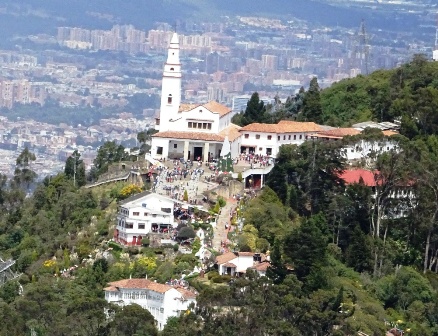
stands and a big outdoor food court. Ray stopped to take a photo of Monserrate,
just across a valley. The small viewing platform at the top was filled with
people. We estimated that about half the population of Bogota was either at
Monserrate or Guadalupe that morning. We did get a good spot to see how really
big Bogota is and take lots of photos.
It was time for the noon mass in the small
church. We left that treat to the locals and started back down to the car. We
got to the turn in the road where police were still turning away cars. There was
a long line of several hundred people along the side of the road all hoping to
get on the next bus back to town. It would be a long wait. We were glad our
driver had stayed to drive us back to the hostel. It took us an hour to get to
the shrine of Guadalupe but less than half that time to get down again, but it
was an experience and worthwhile to see the view.
Later we discovered than none of the fellow
tourists in the other taxi made it to the top of Monserrate. It was just too
long a wait.
Bogota, at 2625m (8600 ft), is the capital of
Colombia and has 7.4 million people spread over a wide area hemmed in by
mountains. It is a big city and at such a high altitude, is a lot colder than
the tropical Yucatan we had just left. We arrived in mid-day to sunny, warm 20C
weather, but after 4:30 PM, when the sun started to go down the temperature
dropped to a low of 8C overnight. We had come prepared with long pants, a fleece
and a rain jacket to provide at least three layers. The other acclimatization we
coped with was the difficulty of climbing the steep street to our hostel in La
Candelaria, the old Colonial section of town. All of sudden we were walking much
slower than usual and even stopping to catch our breath. I think we were getting
used to the altitude and climate before we left a few days later.
There were benefits to staying in the Candelaria. All the
best sites were a short walk away and there was no shortage of restaurants. We
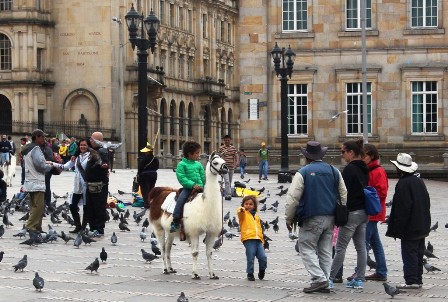
visited the Plaza de Bolivar, a huge square in front of the Cathedral and
surrounded with important government building. All the tourists, both local and
foreign end up at this square, buying corn to feed the pigeons and watching
children ride the llamas waiting for customers.
We were approached by a young policeman, who asked us
where we from and asked if we would like to tour the National Police Museum. It
didn’t sound like our first choice of activites so we refused and continued
walking the streets admiring the beautiful, well restored buildings. I was
reading the Lonely Planet as we walked and was surprised to read that the Police
Museum was more than I had thought. We sought out the young man who had
approached us and told him we had changed our mind. He took us to the Museum,
housed in the original headquarters of the National Police, where we waited for
another guide to show us around the museum. Our guide, Jonathan, explained that
all 18 year old boys in Colombia are required to spend one year in the National
Police force. Those who are interested, train to be a guide in the museum.
Jonathan considered being a guide a lot safer and more interesting than standing
guard at a building or street corner. The job also gave him the opportunity to
practise his English skills.
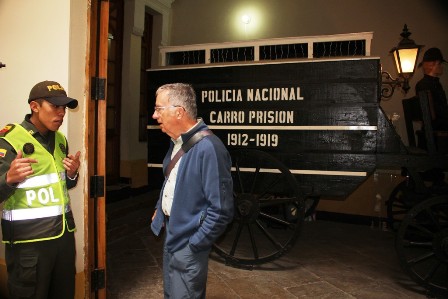
The tour was interesting. It had examples of old
transport vehicles, including a paddy wagon that picked up people found guilty
of minor infractions and kept them in the wagon, in full view of the population
for one day. Nowadays they would be fined, but public humiliation was the
punishment then. There were also displays highlighting the different roles
played by the police, including social service. The biggest draw for most
visitors was the role played by the police in apprehending and controlling the
drug trade, whose most infamous member was Pablo Escobar. How many of you have
watched the TV miniseries, now on Netflix, Narcos. We watched it before we left
home and are glad it is no longer as violent as it once was.
The afternoon after we visited Guadalupe hill, we joined
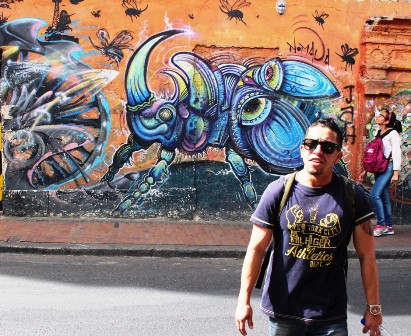
the immensely popular Graffiti walking tour. About 30 tourists followed the very
knowledgeable Jay, who was born in Colombia and Raised in New York and Florida.
We spent 2 ½ hours walking the streets of Candalaria and into some of the
business area admiring the art work covering almost every wall space, both on
public and private spaces. The tour was originated by Crisp, the tag name of one
of the artists, a few years ago. The graffiti artists and they are artists, like
to think they have won the battle to keep on painting without being arrested.
About a year or two ago the city invited artists to paint the walls of a new
super highway leading to the airport. They had expected just a few artists to
show up and were astounded when 400 showed up. I was certainly impressed by the
works. Bogota now draws artists from all over the world and is counted one of
the 10 best cities to view graffiti art.
Click the photo
above to see a Graffiti Tour album. Close the window to return.
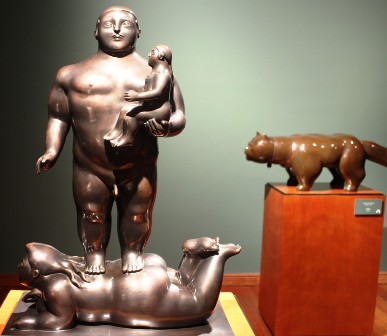
The Botero Museum, featuring works by
Fernando Botero, Colombia’s most famous artist is on everyone’s list, ours
included. Botero specializes in depicting decidedly chubby people, often in
poses poking fun at famous works of art. There was also a smaller collection of
works by the world’s top masters including Picasa, Juan Miro and others.
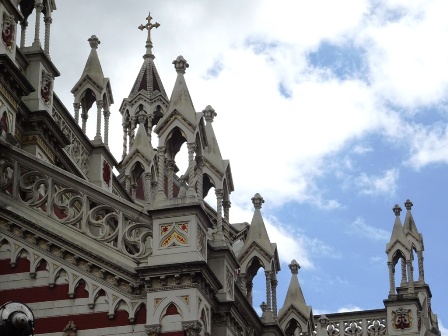
Our favourite church was the small San
Agustin Church, near Plaza de Bolivar. It is covered in over-the-top
ornamentation on every surface and then enriched with gold leaf. It was
sumptuousness gone wild, but beautifully done.
We did a lot with our 3 ½ days in Bogota but
left a lot more for future visits. We have one more day in Bogota before flying
back to Mexico at the end of January, so perhaps we will be able to add a few
more highlights to our list.
Return to
Columbia Intro
Return to
Travels
Return to
Introduction