Episode 3: Rotorua Hikes to Havelock
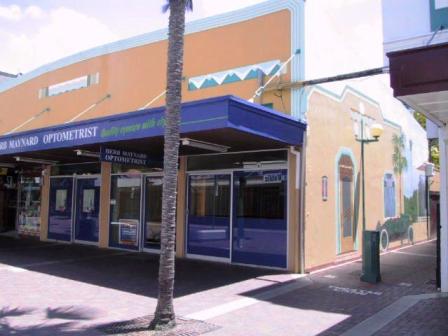
Art Deco building in Napier
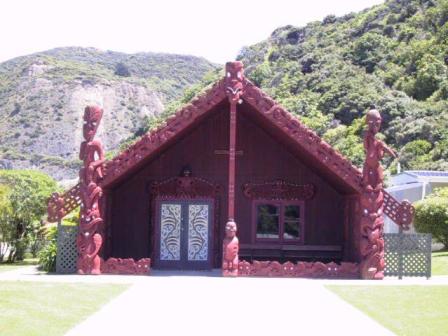
Marae at Pukera Bay
Read Previous Episode
Coromandel to Waitomo or Next Nelson to Arthur’s Pass
Episode 3 Page 1 of 2 Rotorua to Waikanae
Monday, 7 January
2002, Nelson, South Island New Zealand
Skip to
Episode 3: Page 2 Wellington to Kayak Trip
What have we
been doing since you last heard from us? Just before
Christmas, the weather started to improve so we have been
enjoying more sunny days than rainy ones. We have been
tramping through forests, driving the New Zealand scenic
byways, celebrating Christmas and New Year’s, kiwi style,
visiting new friends and kayaking in Marlborough Sound.
We discovered a good source of tramping information at
the Map and Track store in Rotorua. The owner sold us
maps of the local area and recommended a few good day-walks.
With the weather still so unsettled, we were not willing
to try another overnighter yet. Instead, we found a
trail, just out of town that led to the top of a hill
where we had a great view of the town on Lake Rotorua,
the adjacent Lake Rotoiti and far in the distance, the
Bay of Plenty. We had not realized we were so close to
the sea, but I guess no place in New Zealand is very far
from the ocean. One of the bonuses of this walk was that
we had the place to ourselves, just the trees and us.
The Map and Track owner talked so highly of the
Whirinaki Forest as a great place to hike that we booked
into a small, rustic “resort” run by a forest
guide and his family. We should have stopped and taken a
photo on the road sign on our way there. It was the
typical NZ twisty road sign, but it warned of 120K of the
same to come. As we discovered when we left, only the
first 20 K of that road were paved. Ray always tells me
he gets bored driving on super highways, so he must
consider the roads in NZ a dream come true!
Anyway, we had a small cabin, complete with kitchen
all to ourselves and we had the forest tracks almost all
to ourselves. The Whirinaki Forest Reserve is one of the
most recently created in NZ. During the 1970s it was the
center of a bitter fight between Conservationists and
Loggers (sound familiar). The Whirinaki is a podocarp
forest, which means the trees are the same as they were
thousands of years ago. It is one of the last forests
like this in NZ and was being heavily logged. The
Conservationists especially took issue with replanting
the area with non-native trees, mostly pines. Anyway, the
Conservationists won, but the locals, mostly Maoris, lost
their logging income and don’t have much to replace it.
By the time we booked into our cabin and had lunch, the
skies were blue and there wasn’t a cloud in sight. We
figured we had better take advantage of the good weather,
so we started out by taking an hour hike through a Forest
Sanctuary, near the Maori village. There were huge stands
of Rimu, and Kahikatea trees, amongst others. The Rimu,
or red pine tree, has pendulous needle-like foliage and
grows to 50 M. It truly was a peaceful spot.
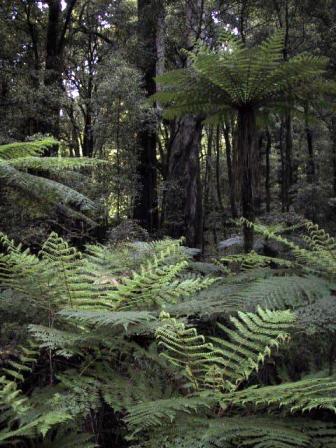
Whirinaki Forest
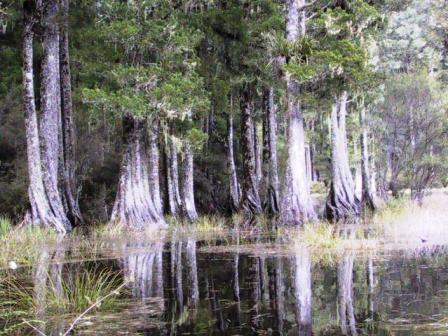
Whirinaki Lagoon
We
figured we still had time for another walk, so we found
the road leading to the Aranaki Lagoon. The sign said it
was a 3 hour return walk but we usually make it in less
than the advertised time and those clouds in the sky
didn’t look too threatening yet, so off we went into the
forest again. About an hour down the trail we heard what
sounded like a lot of sewing machines, whirring away, as
we came closer to the lagoon, the sewing machines turned
into a full-blown textile factory. We soon realized that
was the music of thousands of frogs, all happily
communicating with each other. The lagoon looked like a
mangrove swamp, except that the trees were much higher.
The trees ringing the lagoon have developed above ground
roots to support the tree in the soft bottom of the
lagoon. Just as we were starting to explore more of the
lagoon, we heard the rumbles of thunder in the distance.
It started to rain, softly at first and then steadily
harder. We hoofed it out of there and made it back to the
car in 40 minutes, but not soon enough to avoid getting
completely soaked. It had looked so promising when we
started out that we didn’t bring our rain jackets or
gaiters. We had plastic bags to sit on in the car, but I
was feeling so soggy and chilled in my wet clothes that I
took them off for the ride home Ray thought this was a
riot. I figured since there was no one else around I was
safe. Besides, the car was so steamy no one could see in
anyway. We were glad to get back to the cabin and get
into a hot shower.
There
are several long tramps in the Whirinaki, lasting three
to five days or more. Some of them involve fording
streams, repeatedly, and the condition of much of the
trail was reputed to be very muddy, so we opted to follow
just the first day of one of the tramps. That made for a
very pleasant day, and it didn’t rain. We followed the
Whirinaki river through the dense, native forest passing
a few waterfalls and gorges on the way and ate our lunch
in an empty tent site.
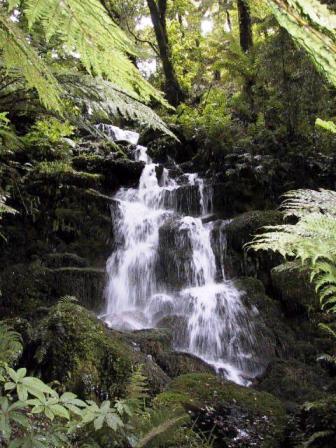
Whirinaki Falls
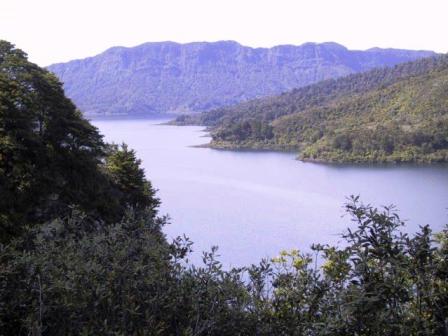
Lake Waikaremoana
December 23 found
us on the road again. We opted to take the scenic route
to the coast, the rest of that 120 K of twisty road. The
road was only paved to the turnoff to our Whirinaki
Resort, so we had 100 K to get used to the narrow, twisty
route up and down the hills. The last third of the trip
was the best as it skirted Lake Waikaremoana, one of the
most beautiful lakes on the North Island.
The road finally led to the ocean and the town of
Wairoa, where we stayed overnight in a camping grounds.
Besides tent and caravan sites, NZ campgrounds also have
cabins or motel units to rent. Ours shared bathroom
facilities with the campgrounds but the unit had its own
kitchen and patio. On our exploration walk of the town we
noticed that Lord of the Rings was playing at the local
theatre and since it was filmed in New Zealand, we
decided to go that night. I read the books some years
ago, so some of the plot came back to me, but it is a
complicated story. Ray was not pleased with the ending.
Of course it doesn’t wrap up neatly because you have to
see Parts II and III when they come out. It was
interesting trying to identify where the filming took
place and have a preview of the scenery we would see on
the South Island.
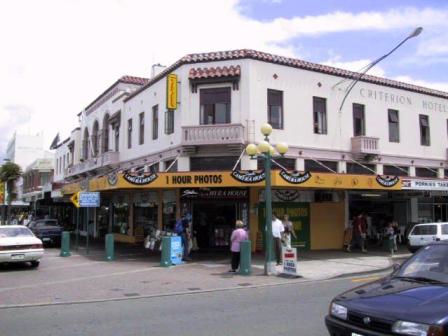
Napier Criterion Backpackers

Napier Art Deco Architecture
Ray had talked to a fellow camper, Guy, from Belgium,
who had just completed a four-day tramp around Lake
Waikaremoana, one that we had considered. He was
hitchhiking his way around NZ, so we offered him a ride
to Napier. We all ended up staying at Criterion
Backpackers for the Christmas period. Napier, on pretty
Hawke Bay, was a great place to spend some time. An
earthquake and subsequent fire in 1931 decimated the
downtown area, but the locals rebuilt the town within two
years, all in the popular Art Deco style. Napier
has very wisely retained and restored the Art Deco
buildings and the town is a popular tourist destination
for people who are interested in architecture. We spent
Christmas morning following a self-guided walking tour of
the downtown. The colours and decorations on the
buildings impressed us. We had visited our daughter Erica
when she lived in Chicago and took an architecture tour
of the downtown and Oak Park, the one-time home of Frank
Lloyd Wright. It made it even more interesting for us to
see the influence of the Chicago architects in Napier.
Guy had mentioned he was interested in visiting a
gannet colony at Cape Kidnappers, not far from Napier.
There was a tour to the bird colony the very afternoon we
arrived in Napier, so we all signed up. We took along
another fellow, Peter, who was staying at Criterion, and
drove out to the start of the tour. The gannet colony is
at the end of an 8 K beach at the base of sheer cliffs.
The route out is only accessible at low tide, so our tour
started at 4:30 PM to take advantage of the tides. We
weren’t the only people on the tour. About 100 people
boarded three flat bed wagons, each towed by a tractor,
for the trip down the beach.
Our personable guides/drivers stopped
several times down the beach to tell us more about the
topography of the area and about the Australasian gannets.
At one spot on the beach the rain had caused large
boulders to come tumbling down from the rock face and
block the way. Our guides had to stop and break up the
boulders with pickaxes and roll them out of the way.
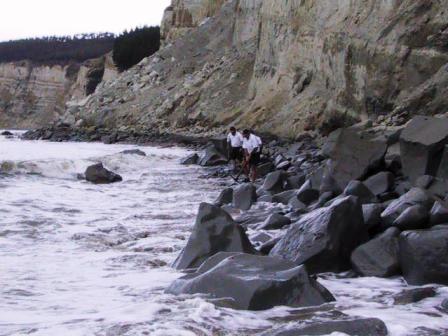
Cape Kidnappers Rocky Slide
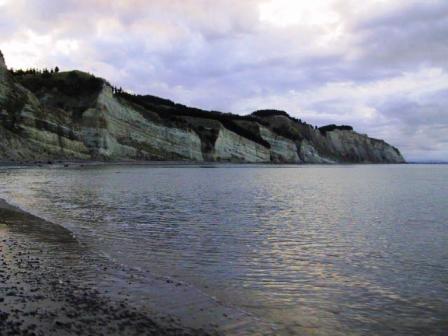
Cape Kidnappers Cliffs
The gannets are large white birds with yellow heads
and black-tipped wings that live on the top of cliffs overlooking
the sea. After wintering farther north in NZ, the gannets
arrive at Cape Kidnappers in late July to build nests and
lay eggs that hatch sometime after November. Many of the
nests had a parent perched atop a fuzzy chick. The babies stay with their parents for 14
weeks after which they fly to Australia, leaving the
parents behind. They stay in Australia 2 – 3 years before
returning to NZ. Only 20% of the young gannets survive
the trip, not a very high survival rate. At the end of
the beach, everybody got off the wagons to walk up a path
to the top of the cliffs where the largest colony was.
You can smell them before you can see them, especially if
you are downwind. We were so interested watching the mannerisms and routines of the birds that
the smell soon ceased to be a problem. Whenever one bird
returns to its mate sitting on the nest, there is a
little ‘Honey, I’m home!” routine with inter-twisting
of necks and mutual preening. We were sorry to say
goodbye to the gannets and walk back to the tractors for
the return trip down the beach, but it would soon be dark.
(A bonus for travelling in the NZ summer is the long days.
It doesn’t get dark until close to 9:00 PM)
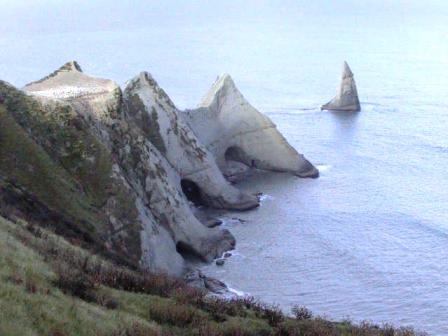
Cape Kidnappers Point
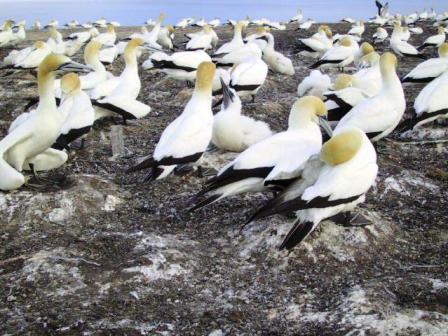
Gannets
 We
We
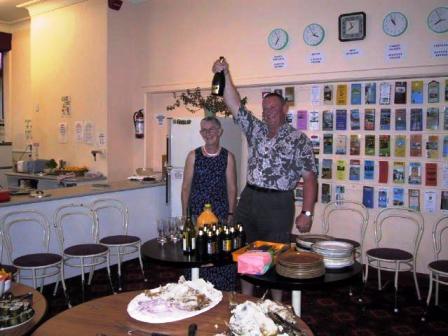
lucked out for our Christmas dinner this year. Jill and Ian, the
owners of the Criterion, where we were staying, put on a
special dinner each year. They
cooked a turkey and a ham and provided a case of bubbly
and asked each of the guests to make a dish typical of
their country. This year there were 35 people from 11
countries and everyone went all out. We had sushi from
Japan, various potato salads, a special pork dish from
Denmark, mussels from Belgium, sauerkraut from Germany
and more food than we could finish. I was not very
creative coming up with a typically Canadian dish. I made
broccoli salad as I like my veggies. It was a great way
to create a celebration and to get everyone talking to
each other.
Boxing Day dawned clear and warm, a perfect day for
the beach. Our hosts suggested Ocean Beach, about 30 K
south of Napier. We took the side roads through orchards
and horse farms. Several bicyclists passed us going in
the other direction and I made the mistake of thinking
that the route made a nice relatively flat loop for
cyclists. We turned the corner and the hills were there.
We were soon following the contours of the land, making
sharp hairpin turns around deep ravines. A challenging,
but quiet route for cyclists.
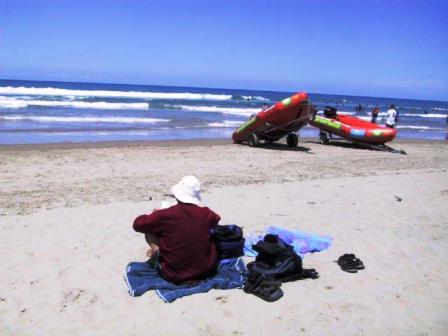 The final 10 K to the beach was straight up a hill
with paragliders getting ready to take off from the top.
The road down to the beach was narrow enough that there
was a sign warning that the uphill car had the right of
way. Because of the remoteness of the beach, we expected
it to be deserted, but no, it was a popular destination
for local residents. The parking lot was nearly full and
there were lots of umbrellas already on the beach, but
mostly in front of the life guard station. The white sand
beach stretched several K in either direction so there
was lots of room for everyone. The favourite activity was
to catch the waves and ride small boogie boards into
shore. It looked like a lot of fun. The water temperature
at 18 C felt cool compared to Fiji, but we braved it
anyway. Many people, even children, wore wetsuits to
enable them to stay in longer. We stayed a little too
long soaking up the rays and Solarcaine had to come to
the rescue again.
December 27 found us on the road again, heading for
Waikanae on the West Coast north of Wellington. Before we
left the area, we had two stops to make. The region of
Hawke Bay is one of the prime winemaking areas in NZ, so
we had to visit at least one winery to sample the local
produce and to buy a few bottles. We chose the Lombardi
winery where we bought their specialty, Sauvignon Blanc.
The other stop was a drive up to Te Mata Peak, at 399 M,
for a dramatic view of the area we were leaving. You can
see almost all of Hawke Bay and if the clouds hadn’t been
gathering in the west, we could have spied Ruapehu in
Tongariro Park. On our way up the hill we passed two
cyclists coming down. To our surprise, they were just
approaching the top parking lot when we were leaving.
This must be a training run for hill climbers.
Before we left Ottawa, I had been introduced to two
women who had both completed an exchange work term in the
Library of Parliament in Wellington. My sister Mary
introduced me to her friend, Elizabeth Reicker, and I met
DianeThomson playing tennis. Diane had given me the email
address of Nedra Shand, who had befriended both women
when they were in NZ. Nedra had been sending me
suggestions of places to visit and had kindly invited us
to stay with her and her husband Gordon, and their three
Staffordshire terriers, at their home in Waikanae. We
were given a warm welcome and enjoyed their hospitality
for two nights.
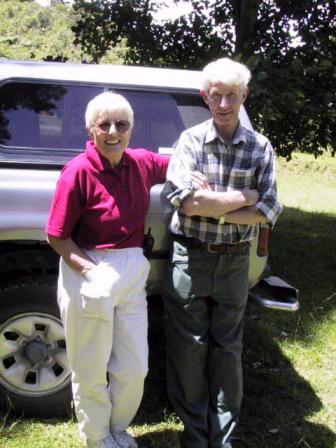
Nedra and Gordon Shand
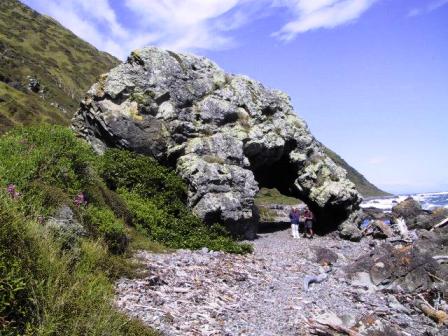
Pukera Bay
Nedra was looking forward to taking us on some of the
many trails in the area. In the morning, Gordon drove
us south on the coast past Pukerua Bay and let us off at
the beginning of a coastal walk. We had the whole trail
to ourselves. At one point we were in danger of being
attacked by two gulls. We discovered we were coming to
close to a gull chick that had strayed from its nest. We
saw several blue herons, but none of the penguins that
live in the area. Nedra figured the surf was too high for
the penguins to come into shore.
Gordon met us at the end of our walk and drove us back
up the coast to a picnic spot at a historic Maori battle
site. After a pleasant lunch beneath the trees we
returned to Waikanae via the Paekakariki Hill road to
view the coastline from the top of the cliffs.
Once back in Waikanae and fortified with tea, Nedra
led us off again to explore a bushwalk in a Reserve just
back of their house. The walk reminded us of the Gatineau
hills, but a little higher. It was straight up to a ridge
top, with a good view as a reward. Like most of NZ, this
area has hundreds of paths for hikers to explore. Thank
you, Nedra and Gordon, for showing us some of your
delightful area.
Next:
Episode 3: Page 2 Wellington to Kayak Trip
Read about our visits to the
Cook Islands or
Fiji
Return to
New Zealand
Intro
Return to
Travels
Return to
Introduction