Tips for the Traveller in New Zealand
Tramping or
Hiking
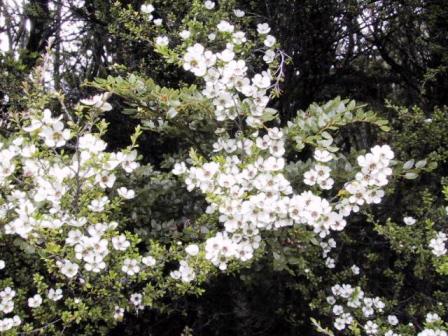
Manuka in bloom
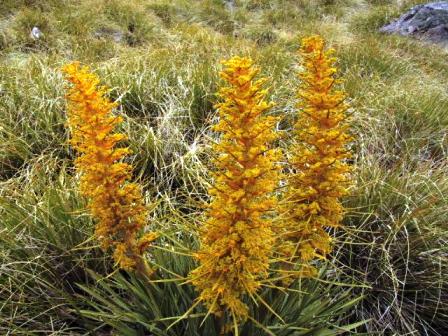
Speargrass
During our travels in New Zealand we have
picked up quite a few hints to make travelling, especially as a
backpacker, easier. Travel guides such as the Rough Guide and the
Lonely Planet give excellent recommendations for places to stay,
where to eat, places to see, a brief history of the country and
guides for cultural differences. Note that the travel industry
changes quickly and may not make it into the version of the guide
book you choose. New businesses open up and old ones cease to
exist.
If you plan to travel in New Zealand in the
near future, have a look at our tips. We have combined our
experiences with our observations of travel in New Zealand to
give our personal recommendations for modes of travel, places to
stay, food, tramping and what to bring if you are backpacking.
If anyone out there has other suggestions to
pass along, just send us an email. We would love to benefit from
other people’s experiences.
Click
on any of the following topics to go directly to that
sectionTransportation
Accommodation
Food
Tramping or Hiking
Packing Light
Transportation
Getting around in New Zealand is easy, whether it is
travelling by bus, by car or even hitchhiking. We found
having our own car a great way to get around. It allowed
us to go wherever and whenever we wanted and it was very
economical. We travelled the highways as well as unpaved
back roads, of which there are many. Having our own car
allowed us to store extra items in the traunk (or boot in
Kiwi) we didn’t want to carry with us when we went on an
overnight tramp. Since the places we stayed in all had
good kitchen facilities, we were able to transport a
cardboard carton of non-perishables and a cooler (or
“chilly bag”) for the perishables around with
us in the car.
Renting a car
There are lots of car rental agencies offering many
models of cars and motor homes (caravans). Some of our
friends have found it is cheaper to rent in New Zealand
rather than arrange the rental before leaving home.
Most of the car rental agencies deal in late model
cars, but there are a few that rent older models at a
reduced rate. Caravans are very popular and can be quite
luxurious. They cost more than a regular car rental, but
fees in campgrounds are less than motels.
Buying a second hand car
Buying a backpacker car was the most economical and
convenient way for two people to see New Zealand. Sedans,
station wagons and camper vans are offered for sale. Most
of the vehicles are old by North American standards but
the New Zealand climate seems to be kind to cars. We
bought a 1986 Honda Accord and it performed very well for
the three months we owned it.
Some car rental agencies have a buy-back arrangement
where you buy a used car and they guarantee to buy it
back at the end of your trip. We didn’t follow this route
as it was reputed to be more expensive.
There are two common ways of buying a second hand car
in New Zealand; one is to attend a car auction in one of
the larger cities, the other is to answer one of the many
handmade notices advertising cars for sale in backpacker
hostels. The car auctions are held in the larger cities,
usually on a weekend and could be a good source. Our car,
Alice, was purchased by her previous owners at an auction
in Auckland as they wanted a car with fewer owners.
We elected not to wait for a car auction. We found out
which hostel in Auckland was the most popular and went
there to check out the current offerings. This was an
easy process as there are often lots of choice and prices
seem to be similar.
It is just a matter of looking them over and making
sure they are in relatively good mechanical order.
Luckily, New Zealand requires that every car undergoes a
safety check once each year. This Waranty of Fitness (WOF)
gives you some confidence that the car will not
completely fall apart while in your ownership. In
addition, it is a good idea to have a mechanic check the
car for any problems and fix them before setting out. Ray
took our car, Alice the Honda, into a garage in Auckland.
Luckily she only needed her oil changed and a new tire to
see her on her way.
Selling a second hand car
You sell the car the same way you buy one. We
investigated going to one of the car auctions, but we
were told that car wholesalers go to these and that the
prices were quite low.
We made up spiffy advertisements to find Alice a ‘new
home’ and distributed them to most of the backpacker
hostels in Christchurch, our final destination. Although
we sold Alice within 24 hours, you are wise to allow a
couple of days before you have to give the car away
because you have run out of time. You need a telephone
number for prospective buyers to contact you. That means
you have to stay by the phone waiting for calls instead
of running around town catching the last must-see
attractions. A better solution would be to rent a cell
phone for the last week and carry it with you. That said,
there is nothing like personal contact with a buyer. We
happened to be around putting up notices when prospective
buyers were reading the notices. We sold to one of these
buyers.
Buses
There are several bus lines catering to backpackers. One
company, Magic Bus, sells different packages, depending
how long you are travelling or how much of the island you
want to visit. The buses visit the most popular areas and
drop clients off at backpackers hostels. All types allow
you to stop off as often as you wish, within the package
time limits. There are regular local buses but they only
service the major cities and towns. Most backpackers
chose one of the special bus lines. One advantage is that
single travellers get the chance to meet fellow
travellers and have company along the way.
Ferries
There are two ferries linking Wellington on the North
Island and Picton on the South Island. The Lynx is the
“fast” ferry, taking about 2 1/4 hours to
traverse the Cook Straight and the Interislander ferry
takes about 1/2 hour more. The ferry bookings get filled
up very early in the prime season, from the end of
December to the end of February. In addition, you pay a
premium price for last minute bookings. For these
reasons, it is wise to book well in advance. There are
different rates depending on the date and time of the
crossing, so make sure you ask for the lowest rate
available. We booked at the end of November and were able
to get an afternoon sailing on January 1. The rest of
that first week in January was already full. Ray had to
ask twice if there were any other sailings that would be
cheaper than the first price quoted. We ended up paying $160NZ
for the car and $40NZ for each of two passengers. We have
heard of lower rates for Kiwi residents who booked the
previous summer, so you could try your luck on the
internet if you know the date you wish to sail. The
lowest rate for a foot passenger we heard of was $25NZ
for a 1 AM sailing.
There are also ferries in Auckland Harbour linking the
islands in the Hauraki Gulf and a ferry to get to Stewart
Island from Ivercargill. Inquire about these ferries in
New Zealand.
Bicycling
We are experienced bicycle tourers, but this time we
elected to drive around New Zealand. This year I feel we
made a good decision. New Zealand experienced the worst
summer weather on record. November and December were
especially rainy and I do not enjoy getting soaked.
Nevertheless, we spoke to many bicyclists and if you are
interested in getting around by bicycle, here are our
suggestions.
Learn to like hills. There are lots of them and
many are long and steep.
Bring full rain gear and waterproof paniers.
Bring your own towel and sleeping bag.
Use a touring bike with at least 28 mm tires to
travel unsealed roads.
Get good detailed maps.
An easier way to see New Zealand by bicycle is to
join a guided bicycle tour group. For a price all your meals and
accommodation is arranged and your luggage is transported each day to
the next location. Companies come and go so the best bet is to go
through a travel agent or google bicycle tours in New Zealand and read
their testimonials.
New Zealand seems to be one of the last, safe places to
hitchhike. We picked up several, mostly young people who
were travelling super economically. The downside is you
need to have lots of time as you never know how long it
will take to get a ride. We had room for just one
hitchhiker, so couples were at a slight disadvantage.
Accommodation
There are lots of choices of where to
stay, depending on how much you want to spend. We were on
a limited budget, so the backpacker hostel type of
accommodation suited us just fine.
Hostels
This was our choice. Hostels are no longer restricted to
the under 30 age group, although we, as middle-aged
travellers, were definitely in the minority. We looked
forward to meeting everyone and trading travel
experiences. For us, this gave the hostels a definite
edge over motels, where you are less likely to interact
with other guests.
Hostels all provide a choice of dorm rooms and double
rooms. A very few even have an option of a room with a
private bathroom, but this is unusual. We were able to
get a double or twin bedded room for an average cost of $40NZ
per night where ever we went. Dorms slept from four to
twelve people and usually cost less than $20NZ per bed.
The beds come with a clean bottom sheet and a pillow
and pillowcase, but you are usually expected to provide
your own soap, towels and blankets or sleeping bag. Some
hostels had towels and duvets at additional cost.
The shared bathrooms were always clean and
conveniently located. The kitchens were well equipped
with multiple sinks, stoves and refrigerators. We had the
use of pots and pans, dishes and cutlery, plus some
hostels even provided spices. There was usually a shelf
of “free food” left behind by other travellers.
It was worth your while to look through the selection for
usuable items.
The hostels all had good coin operated washers and
dryers, so having clean clothes was easy. A box of
detergent soon was added to our backpacker’s kit. Many
hostels also had outside clothes lines to hang up those
items that can’t go in a dryer. We found that a few of
our clothes pins came in handy when there were not enough
at the hostel.
Several hostels had computer terminal with Internet
connections for the use of their guests. Sometimes you
were offered a half hour free, but most were coin
operated machines. The backpacker owners have had too
much trouble in the past with people who changed the
settings or imported viruses. As a result, the coin
operated machines allowed internet connection only and
had no CD or floppy drive access.
There are lots of hostel choices all over the country.
Hostelling International runs quite a few and sells an
annual membership, $30 each in 2002. You could stay in a
hostel without being a member, but there is a surcharge
of $3NZ each for the room . We got a card that got
stamped once for each night we stayed in a hostel. When
the total reached $30, we would be given an annual
membership good for the rest of the year.
The backpacker hostels in New Zealand formed an
organization, Budget Backpacker Hostels (BBH) in August
2001 to offer similar advantages to a Hostelling
International membership. For $40NZ each, we got a
booklet listing all the member hostels, plus a $20NZ
phone card. Without the membership there was a surcharge
of $1 – $3 per person. The phone card allowed us to call
anywhere in New Zealand or North America for just $0.25
per minute. We used the cards to call everybody at home
at Christmas and to book ahead for the next night’s
lodging. The two cards we bought lasted until the end of
our trip. The hostel listings included rates, amenities
and guest ratings. The membership was good value and was
used by the majority of backpackers we met. For an online
look at member hostels, try www.backpack.co.nz
Camping and Caravan Parks
The very least expensive way to travel is to take a tent
and camp. There are a few out of the way places where you
can set up your tent for free, but this is not encouraged.
Instead, many of the backpacker hostels have space for
tents, at a reduced rate, or you can stay at one of the
many campgrounds. The only problem with campgrounds is
that they are often a distance from town. This is a
problem if you do not have a car or at least a bicycle.
If you are travelling in your own caravan, most parks
have hook-ups, kitchen facilities and washrooms to use.
The prices we saw advertised were very reasonable.
Caravan parks often have simple cabins to stay in.
They usually had double or twin beds and partial kitchen
facilities, but no private toilet or shower. You could
count on a table and chairs in the cabin and a few cabins
had a fridge and stove but most expected you to use the
communal kitchen to prepare your meals. You may even have
to provide your own dishes and pots and pans. The beds
come with a clean bottom sheet and pillow, but you
provide your own towels, soap and sleeping bag or
blankets. These are a good alternative if you don’t have
a tent or it is raining, as it often was when we were in
New Zealand.
Homestay
We were lucky enough to stay as paying guests in three
different private homes in New Zealand. We had our own
bedroom and shared the bathroom and kitchen facilities
with the rest of the family. It gave us a chance to talk
with New Zealanders and find out more about their lives
and how they differed with ours in Canada. The problem is
that these are harder to find. Two we stayed in were
advertised as hostels and the third was a referral when
the homestay-hostel was full. The rates were about the
same as a hostel. Ask around and you may be lucky.
Motels
There are lots of very nice motels to stay in. As a rule,
they come equipped with a TV, bedding, towels, soap and a
full kitchen. The price is about double that charged for
a double room in a hostel, but you get a private bathroom.
Bed and Breakfast
Our experience with B&Bs in New Zealand is limited as
the ones we saw advertised were far beyond our budget.
The usual rates were over $100NZ per night for a double
room. The ones we saw were very nicely decorated rooms in
private homes and included a more-than-we-could-eat
breakfast. Some homes offer additonal meals as well. The
advantage is a very pleasant atmoshphere and the chance
to interact with New Zealanders.
Farmstay
Again, our experience is limited, mostly because of our
budget. Several we read about operated as luxury cabins
in a country setting and others are more like B&Bs on
a farm. The value, in my opinion, would be to experience
farm life in New Zealand.
Several of the young people we met had obtained work
visas and spent up to three months working on a farm.
They loved the experience, but it was hard work and does
not pay very well.
Some farms, mostly organic, offer room and board in
return for four hours unpaid work per day. Since you are
not paid a wage, you do not need a work permit.
Food
Although there are lots of restaurants
in the tourist centers and larger towns, meals are not
inexpensive. As mentioned in our tips, nearly every type
of accommodation has kitchen facilities for their guests.
Consequently, many travellers elect to prepare most of
their own meals and save dining out for special occasions.
All the larger towns had large, well
stocked grocery stores, making it easy to prepare simple,
nutricious meals. We bought a “chilly bag” (or
cooler) and a freezer pack to transport our perishables.
As soon as we reached our destination, we stored our food
in the refrigerator in a plastic bag marked with our name
and the date we expected to leave. Our non-perishables,
stored in a cardboard box, either went on a shelf in the
communal kitchen or in our room. We never had any
problems with food theft, but the naming system allows
the hostel owners to clean out the refrigerator on a
regular basis.
We had our own cooking pot and dishes
with us but these were only needed for our overnight
hiking trips. The kitchens were generally well equipped.
The only item often lacking was a sharp knife, so our
Swiss Army knife got good useage.
There were often a number of people
trying to prepare dinner at the same time, but generally
this was accomplished in a cooperative manner. We were
pleased to note the efforts put into tasty meals by all
the backpackers. Except for the occasional slob, each
person cleaned up their own pots and pans and dishes. The
owner’s responsibility was to further clean the kitchen
on a daily basis.
Our favourite meals were simple stir
fries with lots of fresh vegetables and a smaller portion
of meat, poultry, fish or cheese served over rice or
pasta.
Of course, a meal is not complete
without a glass of wine, so we sampled several of the
local offerings. The New Zealand wines, especially the
Sauvignon Blanc and Chardonnay, were very good, but often
a little more expensive than their Australian
counterparts. For everyday meals, we stuck to whatever
was the bargain offering in the local store and only
occasionally indulged in the local vintages.
We are not big beer drinkers, but we
managed to taste many of the New Zealand brews. They all
got our approval, especially after returning from a long
tramp.
We are full of praise for the extensive
system of hiking trails and huts in New Zealand. In our
opinion there is no better way to appreciate the New
Zealand landscape than to hike up one of the hills. After
visiting the sights in the cities there is nothing like
getting away from it all on one of the well kept tracks
or trails. More times than not you will have the trail
all to yourself and be able to enjoy the unspoiled
countryside in peace.
Just a few preparations are needed. If
you haven’t been hiking regularly, try a short trail with
not too much uphill, then work up to more strenuous
outings. You do need a good pair of hiking shoes or
boots, and a map of the area. The Department of
Conservation (DOC) is an excellent source of both day
hikes and longer overnight tramps. The DOC also provides
weather and trail condition reports. We used The Lonely
Plant Tramping in New Zealand as a guide for overnight
tramps, plus we would get individual maps from the DOC
for the area we wished to explore.
For a day hike you need a small day
pack to carry water, a snack, your camera and because the
weather can change quickly, a rainjacket and perhaps a
fleece. We carry a sandwich for lunch and a bag of
trailmix for snacks. There are lots of trail mix
varieties in the stores.
Drinking lots of water keeps your
energy level up and allows you to recover quicker after
you have stopped. You can’t depend on your body to tell
you to drink in time. By the time the instinct to drink
kicks in, it is past the time when you really should have
had more water. I like to carry two litres of water,
which will last me all day long. Carry at least one liter
for a short hike. Nalgene bottles, purchased at most
outdoor stores, are great as they have a screw top that
doesn’t leak. You will drink more water if it is easily
accessible. That means keep the bottle on the outside of
your daypack. If your pack does not have side mesh
pockets to hold a bottle, outdoor stores sell a fabric
pouch that attaches a Nalgene sized bottle to a strap on
your day pack. You can also attach the bottle with a
carabiner clip, used by moutainclimbers. Last summer I
bought a plastic bladder system, called a Platypus, that
holds two litres of water and is dispensed through a
plastic tube and nozzle. It has worked out perfectly.
We have found that a walking stick is
invaluable. It saves your knees on the downhill, helps to
climb those hills and provides extra balance when you are
crossing streams. Many people use two walking sticks,
which takes another 20% of the load off your knees.
Packing Light
No, you don’t need to bring absolutely
everything you might ever need. Each year we travel we
find we can get along with fewer things. Just remember,
extra clothes add weight and even car trunks have their
limits. Laundry facilities are plentiful and you can
always buy some essential you have forgotten or used up.
The trick is to make sure everything has multiple
purposes. If you will be travelling with one or more
other people, you can share articles like a first aid kit
or pots and pans.
Organizing your belongings means you
can find that warm sweater or spare battery when you need
it. We use stuff sacks made of light weight nylon, mesh
or siimply plastic zip lock bags. Plastic bags help keep
your belongs dry but they do rip. We carry a large green
garbage bag to use to line our backpack when there is a
chance it will rain while we are hiking. I like mesh bags
for my clothes so I can see what is inside. One cloth bag
is good for all those little articles that might fall out
of or make holes in mesh bags.
We have come up with a list of
suggested items for the backpacker. Since it is quite
long, it is on a separate page. Click Backpacker
Packing list to see our
suggestions.
Return to NZ Intro
Read about our visits to the
Cook Islands or
Fiji
Return to
Introduction