Episode 6: Queenstown to Invercargill
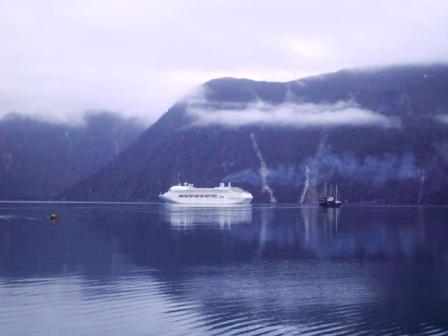
Cruise ship in Milford Sound
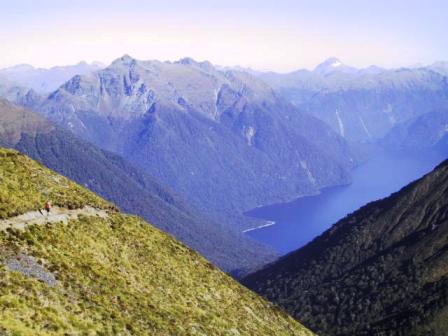
View of Lake Te Anau from Kepler Track
Read Previous Episode
Greymouth to Queenstown or Next
Catlins to Christchurch
Episode 6: Page 1 of 2 Queenstown to Kepler
Track
Sunday 10 February
2002, Invercargill
Skip to
Episode 6: Page 2 Invercargill to
Stewart Island
Boats, Switchbacks, Boardwalks and 10,000 Steps
The
tale continues. We are now in the extreme south of New
Zealand after having travelled the length of the West
Coast of the South Island. We had great weather until we
started to drive to Invercargill, but hey, we needed a
down day.
I have decided that Kiwis must be very determined
people to ski. After seeing the ski fields in the Nelson
Lakes area and then visiting the Remarkables ski fields
in Queenstown in the summer, I admire their determination.
Just outside Queenstown, a sign at the entrance of the
ski road warns drivers to put on their chains; good
advice. You drive for nearly 45 minutes over 14 K of dirt
road switchbacks to get to the base lodge at the foot of
a bowl at 1935 M. According to the literature, the
vertical is 357 M. There are three quad chairs going up
different sides of the bowl but in the summertime the
slopes don’t look very skiable. They are just big rock
piles. They must need a lot of snow to cover all those
rocks and there was no evidence of any snow making
equipment. We wanted to get to the top of a ridge we
could see above one of the tows. It took us 45 minutes to
climb up a service road, then a rocky trail to get to the
top. The highest peaks of the Remarkables Range are at
2324 M and we reached a small viewing platform on a
saddle just below. Our reward was a great view of Mt
Aspiring in the north and two arms of Lake Wakatipu. We
took a different route back down to the day lodge,
passing a small glacier lake. We passed two fellows who
said they had been in for a swim, but it looked too cold
for our taste.
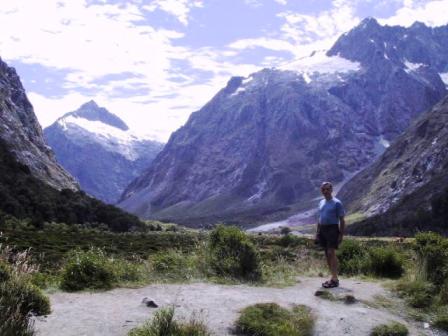 Milford Sound is no more than 100 K due west of
Queenstown, but there are no roads going directly there.
Instead, you have to drive 100 K south, along the shores
of Lake Wakatipu and into rolling hills, then head west
another 100 K to Te Anau before taking the 120 K long
Milford Sound road north again. We had a reservation for
an overnight cruise in Milford Sound on the Wanderer, so
off we drove on Wednesday, January 30. The most scenic
part of the trip is the Milford Road section. There are
lots of mountains to see and waterfalls to stop and
admire. If we had had more time, we could have hiked the
last section of the Routeburn Track, which ends on the
Milford Road.
Up to 80 buses a day drive this road during the day,
bringing their passengers for a day boat tour in the
Sound. We drove to Milford in the afternoon. That meant
that a steady stream of buses leaving Milford passed us
on the road in. The hairiest part of the route is a 1200-M
long tunnel. It was narrow and downhill all the way and
the only light was from headlights shining off reflectors
on the sides of the tunnel. You just hope you don’t meet
many tour buses in the middle. We passed several
bicyclists before we reached the tunnel. They were being
followed by a support van that would pick them up and
drive them through the tunnel. It would not be a fun ride
in the dark.
We were very pleased with our overnight cruise. We
left the dock at 5:00 PM and the only boats in the Sound
were our boat, the Wanderer, the more upscale sister
ship, the Mariner, and one small tour boat making an
early evening trip. The Wanderer can accommodate about
sixty people. The small cabins on the lower deck each
slept four people in bunk beds. The dining room on the
next deck had small booths around the sides and a long
table in the middle. We were served soup and a roll soon
after we left the dock. We would be eating dinner on
board later, but first we had a tour down the Sound.
Milford Sound was formed after glaciers receded from
the sea, leaving sheer
cliffs on either side of a narrow finger of water. The
annual rainfall in Milford is 6 M, but the whole of
Fiordland had been experiencing a drought for the last
month and it was clear sunny skies the evening we visited.
The crew told us
they consider the Sound is at its best during a heavy
rainfall. Since there is almost no soil on the
surrounding mountains to retain the rainwater, the cliffs
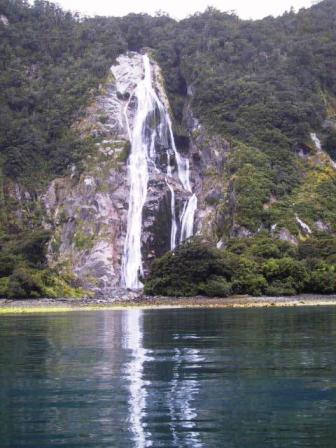
turn into one continuous waterfall. I was content to
admire the few remaining permanent waterfalls in the warm
summer evening.
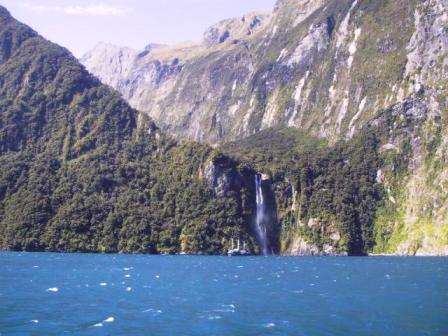
Waterfall in Milford Sound
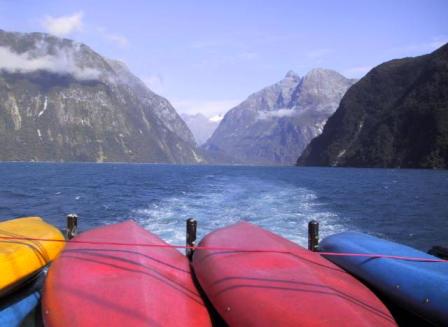
Kayaks for our use
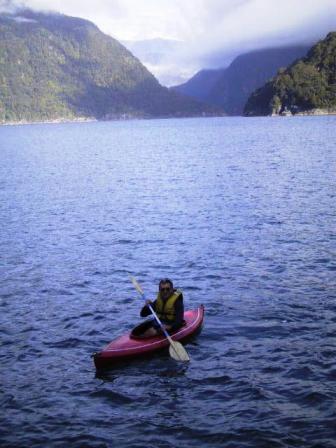
Ray takes a turn
Near the mouth of the Sound, we anchored and got ready
to go kayaking. The
boat carried about 26 one-person kayaks for us to use.
Ray and I made sure we got in line early to get a boat.
It was a lot of fun. We spent about an hour paddling
around the bay. The only disappointment was the lack of
wildlife. If you are there at the right time of year,
there are penguins on the shore and dolphins swimming
beside you in the water. They all had the
day off when we were there. Personally, I think the
penguins are a hoax. Despite all the hype, I am still
waiting to see one in the wild. Oh, well, the South Coast
promises more penguins. In the meantime, we enjoyed
paddling around by ourselves.
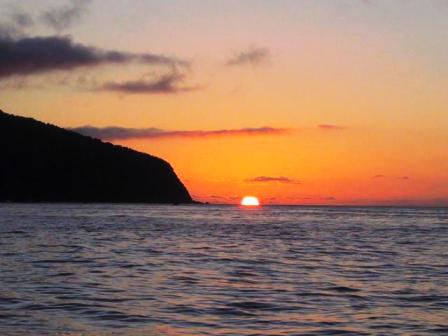 Dinner, what I would call good nourishing Kiwi food,
Lamb Shanks, potatoes, kumara (sweet potatoes) and
veggies, was served shortly after we got underway again.
We motored out of the sound and toured a short distance
around the mouth. No one lingered over their dinner,
although it was very tasty, as they all wanted to be
outside watching the sights. We stayed out
long enough for the sun to make a beautiful display as it
set over the ocean. Then it was back down the Sound to
our mooring for the night in Davis Inlet, a nice peaceful
location. We had time to find the Southern Cross and get
a short lesson in Southern navigation before heading to
bed. The next morning we had a good breakfast and another
tour of the Sound before returning to the dock at 9:00 AM.
I’ve been recommending the cruise to all our fellow
travellers ever since.
We drove back to Te Anau where we stayed at Rosie’s
Homestay hostel. Rosie has been renting rooms in her
family home to travellers for the last nine years, but
chooses to to run a full Bed and Breakfast operation. Her
four children, aged 9 to 17 are quite used to strangers
in their home and were pleased to tell us about their
schools and life in NZ. It was nice to have the
interaction with a Kiwi family.
For those of you who might be interested, Kiwi
bathrooms, especially in Backpackers, are models of
efficiency. Most are designed in the English fashion with
separate rooms for the toilet and the shower. Usually
both rooms have a sink designed to fit in the smallest of
spaces. When I first encountered one of these mini-sinks,
I thought they were quite useless. Now I am quite used to
them and have even grown to admire them. They have a
faucet at each end and are only about one small hand span
wide. Just big enough to wash your hands or brush your
teeth.
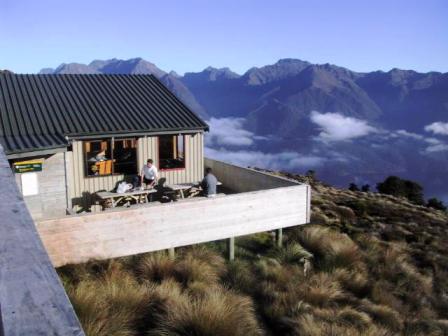 We left the next morning, Friday, February 1, to start
the Kepler Track. We took a boat shuttle across Lake Te
Anau to Brod Bay to cut off a boring round the lake walk.
If we had known the walk up to the first hut was going to
be so short, we probably would have elected to start at
an alternate location half way around the lake. That extra leg only took most
people a little more than an hour and we reached Luxmore
Hut at noon. It was a steady climb on switchbacks through
a beech tree forest to the hut over immaculately kept
trails much like the Routeburn Track. We actually went up
800 M to the hut, almost the same altitude gain as the
Gillespie Pass, but the switchbacks and the condition of
the trail made it a piece of cake.
Luxmore Hut, in a meadow above the tree line, was the
most luxurious hut we have stayed in to date. It had a
large, separate kitchen and dining area and two bunkrooms.
There were even indoor flush toilets, although there was
only cold running water and no showers. We were almost
the first guests for the night so we chose beds in the
smaller and sunnier bunkroom that had two banks of quad
bunks. The other room had single bunks for another 40
people.
We were greeted by the hut warden, another middle aged
woman, soon after we got there. She was waiting for a helicopter to
arrive, bringing a new hut warden for the week and taking
her back home. A few minutes later, the helicopter came
into view and landed on a wooden platform right next to
the hut. Carpenters had been working on new windows in
the hut the previous week and there was much debris to be
flown out. The helicopter exchanged its passengers,
hooked up two large bags of debris to its undercarriage
and took off again without even shutting down its engines.
It was quite a sight.
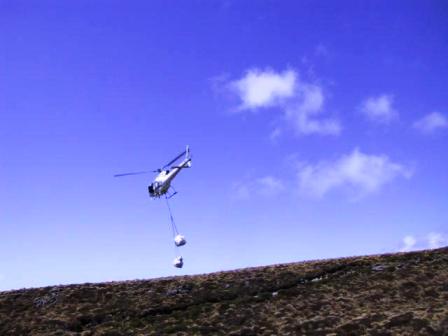
Helicopter brings passengers and
leaves with debris
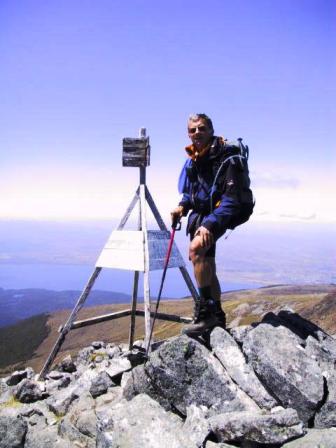
Trig on Luxmore summit
The
day was sunny but cool, just right for an afternoon walk.
We took a recommendation to hike ahead up the trail to
the Luxmore Saddle and climb 15 minutes to the Luxmore
summit. From there we had a beautiful 360-degree view of
the mountains, Lake Te Anau and the nearby Lake Manapouri.
We made a detour on the way back to the hut to visit
the Luxmore Caves. There was a lot of limestone in the
area and that meant caves. The main cave extends nearly 1
K into the hills with many side passages. There were
sturdy wooden steps leading down to the cave but you
needed to feel your way along after that. We just had a
weak headlamp to guide us so we didn’t go very far into
the system. We made sure we could still see the light
from the cave opening and walked until we came to the
first stalactites and limestone formations. It would be
interesting to explore with proper headlamps and a guide.
Ray is getting very brave about caves and claims we
wouldn’t need a guide.
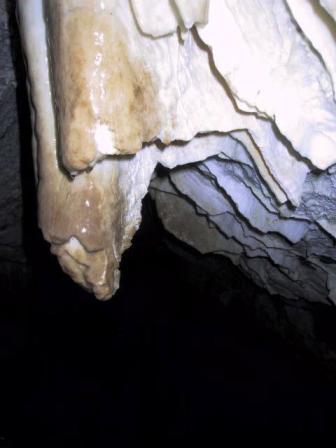
Luxmore Cave Formation
By the time we got back to the hut near 4:30 PM, a
horde of other trampers had arrived. There were about 40
people staying in the hut that night, but there was room
for everyone.
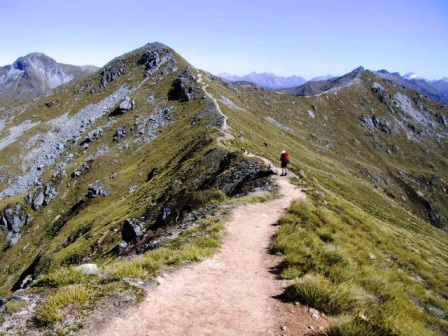
Kepler Trail
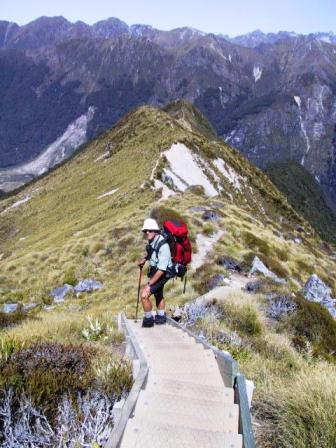
Kepler trail stairs
We had perfect weather for
the second day of our walk. The majority of the day
followed a ridge above the tree line before descending
through the forest to the Iris Burn Hut. It was warm and
sunny so we had the maximum views all the way. No one was in a
big hurry to leave Luxmore in the morning so we were one
of the first people to start on the trail. We hiked in
glorious solitude until lunchtime. Even after that we
only met the occasional tramper. With a relaxing break
for lunch we had six hours of hiking over more pristine
trails. Even one section down a steep rocky slope was
made easier by wooden stairs. The section through the
forest dropped 900 M over multiple switchbacks, making it
easier on our knees. We were told afterwards that there
are 96 switchbacks on the Kepler Track. All the same, we
were glad to take our boots off and rest when we reached
Iris Burn Hut.
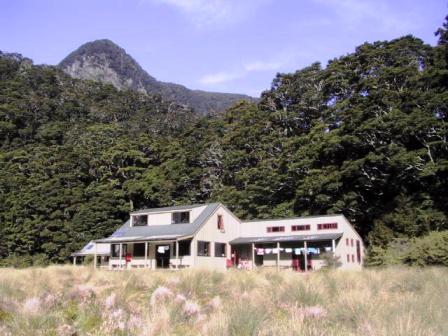
Kepler Iris Burn Hut
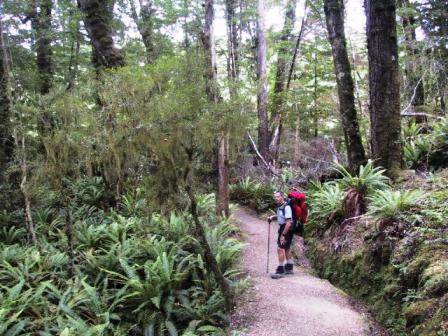
Kepler Fern Forest
Iris Burn had similar
facilities to Luxmore Hut. Our only problem was that
although gas burners were provide you needed matches to
light them and we, along with all the early arrivals,
forgot to bring any. We had to wait for the later
arrivals to get our afternoon tea. We washed out some of
our clothes in cold water and hung them on the line to
dry. It was so warm it took no time at all to dry.
Our
last day of the hike was through the trees nearly all the
way. We have seen a lot of NZ beech tree forests, so we
didn’t waste too much time admiring the view. Like many
of our fellow trampers, we hustled ahead to the end. One
stop we did make was at the Big Slip of 1984. Part of the
mountain 400-M across the valley gave way during heavy
rains and pushed huge boulders and mountains of mud and
stone all the way across the valley. Nature sure is
powerful. We had lunch at Motauro Hut, where you can stay
a third night before hiking back to Te Anau. We had
planned to hike an hour further to Rainbow Reach where a
shuttle bus makes a regular daily run to take trampers
back to town. We were double glad we had made that
decision, as the sandflies were fierce at the hut. Even
my DEET was no match for them. They soon drove us indoors
to finish our lunch.
Next:
Episode 6: Part 2 Invercargill to Stewart Island
Read about our visits to the
Cook Islands or
Fiji
Return to
New Zealand
Intro
Return to
Travels
Return to
Introduction