Episode 2: Naxos
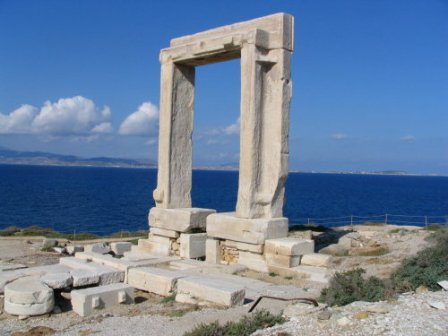
Click the photo of the Portara
above to see an album of photos for Naxos.
Close the window to return to this page.
Read Previous Episode
Athens
or Next Episode
Santorini
24 September 2005
– 1 October 2005We took the Blue Star Ferry from
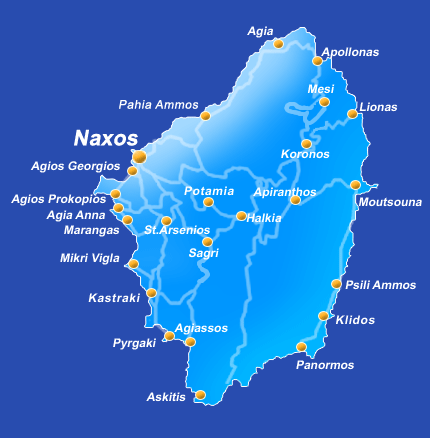
Athens to Naxos, the largest island in the Cyclades at
448 Sq Km, early the first Saturday morning. We were
happy to be met by Vagelis Kavuras at the port in Naxos
Town (also known as Hora) after our pleasant 5-hour trip.
He drove us to his family run Hotel Agios Prokopis, about
6 Km from Hora and just a short walk to the lovely sandy
beach, Agios Prokopis.
We had spacious
studio rooms set around an inviting pool. The hotel
served a nice breakfast on the patio every morning and we
had either lunch or dinner at one of the restaurants in
Hora or Agios Prokopis. Each unit had a basic kitchen
that we used to prepare a picnic style meal, which we ate
on the patio around the pool. Our host family was
especially welcoming, providing us with a bottle of their
own quite good wine on two occasions. This is a spot we
would return to.
The weather was warm and sunny for our week on Naxos
so we made sure we swam every day. The beach had the
usual profusion of beach chairs and umbrellas to rent but
we preferred to pick a spot to put our towels or rush
mats on the coarse white sand beach.
We were
not quite brave enough to join in the nudist section of
the beach, but given more time, who knows. The water was
pristine and clear and about 75 C in late September. The
salt content of the Mediterranean is much higher than the
Atlantic or Pacific so floating is a piece of cake. After
our swim, we would walk down the almost 2 Km of beach to
dry off. In fact, we had almost 10 Km of beach to choose
from. Since we had rental cars we were able to try out
other nearby beaches. We drove around a small headland
and past several restaurants and small hotels to try out
Plaka Beach, with finer sand and fewer swimmers. Our tans
improved nicely over the week.
Naxos had lots of other towns
to explore. The Portara (Great Door), all that is left of
a 6th C BC temple to Apollo, overlooks Naxos harbour.
Naxos Town, has an old section, the Kastro, with narrow
winding streets lined with shops and restaurants snaking
up a hill to a Venetian castle on the top.
Sunday evening we
attended an open-air concert and wine tasting in a
courtyard next to the Venetian Museum, a typical home
built during the Venetian domination in the 13th C AD. We
sampled local wines and the unique-to-Naxos Kitron
liqueur, a Cointreau variety made from the leaves of a
warty looking citrus fruit. That left us in a good mood
to enjoy traditional music played on a violin, a bouzouki
and a Greek bagpipe. Four young people, members of a
traditional dance group in a nearby village,
energetically performed for us. The evening ended by
Carolyn and I joining a conga line of Greek dancers. The
wine helped our expertise.
Each day we chose a different route to explore the
island of Naxos. Ray and I were keen to hike up to the
top of Mount Zas (or Zeus – the Greeks are not fussy
about how place names are spelled, variations of place
names abound), at 1000 M the highest peak in the Cyclades.
Jack and Jenni had a geo-cache to find in a cave on the
hill, so we all took off in our rental cars. The narrow,
winding road to a parking lot at the start of the walk
was the first of many such roads we discovered in the
islands. For those people who don’t like heights, it is
better to close your eyes while negotiating the hill. The
rest of us, not the drivers, just enjoyed the great views
of the spectacular but barren, rocky landscape.
From the parking lot it was a
20-minute walk to a spring just outside a cave that once
served as a chapel. Ray helped Jack locate his plastic
baggie geo-cache inside the cave and Jack left a pin from
his hometown of Quispamsis, outside Saint John NB. Ray
and I continued up the mountain on a poorly marked trail.
We followed another threesome thinking, erroneously they
knew where they were going. As Ray would say, we explored
a new route up some loose skree until we finally
discovered the easier cairn marked trail to the top. An
hour later we were enjoying the view and snapping photos.
The trip down was much easier and we rejoined Jack and
Jenni back at the car. Lorie and Carolyn had left earlier
to explore other nearby towns.
After a brief
detour to locate yet another geo-cache in a roadside
Chapel. Jenni couldn’t resist pulling a bell rope to ring
the bell in the steeple. I was worried that would bring
villagers running to see if there was a fire or other
catastrophe, but all was quiet. We hustled back to the
car and drove to Apiranthos for lunch.
This mountain village, with
many of its buildings, streets and walls built of white
Naxos marble, is considered the prettiest village on
Naxos. It also has several good restaurants, one of which
we chose with a balcony overlooking the valley. On the
way back to our hotel we stopped in Chalki to visit a
Kitron distillery. We had a short tour, sampled the three
varieties of this liqueur, and bought a bottle to enjoy
after our meals.
Our map indicated what looked like a good back-roads
route to the Temple of Demeter. Part of it was unpaved,
but how bad could it be? It was an adventure. We drove on
progressively rougher roads that ended in a farmyard. A
helpful farm worker pointed out the road to follow to get
to the temple. Ray and I were in the larger Hyundai
Accent and drove slowly over the rocky road to reach the
paved highway again. When the other four, driving in the
smaller Kia Picanto, reached the paved highway, Carolyn
got out and kissed the pavement. They were sure they were
hitting bottom the whole way and would rip the gas tank
open. Luckily it didn’t.
The Temple of
Demeter, Goddess of the Crops, was worth the trip. The
site was one of the best presentations we saw. The
surroundings had been carefully landscaped with native
plants and informative signs were everywhere. Just a few
years ago the 6th C BC temple was discovered dismantled
on its original site and overbuilt with a 6th C AD
chapel, but luckily all the original pieces were there.
Archaeologists have been working hard to reconstruct the
original temple, built entirely of marble. Even the roof
and trusses were marble, giving the whole building a
translucent effect in the sunlight. A small museum onsite
gave us more information about the work that has been
going on.
On the way back to our hotel we made a brief visit to
another good reconstruction effort. The Temple of
Dionysis, started in the 6th C BC as a tribute to the God
of Wine. The work is not as advanced as the Temple of
Demeter but the informative signs explaining how four
different temples expanded the original structure and the
olive groves and grapevines surrounding the site made for
a peaceful stop.
Our road trip to the north end of the island nearly
did Lorie in. Jenni had suggested we take a side road to
see the Ipsilotera Tower, a Venetian Fortress Monastery
of note. Once again the road was unpaved the route got
progressively worse. We reached the Tower without
incident, but it was not open to visitors and looked
rather forbidding. Instead of retracing our route to the
main road, we decided to follow the road ahead that on
the map came out in a town farther down the main road.
Ray and I were alone in the Hyundai and barely made it
over what progressed into a cow path, but the other four
in the Kia were scraping bottom. When we finally made it
into town, Lorie blasted us for taking us on such a
dangerous route. Their guidebook apparently said not to
go that way. Unfortunately no one informed Ray and I of
the caution. We promised not to pick any more yellow (unpaved)
roads. Anyway, we made it through without damaging the
cars and continued north, stopping now and then to enjoy
the view. Jack said he had not expected the island to be
as rugged as it is. The western shore where we stayed
with its long beaches is relatively flat but the
Northeast coast of Naxos is dramatic with the road
following along the top of a sheer cliff.
Our destination that day was
Apollonia, a small fishing village currently being
developed as a resort. In late September it was very
quiet and picturesque, with outdoor cafes lining the
small port. We had coffee and a snack and visited a shop
where we all purchased well-made silver jewellery in
traditional Greek designs and small reproductions of
Cycladic sculptures from 3000 BC in white Naxos marble.
Just
outside the town is an ancient marble quarry where an
unfinished 10 M tall Kouros, a striding man, lay
abandoned. The archaeologists say it was probably a
figure of Dionysis, the patron God of the island and was
rejected in the 6th C BC when part of the statue broke.
On our way home we visited another spot where a rejected
Kouros, almost as tall as the Apollonia one, lies for
eternity. We walked to the Kouros with an elderly Swedish
couple. The gentleman told me he had visited Naxos 77
years before but everything had changed. I wonder what it
would have seemed like then.
We stopped by the road to
watch a marble quarry still in operation. While big slabs
of marble were cut from the side of a mountain, a
bulldozer was pushing unwanted pieces over the side of
the hill. What seemed to us huge chunks came tumbling
down the mountainside, almost to the road. It would be
easy to get small pieces of marble to make sculptures
like the ones we bought in Apollonia, but not when the
workers were there.
Naxos has an
excess of small chapels, many from Byzantine times. In
some areas it seemed that each family had built their own
chapel. It must be a lot of work for the people to
maintain them as well as they do. We visited one of the
most famous. The Panayia Drossiani, Our Lady of
Refreshment, is noted for its frescoes from the 7th and
10th C AD. Just after the frescoes were completed, a
severe drought on the island was ended. An Icon of the
Virgin Mary was credited with this miracle and hence the
name of the church. The frescoes were lovely but I was
disappointed that no photos were allowed inside the
church.
Another afternoon
Ray, Jack and I took a short hike up a hillside to visit
another Byzantine chapel, Kaloritsa. At least the trail
was well marked and we had no trouble finding the chapel.
Our guidebook said to visit in the late afternoon so that
sunlight would illuminate 13th C AD frescoes painted on
the walls of a cave chapel inside the ruins of the main
chapel. You cannot go inside the cave but we did have a
good view.
Return to Greece
Intro
Return to
Travels
Return to
Introduction