Episode 3: El Salvador Daliances
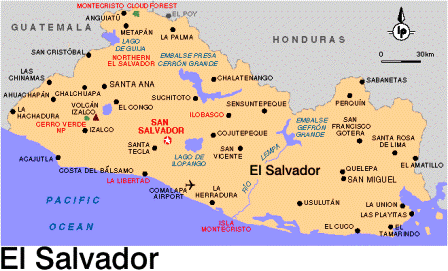
Click
the map above to see an album of El
Salvador photos. Close the window to return to this page.
Read the Previous Epsiode
Crossing Borders
or next episode
Saints on Parade
Tuesday 15 March
2005, Leon, NicaraguaYes we are in sunny, hot
Nicaragua after spending two weeks traveling through El
Salvador. If anyone tells you to stay away from El
Salvador because it is a dangerous country, tell them it
is no worse than the rest of Central America. Yes, petty
crime exists as it does elsewhere, but we never felt
threatened. As we expected, the people were warm and
friendly and always willing to answer our questions and
help us get to our intended destination. Most of the time
we were the only Gringos, but we had no problems finding
transportation and a place to stay.
El Salvador uses the American Dollar but prices are
what I remember in Canada during the 1950s. We paid as
little as $0.75 for a beer, less for a soft drink and
lunch for two people was under $4.00.
Breakfast in El Salvador was similar to what is
offered in other Central American countries; a Desayuno
Typico is eggs scrambled with onion, green pepper and
tomato, refried beans, fried plantains, a piece of
Farmer’s cheese with a thick cream(I skip the cheese and
cream as it is too rich and salty for my taste),
tortillas and coffee. That gets you through until lunch,
the main meal of the day. We try to find a cheap and
filling Menu del Dia or a Comedor (small restaurant) a la
Vista (you choose from foods on display). There is
usually a choice of chicken or a meat dish with rice,
salad or other vegetable dish, plus tortillas. We have
eaten so much by supper time that we are content to visit
a Pupuseria where we order two or three Pupusas, but
locals eat many more. Pupusas, a cornmeal mass stuffed
with farmer’s cheese, refried beans or sometimes spinach,
are fried on an outdoor griddle. On the table is a large
glass jar of homemade Curtido, a spicy, pickled coleslaw
and a container of tomato salsa. You spoon Curtido and
salsa onto the potato pancake-like delicacies and eat
them with your fingers. Messy and good. Only in El
Salvador you say? Pity.
Our route from Guatemala to El Salvador was long
enough to include an overnight in Chiquimula, a
forgettable town with at least a nice central plaza. The
border, when we reached it the next day was clogged with
transport trucks, mostly hauling containers from ships in
Puerto Barrios, the only Caribbean port in Guatemala, to
El Salvador and beyond. Our minibus passed at least 100
parked trucks to drop us at the border. There were so
many trucks I thought maybe there was a work-to-rule
strike, but I guess that is the usual occurrence. We just
filled out forms and walked across with no problems.
At the bus stop on the El Salvador side, a woman who
said she could speak English approached us. She said she
loves to practice her English, which was about as good as
my Spanish, so we chatted away, understanding about half
of what was said. We ended up sharing a taxi to the town
of Metapan with her, but regretfully refused a visit to
her home.
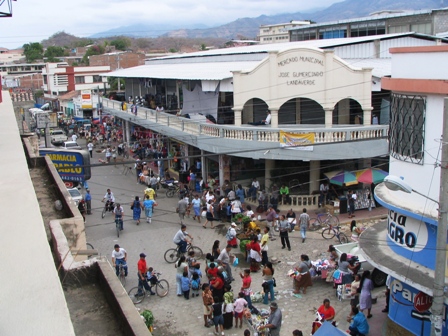 Metapan was one
of the most unattractive towns we have visited. It didn’t
have a nice central square, the streets had been torn up
and garbage was everywhere. The informal market area did
add character to the town. Unlike most towns that have a
central market building, Metapan vendors set up shop at
curbside or roamed the streets carrying their goods in
their arms. Music blared from corner loud speakers to put
shoppers in the buying mood. We could watch all the
activity from the rooftop terrace of our hotel.
The reason we stopped in Metapan was to take a
recommended bus ride eastwards over the mountains. It was
an interesting three hour drive slowly up and down a dirt
road, with views of the mountains all around us. We ended
at the border town of El Poy where once again the trucks
were lined up to cross to Guatemala.
We took another bus to the town of La Palma, a much
prettier town full of artisans shops. The artist Fernando
Llort settled here in 1972 and taught locals to produce
colourful naif style paintings of village life and gaily
decorated crosses. If you have ever seen art work sold
from El Salvador, it was probably painted in La Palma. We
stayed in the best hotel in town, a simple resort with a
restaurant and pool. It wasn\’b4t the same standard as a
North American resort, but at US$23 per night it was a
good deal.
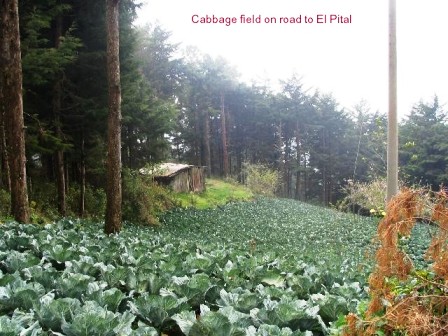 Near La Palma is
the highest peak in El Salvador, El Pital 2730M. We took
a bus up into the hills to the trailhead for El Pital. We
walked along a dirt road for an hour past fields of green
cabbages, waiting to be harvested for pickled coleslaw to
go with Pupusas. It had poured rain the night before, the
first real rain we had experienced in Central America,
and clouds were still lingering on the top of El Pital.
In fact, when we reached the top, we couldn’t see a thing
and the temperature had dropped dramatically. We were
sweating on the way up, but it took quite a while for me
to warm up on the way down.
The next bus back to town wasn’t due to leave for more
than an hour so Ray had lots of time to chat to Walter,
an Agro-economist who retired to the area. He is a Ham
radio operator and loves to chat in English. Ray found
him very interesting. Walter helped us by arranging for a
ride in the back of a pickup truck all the way to town.
Our next stop was
Suchitoto, a colonial style town that has been compared
to Antigua, before it became a tourist destination. It is
a quiet, pretty town, full of potential, but still
undiscovered. Friday noon, the bus to Suchitoto makes a
special detour to pick up school children returning to
their homes for lunch. The rest of the passengers on this
already crowded bus were prepared for this detour down a
bumpy, dusty road. Most closed the windows and got out
handkerchiefs to put over their faces. We bumped down to
one school where the children were all waiting, all 50 of
them, in a nice straight line. I would never have
believed they could all get on, but that was just the
first school stop. Two more school-fulls crowded on,
thankfully to go but a short distance.
We got off the bus in Suchitoto trying to find our way
on unmarked streets to a hotel listed in our guidebook. A
young French girl, working as a volunteer in Suchitoto,
offered to help. She mentioned that her landlady, Senora
Rubia Ebolo, had a spare room, so we ended up staying
there too. It wasn’t the plushest accommodations but it
had laundry facilities and a relaxing courtyard.
Suchitoto was the
hottest we had experienced yet, so we did a lot of
relaxing. We did walk one Km down to a reservoir lake,
Embalse Cerron Grande, to have a look. A new tourist
center on the edge of the lake, still awaiting tourists,
has been built with the help of Belgium. Tour boats sat
waiting to take customers on a tour of the lake. At US$10
each, we were content just to enjoy the view from our
side.
Saturday night is movie night in Suchitoto. Movies are
projected on a sheet set against a wall on the town
square and using a television DVD player, movies are
shown to the assembled families. The French government
must have sponsored the show that night for the audience
suffered through a documentary of technology in France
before the main offering. We gave up and wandered to
another park where everyone sat in lawn chairs watching a
classic Charlie Chaplin silent movie. That was much
better. Our entertainment for the night didn’t end there
as a very good group was playing at a local hostal/bar, 2
Gardenias. We had a beer and listened to their repertoire
of traditional Spanish songs and latinized Beatles and
American classics.
We had planned to visit the town of Santa Ana, but the
bus from Suchitoto went past a lake, Lago de Coatepeque,
which sounded more inviting. Many wealthy San
Salvadoreans maintain vacation properties on the lake. We
detoured to the lake and booked into a simple hostal,
Amacuilco, on the lake. We got the best room in the
house, a simple wood cabin with a balcony overlooking the
lake. At the end of a rather rickety wooden walkway was a
terrace with tables and chairs. A ladder led down to the
cooling lake waters, just what we needed after a hot bus
ride.
We were not the only Gringos at Amacuilco. A group of
young backpackers were staying there as well. We had a
nice chat with them in the afternoon, but that night we
wished they were not there. After many beers, a
Portuguese fellow decided to have an all night bongo drum
marathon on the lakeside terrace. Sound carries very well
at the lake and by 2:30 AM Ray had had enough. He stomped
down to the terrace and asked him to quit. The drum
player told him he could play as long as he wished, so
Ray and another couple who wanted to sleep enlisted the
help of Sandra, the manager, to put an end to the noise.
The bongo player wasn’t even very good!
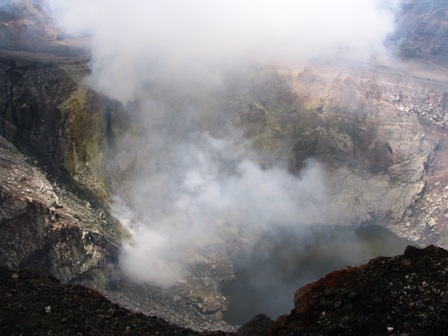 Early the next
day we took the bus to Cerro Verde National Park on the
other side of the lake, to do a day hike of a volcano. We
had a great day. We joined four young ladies travelling
and volunteering in Central America for a guided hike to
the top of the volcano. There are two active volcanos you
can climb, the barren Volcan Izalco, which erupted
continuously until 1957, and Volcan Santa Ana. We opted
for Santa Ana. For US$1 each we had the services of a
young girl as guide and an escort of two policemen. As
was the case in Guatemala, incidents had occurred on the
trails in the past so a police escort is now provided. It
was about 1 hour of hot uphill climbing until we passed
hillsides of Yucca and reached the barren slopes of the
volcano. In another 20 minutes we were on the top. One
side fell away more than a hundred meters to a smoking,
sulphorous crater lake. The other side gave a spectacular
view of Lago de Coatepeque, even farther below us. We had
a snack at the top and reluctantly retraced our steps
back down the volcano.
Back at the hostal we learned that Sandra had evicted
the crowd of rowdies, but not without some trouble. The
bongo player took exception to being asked to leave and
had a temper tantrum. No wonder some establishments count
backpackers a mixed blessing.
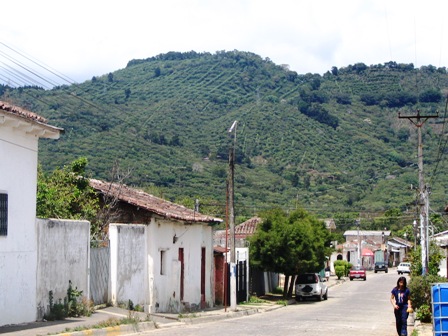
We continued farther west the next day, to the town of
Juayua, a pretty small town in the middle of hills and
coffee plantations. Juayua and two other neighbouring
towns were the center of indigenous uprising which led to
a revolutionary movement in 1932 that was brutally
crushed by government forces, backed by the coffee owners.
The military retaliated by killing anyone that looked
vaguely indigenous. Most of those surviving fled to
Honduras and Guatemala. Juayua is now a quiet town with
tree lined streets.
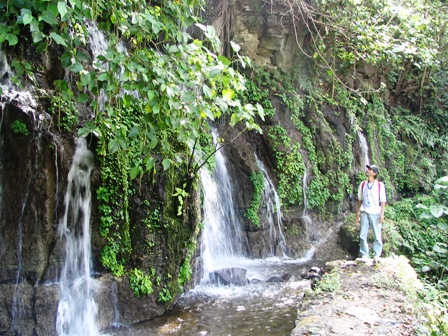 The Lonely Planet recommended
hiring a guide for hikes in the area, so we arranged for
Lara, a local man, to lead us. He was most pleasant and
once he realized we old fogies were quite fit, took us on
a good exploration of the countryside. We walked to Los
Chorros de Calera, a series of waterfalls forming large
pools in the middle of a jungle. They are actually
dikes used to generate hydroelectric power for Juayua. We
visited the rather primitive hydro plant, built in the
1960s, and continued on through a coffee plantation. The
coffee owners have built a public park with a swimming
hole and a series of wash tubs. A school group was just
leaving the park when we arrived and some boys were
swimming and bathing in the water but the tub area looked
unused. Perhaps it was too far from town to be useful.
We walked about two Km back to town, through a very
poor looking subdivision, typical of the outskirts of the
towns. The homes were little more than shacks, although
most were relatively neat. Water was provided from common
taps and carried to the homes in big plastic jugs. Large
piles of firewood were piled beside the houses for sale
to townspeople.
 We
We
hired Lara again for a second hike in the neighbouring
town of Apaneca, at 1450 M the highest town in San
Salvador, and therefore one of the coolest spots. Juayua
has established a popular food festival on the weekends
and Apaneca is trying to become an artisan center
although we didn’t see much evidence of it when we were
there. We walked to one of two crater lakes, Laguna de
las Ninfas, north of town. We passed a gated community of
vacation homes and then climbed up and down a dirt road
to reach the shallow lake. Reeds, used to weave baskets,
grow at the shore. We walked around the small lake,
through a coffee plantation, and then up a hill to look
down on a former crater lake. Lara led us on paths along
a ridge, but to regain the main road back to town, we had
to cut through a farmer’s house, with permission. It was
a simple mud-floored hut, one of many in the area, but we
were welcome to walk through.
Back in Apaneca, we had lunch in a Comedore (restaurant)
complex across from the town plaza and the site of the
town church. The 400-year old Iglesia San Andres Apostle
was one of the oldest in El Salvador but it was
completely destroyed in a January 2001 earthquake. It is
now behind a metal fence, in the process of
reconstruction.
Juayua has a
large church on the side of the town plaza. It has a
unique to El Salvador set of bells that toll the hour
plus play tunes for the 6 PM service. Chairs were set up
under a large canopy in front of the church one evening
and a service was transmitted by loudspeaker to the town.
We couldn’t figure out why the service would continue all
night long. It didn’t bother me but Ray used his earplugs.
In the morning our hostess, Clara, told us it was a wake
for a lady, a dedicated member of the congregation. It
still seemed unusual to us.
El Salvador had a long and bloody past. The ‘conflict’
lasted from the 1970s to 1992. Perquin was the
headquarters of the FMLN, the left-wing opposition to the
government. This tiny town, perched in the mountains
close to the Honduras border, now has a small museum as a
memorial to the atrocities that occurred during this time.
We were told it would give more insight into El
Salvador’s history and it was a pretty location, so how
could we resist.
We stopped overnight on the way in San Miguel, a large
commercial town with a good, modern hotel with a small
pool across from the bus station. That was a bonus at US$26,
the upper end of our price range.
In Perquin we stayed just out of town as the lone
guests in a converted lumber mill. It was clean and
comfortable. We visited the museum with its pictures of
the assassinated leaders of the FMLN, including many
women, and display of armaments. Behind the building are
the remains of a downed helicopter that killed the hated
Colonel Monterrosa, blamed for the 1981 massacre of 1000
townspeople in the nearby town of El Mozote.
Across the street
from the museum is Cerro Perquin. A path to the top
passes by the former guerrilla camp, bomb craters,
trenches and a tunnel used by the FMLN. The view from the
top looks over green mountains stretching to Honduras not
far to the north.
That was our last stop in El Salvador. The next day we
started early for a long trip to Nicaragua. We took one
truck, four buses, one minibus, one taxi, and crossed the
border from El Salvador to Honduras, then crossed from
Honduras to Nicaragua, finally arriving in Leon at 6 PM.
Our connections were so good that we never had time to
stop for lunch.
The biggest rest break was at the El Salvador-Honduras
border. The extremely inefficient system had us lining up
to fill out forms and get stamped out of El Salvador,
then lining up again at an adjacent wicket to pay US$3
each and get our passports stamped to enter Honduras.
They staple the entrance fee to the filled in form so
they didn’t even have change when we tried to pay with a
$10 bill. It didn’t help that there was a bus load of El
Salvadorean kids going to a basketball tournament trying
to get through this process too. It took an hour before
we were on our way again.
The Honduras-Nicaragua border was easy in comparison.
We got off the bus to be besieged by cyclo drivers all
vying for our business to ride us to the immigration
office and then to the bus. We elected to walk to the
immigration office, which was almost deserted and took
just a short time to be processed. One driver, Alexander
(the Great, he told us) spoke good English and convinced
us we needed his services to get to the bus station in
time to make the 3 PM bus. He was right. He worked hard
for his money, riding 2 KM over a bridge and up another
incline to the bus. We got on just before it departed.
I am sure the Nicaragua roads will be good in another
year or two but they are currently being rebuilt for the
first 50 Km from the border. After mostly good El
Salvador roads, the bumpy ride was slow and dusty. We
were glad to finally reach Leon, find a hostal, have a
shower and finally have supper.
We were too tired to care that our accommodations were
less than acceptable, so we changed hostals the next
morning. Leon is pleasant, but very hot, so we are using
the opportunity to relax, walk about town a bit and write
this latest episode. Tomorrow we head to a beach area 20
Km from town to try out the Pacific surf for a few days.
I guess those of you who ski are glad of the new snow
that has fallen in March, but the rest of you have
probably had enough. We are staying near fans to keep
cool. What a contrast.
Return to
Travels
Return to
Introduction