Episode 2: Crossing Borders
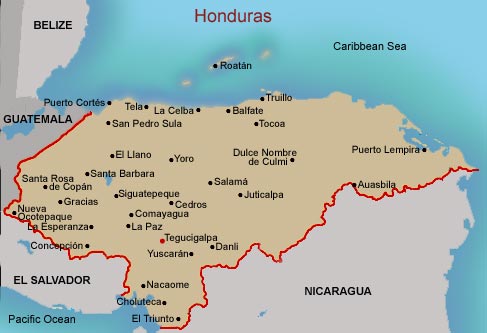
Click the map above
to see an album of photos for Honduras. Close the window with the photo
album to return to this page
Read the Previous Epsiode
Riding the Chicken Bus
or next episode
Page 1 of 2
Sunday 27 February
2005 Flores, GuatemalaInstead of crossing from
province to province or state to state, we have been
crossing international borders. We have entered Guatemala
three times, made side trips to Honduras and Belize, and
we leave shortly to make our way to El Salvador. It has
been getting progressively warmer, with a high of 32 C
yesterday, in the shade. We have forgotten all about
winter and the need to wear warm fleece, sunscreen is
what we need now.
But back to our adventures: I fear I gave a very bad
impression of Antigua. It is really a nice town, trying
very hard to cater to the many tourists who visit. The
town plaza, with its gushing maidens fountain is a
lovely, leafy haven, devoid of hard sell merchants.
Saturday night it is often the place to come and enjoy a
free outdoor concert. We were there at the beginning of a
week of cultural activities and the entertainment that
Saturday was an excellent quartet, a family group of
three brothers and a sister, who sang rumba and flamenco
numbers to the obvious enjoyment of the audience.
Mayan cities thrived over much of Central America for
up to 2000 years before being abandoned about 1000 AD. No
visit to Central America would be complete without at
least one visit to rediscovered Mayan ruins. Our first
choice was Copan, just over the border in Honduras. The
easiest way to get there is to take a minibus from
Antigua. The only glitch is that the bus leaves Antigua
at 4 AM so that five hours later you are at the entrance
to the Copan ruins. Ray is a morning person but I prefer
a later start to my day. Travelling does not allow that,
so I have been forced to adjust my schedule. We were
waiting out in the cold, dark street at 3:55 AM for a bus
that did not arrive for more than an hour. The bus driver
slept in! He is not long for that job. We picked up two
other couples, one of whom had headed back to bed, and
away we went. At least none of us were on a fixed
schedule, but we all could have used the extra sleep, but
this is Central America; mañana, mañana.
Internet dating seems to be paying off as we have met
two couples who have married after meeting their partners
through the Internet. Steve and Annie, from Connecticut,
travelled with us to Copan and we later met Luke, from
the Netherlands, who met and married Anne, a Taiwanese
girl living in New York. Lana, an American girl, a non-stop
talker, related hilarious tales of unsuccessful Internet
dating. The guys probably gave up trying to get a word in
edgewise.
We stayed in
Copan Ruinas, the town 1.5 km from the ruins themselves.
The first day we visited the local museum, getting a good
introduction to the ancient city. Up to 27,500 people
lived at Copan at its height in the 7th and 8th centuries.
Like most other Mayan cities, it was abandoned by 1000 AD.
The theory given is that the agricultural practices
caused the decline. Farmers in the area still employ the
slash and burn method of clearing land. They plant corn
and other crops that thrive for just five years before
the land is depleted, after which they must slash and
burn more land. With fewer trees, there is less rain, the
water supply dries up and crops do not grow. Burials from
the 9th C have shown signs of malnutrition for lower and
upper class people. There is also a theory that the lower
classes may have lost confidence in the the priests when
conditions did not improve and led a revolt against the
upper classes. This would have eliminated the people with
the most knowledge, further deteriorating the situation.
Eventually people migrated elsewhere and the cities were
abandoned to the jungle.
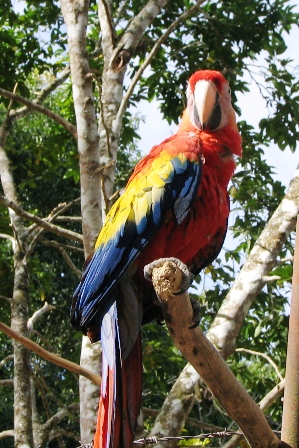
Macaw at Copan
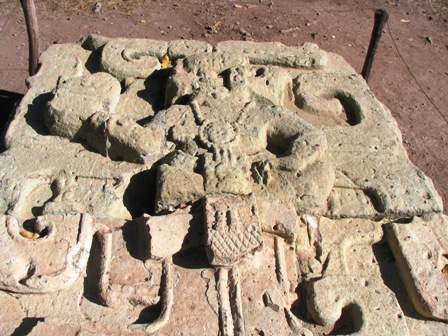
Copan Carving
Steve, Annie, Ray
and I shared a local guide, Fredy, to tour Copan. He was
very knowledgeable, leading us around the large complex
that included two ceremonial areas surrounded by pyramids
with altars on top, one for the Royals and one for the
common people, as well as a large residential area. Copan
is known for its Stelae, huge carved stones erected by
each of the 17 rulers between 250 to 850 AD. Each is
carved in the likeness of the ruler and has hieroglyphics
giving the date of the ascension to the throne and
details of important events during the reign of the King.
The 15th ruler, Smoke Shell, built a pyramid with a
stairway covered in hieroglyphics, reputed to be the
largest in the New World.
Copan
also boasts a ballfield, similar to those found in other
Mayan sites. A team of five players, dressed in red,
depicting either East, or Good, depending on who you
listen two, play an opposing team dressed in black,
depicting West or Evil. The relatively small rectangular
playing field is between two banks of concrete steps,
topped by a large stone eagle head. Points were scored
when a rubber ball, hit by any of the 13 joints of the
body, managed to strike the eagle head of the opposing
team. In Copan the game was played once a year with the
player deemed the best in the game, gaining eternal life
by being sacrificed to the gods. What a reward!
We
also visited a residential site 1.5 km away. Las
Sepulturas was the palace compound of an important Royal
scribe. It consisted of several plazas surrounded by
homes for his wives and children and smaller plaza
compounds for his adult sons and their families. Several
bodies were discovered buried at this site, hence the
name Sepulturas. Only about 25% of Copan has been
investigated, leaving much work for future generations of
archaeologists.
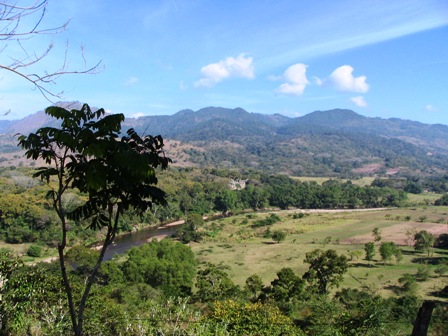
View from horse ride
We stayed another
day in Copan Ruinas for a horse ride across a bridge and
up a hill to Hacienda San Lucas, a Spanish style building
filled with antiques set in lovely gardens. We left our
horses there and followed a jungle path to a sacred Mayan
fertility spot called Los Sapos, the Toads. There was one
rock in the shape of a toad and another depicting a woman
giving birth. I am not sure of the connection. Further in
the woods was a small pond fed by underground steams that
is used by locals for bathing and washing clothes. We
returned to our horses and followed our guide, Charlo and
his nine year old son out to another small town and back
to Copan Ruinas.
In this warm climate, most people live their lives
outdoors. Each house in town had an outdoor stove fired
by wood. Laundry is done by hand in large, three part
stone tubs. Hardly anyone has a washing machine. We have
been using the tubs to wash our clothes. The largest
center tub has a tap dispensing clean water. The
shallower tubs on either side are sloped towards a drain
at the back. The left hand tub usually has a built in
scrub board for the first wash and the right hand tub is
used for the rinse cycle. You stuff a plastic bag in the
drain and use a plastic bowl to scoop clear water from
the center into the side tub. It works, if a little
labour intensive.
Copan was our only stop in Honduras. From there we
returned to Guatemala, taking four different vehicles to
get to Rio Dulce. We took a pickup truck to the border
and changed to a collectivo for the ride to Chiquimula
where we boarded a rickety old pullman bus to the town of
Moreno, where we changed again to a collectivo for a
short ride to Rio Dulce. Collectivos are 14 passenger
minivans that pick up passengers along their route until
they have at least 25 passengers plus several more
hanging on the outside. They are cheap and efficient, if
a little crowded.
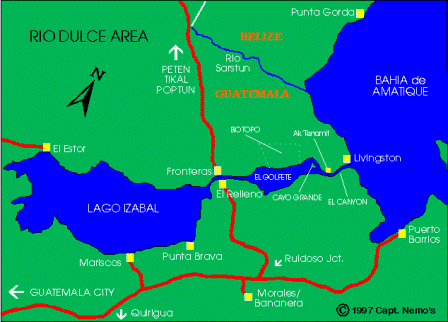
Click
the map above to see
an album of photos for Rio Dulce. Close the window with the
photo album to return to this page
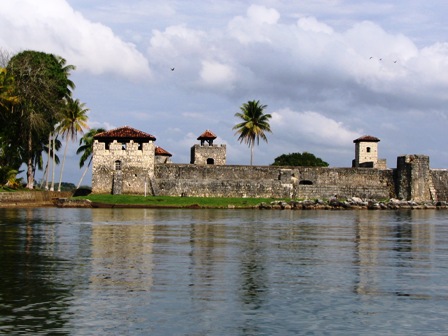
San Felipe Castle on Rio Dulce
Rio Dulce flows
from the eastern end of Lago de Izabel, the largest lake
in Guatemala, to Livingston on the Caribbean. We stayed
at Hacienda Tijax, a small resort across the harbour from
the town of Rio Dulce. The town is not much more than
stores on either side of the highway to Puerto Barrios,
the only Caribbean port for Guatemala. Tijax was much
nicer. Small cabins are set in the woods behind a
swimming pool and restaurant complex. We elected to stay
in a very simple room above the restaurant rather than
the more expensive but nicer cabins. Maybe next time we
would spring for a cabin. There were no screens on the
windows so the mosquito nets came in handy. We had
started taking Malaria pills once a week, just as a
safety precaution after we left the mountains, but the
mosquito situation has not been bad at all. Rio Dulce was
the only place we have used mosquito nets so far.
We spent a pleasant two days at Tijax, swimming and
walking the trails through a mangrove swamp and rubber
tree plantation owned by Tijax. They even cater to cruise
boat groups who want to visit a working rubber tree
plantation.
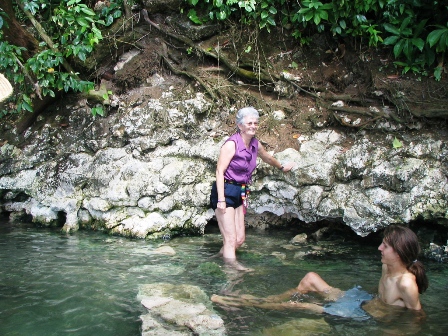 Most people come
to Rio Dulce to take a river cruise to Livingston. We
took a lancha, a motor boat with a canopy cover, with
about eight other people for the three hour trip. The
driver acts as a guide, pointing out all the sights along
the way. Most of the jungle shoreline is protected
natural park. Half way down the river widens into El
Golfete where crocodiles, manatees and turtles, live
although we did not see any. A bit further on the river
flows over limestone rocks with thermal springs. We
stopped to paddle in the hot waters. We continued through
a narrow gorge, called Cueva de la Vaca where our voices
echoed on the steep sides. We stopped for a break at a
small riverside restaurant where we drank fresh coconut
milk out of the shell and scooped out the flesh after the
liquid was finished.
We arrived in Livingston in time for lunch. Livingston
is a small Garifuna town on the Caribbean that is only
accessible by boat. The Garifuna, or Black Caribs, are
descendants of slaves who revolted in St Vincent in 1795
and were sent by the British to Roatan, the largest of
the Bay Islands 50 km off the coast of Honduras. From
there they spread along the Caribbean coast, arriving in
Livingston about 1805.
The town itself is a sleepy, dusty village on a point
of land at the mouth of the Rio Dulce. Cruise ships
moored off the coast visit for the day but I think you
need more time to appreciate its charms. We stayed in an
old wooden hotel on the main street. We listened to an
elderly trumpet player serenaded the tourists as we ate
lunch. That afternoon almost the whole local population
gathered in the community hall for carnival celebrations.
Music played while children paraded in costumes. That
evening the trumpet player joined other musicians for a
live performance in a restaurant. They were fun even if
the trumpet player was a little past his prime.
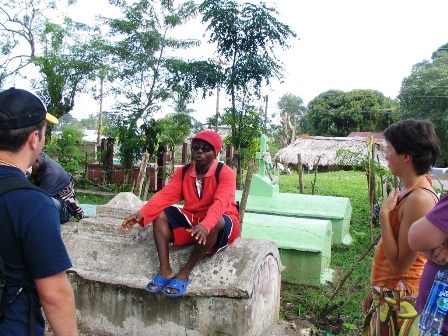 The next day we joined a guided tour of the town. We
had two colourful, local Garifunas, Francis and Eddie as
our guides. We were also escorted by two tourist police.
There have been robbery incidents in the past, so now
police guards are provided. There were angry words
between the guards and the tour guides before we started.
It turns out that the guides who led the tour the day
before refused to buy lunch for the guards. Our tour
proceeded peaceably when the guards were assured they
would get a free lunch.
We
walked through the local cemetery, still festooned with
crepe paper and flowers from the local All Saints Day
celebrations the previous November 1. The whole community
turns out for this event, picnicking on the above ground
tombs and playing music. We walked up a hill past a
voodoo ceremonial spot to a viewpoint where you can look
out towards Honduras to the south and Belize to the north.
We went through part of the Garifuna village, mostly a
collection of wooden huts. This is a very poor area with
no industry and no commercial fishing. Tourism is the
biggest business so unemployment is high.
We reached the Rio Quehueche
where we got a long dugout canoe powered by a motor for a
trip up the jungle river. It seemed to me that the dugout
was even more prone to tipping than a canoe. I found it
better to almost lie down for the trip. When the water
got too shallow, we walked through the jungle to a beach
on the Caribbean. The beach in town is not good for
swimming but it is fine along this section. We stopped at
a restaurant on the beach for lunch then walked the beach
back to town.
Next: Episode 2: Page 2
Return to
Travels
Return to
Introduction