January 2011
Click
the photo above
to see an album of photos. To return to our website close the window.
Read Next Episode:
Zanzibar
Some
Like It Hot – Dar es Salaam, Tanzania
Dar es Salaam
Friday 7 January 2011
After our troubles getting to Paris, the EgyptAir flights from Paris to
Dar es Salaam, Tanzania, via Cairo, were uneventful. The planes were on
time and our luggage even arrived the same time we did. The glitch was
it was an overnight flight, arriving at the ungodly hour of 5:20 AM on
Wednesday January 5. In Paris time that was 3:20 AM, so even though we
slept for part of the flight from Cairo, we arrived tired and slightly
jet lagged. Thank you Jambo (which means Hello in Swahili) Inn for
ensuring our taxi driver was waiting for us. At that time in the morning
there was little traffic and we had a speedy ride to the Inn where a
room was waiting for us.
We crashed until 10 AM when we decided
we should get out and stretch our legs. That is when we realized we were
not acclimatized to Dar heat. Add to that the fact that Dar is not the
most beautiful of cities and the narrow streets are nothing but a
gridlock of cars trying to negotiate through town without traffic lights
or traffic police and you can understand why we didn’t get far that day.
We did find a decent, inexpensive restaurant near the hotel. Besides
that we just caught up on more sleep.
We were still suffering the next day, but we did
manage a bit better. Our walk took us past the Askari Monument, in the
middle of a traffic circle. It was built on the site of a statue of
Major Herman Von Wissmann, a German explorer and soldier, who became
Governor of German East Africa in 1895. The British tore it down after
WWI and erected a bronze statue of an Askari (African) soldier to
commemorate all those Askaris who fought and died for Britain in WWI.
The most interesting
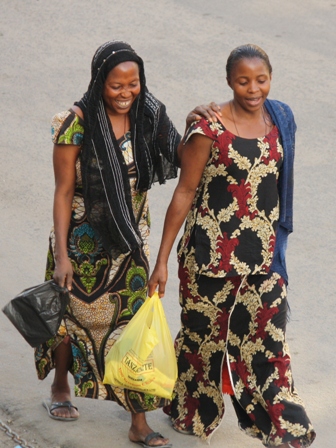
aspect of Dar was the people watching. The men generally wear Western
wear or Islamic robes and the women wear a mixture of western clothes,
traditional African printed cotton dresses or skirts and blouses. A
smaller percentage of the women wear the full Islamic black chador and
hijab. We were entertained at lunch and dinner watching the parking
toutsacross the street from the restaurant direct drivers into
impossibly tight spaces and out again without causing any damage to
their car or the multitude of pedestrians. Watching the women balance
impossible loads of eggs and other produce on their heads and the men
ride bicycles piled high with goods was awe inspiring. I managed to get
a few photos of the parade of people from the safety of our small
balcony.
The wind did blow and the rain fell during our
crossing to Zanzibar but we were safe and sound in the first class Air
Conditioned room on the Azam Fast Ferry. The trip was almost an hour
later than usual and the sky was overcast for our arrival but it wasn’t
raining and it was cooler than the mainland.
We even felt energized enough after checking into
our room to set out to explore Zanzibar Town. It reminded me very much
of Morocco with its Islamic architecture. The streets of the Old Town
are narrow and twisty, shaded by the walls of the buildings on either
side. Most of the buildings are built around a central courtyard with
just a solid concrete wall front to show the street. The doors provide
individuality. They are sturdy wooden structures with intricate carvings
on the lintels and down the sides of the door. Some are reinforced with
steel studs, like a suit of armour, harkening back to the days of
frequent enemy raids. We had lunch in a traditional restaurant near our
Guest House where you choose your food from covered Stainless steel
serving dishes and are charged minimal amounts for each dish. There are
many western style restaurants as well but we prefer to eat locally if
possible. We can always eat pizza at home.
Click one of the following to read about
Rwanda,
Uganda
or
Kenya
Return to
Travels
Return to
Introduction