March 2011
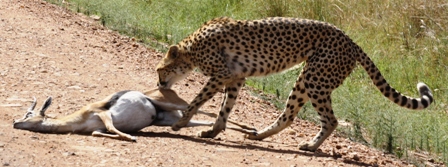
Click the photo of the cheeta above
to see an album of photos.
To return to our website close the window.
Read Next Episode: Lake Nakuru
The Food
Chain in the Masai Mara, Kenya
Masai Mara National Park Kenya
Monday 28 Feb 2011 to Thursday 3 March 2011
Safaris
are turning us into ghouls. Most of the animals in the parks are vegetarians but
the ones everyone wants to see are the predators, at the top of the food chain.
We got several opportunities to observe the food chain in action during our
visit to the Masai Mara National Park in Kenya.
We arrived on Sunday
afternoon by bus from Kampala Uganda to Nakuru, on the shores of Lake Nakuru, in
Kenya to spend the night in a hotel before starting a five day safari in the
Masai Mara and Lake Nakuru National Park. We met our two safari mates, Catriona
Moynihan from Ireland and Lindsey McDonald from Aberdeen Scotland, at breakfast
the next morning. The girls, both fourth year medical students in Aberdeen, had
just finished a six week placement in a hospital in Malawi. They had spent two
days at Amboseli National Park, south of Nairobi, Kenya and were continuing on
to the Masai Mara. Our guide, Ben Mwapi, met us outside the hotel and loaded our
luggage into his minivan from Asili Tour Company in Nairobi.
We set off
through the Rift Valley on good paved roads to Narok, the closest town to the
Masai Mara. The road from Narok to the park is only 75 km but it took us three
hours. Anyone observing the drivers on the paved section would think that all
the drivers were drunk. Ben was just like the other drivers. He negotiated the
road by either keeping a tight slalom course around the continual potholes or
driving with one side of the van on the road and the other side on the unpaved
shoulder. Despite being tilted crazily over the shoulder Ben managed to keep the
minivan upright. We were glad he was driving and not us.
Our home for the
next three nights was a permanent safari tent set in the shade of Acacia trees
at Mara Sidai Rest Camp, just outside the Oloolaimutiek Gates at the southeast
end of the park. We were very comfortable. Our meals were served in a communal
dining lodge.
That
afternoon we set out for our first game drive. The topography is the same as the
Serengeti, broad savannah grasslands surrounded by low hills. We saw antelopes
of many varieties, wildebeest, zebras, Cape buffalo, warthogs, giraffes, and
elephants that afternoon. One observation we made early in on safaris was that a
convergence of multiple minivans and jeeps meant something of interest was
there. If the minivans stayed at the site for more than a minute, we joined
them. The first afternoon minivan gathering revealed a pride of lions lazing in
the shade by the side of the road. There were at least ten lions in the family
of females and young females and males with their manes just starting to bush
out. We watched in fascination, standing up to snap photos from the open pop-up
roof of the van. The pride stretched, yawned and moved to a shadier spot, still
with minivans in tow. Exit time from the park is 6:30 PM with an option to stay
to watch the sunset over the Masai Mara.
Tuesday we
were up before the sun to start an all-day game drive through the park. We had
to slow down for a lone female lion walking unconcernedly along the road in
front of us. Around another bend in the road was a big male lion chowing down on
a freshly killed buffalo. It was not a sight for the faint hearted. He buried
his head in the belly of the beast pulling out the entrails, a special treat for
the king of the lions. Lying in the shade of a bush next to the kill was a
second male lion, waiting his turn for buffalo innards. The females
traditionally do the killing, but Ben told us that the presence of two male
lions indicated they were travelling together, having grown too big to be part
of a pride. They had jointly killed the buffalo and would spend up to a week
devouring the remains. The lion feasted until he was full, stretched and got up
to attempt to drag the buffalo carcass into the shade. It was too heavy for one
lion to drag and the other male wasn’t rushing to help his brother, so we left
them to their rest and moved on.
We stopped to see a family of elephants
forage amongst the trees and to watch yet another pride of lions. Ben said it
was not the same pride as we had seen the day before, but they were equally as
lazy. Our favourite was a baby, trotting after the others when they moved from
the road to a shadier spot.
Only in the Masai Mara would a communications
tower be camouflaged as a tree to make it blend into the environment. We saw a
small plane land at an air strip near the luxury resort Keekorok Lodge. Arriving
by plane sure beats the long African Massage trip by road. We stopped for our
bio break at the resort. The bathrooms were several cuts above the usual African
plumbing and the large souvenir shop had a wide variety of well made items for
sale. The interior of the lodge and the chalets arranged around the manicured
grounds looked very inviting, provided money is no object.
The Hippo Pool
is on the Mara River, half way along the border of the Masai Mara with Tanzania.
Viewing was on a 3 m high ridge overlooking the river. A ranger led our group
along a path at the top of the ridge to see the hippos and crocodiles. Clusters
of hippo pods lay soaking in the shallow waters in both directions on the river.
A large crocodile basked half out of the water just below us. The ranger urged
us on to see the Granddaddy of crocodiles, a huge 5 m long beast lying on the
shore in the shade of a tree. The ranger said it was 75 years old. Ben told us
that crocodiles can live to be 100. After 70 years their skin changes from green
to grey and scaly and their heads develop lumps. This old pappy was certainly
grey and scaly and oh what big teeth he had.
We left to find a picnic
spot for lunch, following a road along the border between Kenya and Tanzania. We
passed a concrete border marker indicating our van was briefly in Tanzania. We
stopped at a picnic area, just over the New Mara Bridge on the border with
Tanzania. The picnic area is managed by administration offices for the Mara
Triangle, administered by a separate council from the rest of the Masai Mara.
Daily fees are collected by the Masai Mara council or the neighbouring council,
depending on which section of the Masai Mara you are staying in. People
travelling from the Serengeti can enter the Masai Mara at this gate, obtain a
transit pass to travel through Kenya and exit at another border gate into
Tanzania, as long as they leave before night time.
I would have liked to
sit on a log overlooking the river to eat my box lunch but that place was taken
by a family of Black Faced Vervet monkeys and they steal your food if they can.
We sat on a log under a tree and watched Grey Capped Social Weavers building
their nests in the tree next to us. A colourful Agama lizard sat on the rocks
and a family of desert rats foraged nearby.
We left
after lunch and retraced our route back to the Oloolaimutiek Gates. Part way
there Ray called out, “road kill”. There was a dead Thompson’s Gazelle in the
middle of the road. We wondered if it had been hit by a car or killed by an
animal. Ben said it had been killed by an animal earlier. There were drag marks
on the road to the gazelle and a cheetah lay in the shade of a bush right beside
us. Ben said she was waiting for cooler temperature to drag the gazelle into the
shade for snacking. Cheetahs like fresh kill so she wouldn’t leave the body very
long. We sat in the van and waited for her to leave her resting spot. Sure
enough, she got up, stretched and walked over to the body, got a good grip on
the hind quarters and dragged it to the bushes where she began gnawing on her
prize. We left her in peace and drove on, back to Mara Sidai.
It was
after 4 Pm and we still had another visit that day. For an additional $25 we
could visit a Masai village. The money is given to the chief of the village who
distributes it amongst the villagers. Ray opted out and returned to our tent for
a rest. The girls and I joined a young Masai man, Muha, for a tour to his
village, a five minute walk from Mara Sidai. A few of the villages near our camp
strive to retain the traditional ways. Muha’s village of 120 people was one of
them.
On the way to the village Muha pointed out several small bushes.
The leaves of one produced a red dye when crushed. The dye was used to colour
the distinctive red blankets the Masai wear. I think they are commercially dyed
and woven nowadays. Leaves from another bush produce soap when boiled, useful
for bathing and cleaning clothes. Muha picked up a baby goat grazing with other
babies at the edge of the village. The herds of larger cows, sheep and goats are
taken to graze in fields nearby every day, tended by one or two Masai boys. The
babies are left near the village where it is safer. We were alerted to the
return of the herd by the excited bleating of the babies who rushed to find
their mothers amongst the returning herd.
The village was surrounded by
a circular fence of thorny bushes, maintained by the men to keep out predators.
The herds are brought into the village for the night. The cows wander about the
village while the sheep and goats are kept in a separate round enclosure within
the village fence. The babies are housed overnight in a separate alcove within
each house. The village dogs raise the alarm if any predator should breach the
fence and attempt to make off with one of the cattle.
Muha and
two other young men demonstrated the traditional way to start a fire by rubbing
two sticks together. It worked. They were able to use the resultant spark to
light a handful of dry grass. Several young men appeared to sing and perform a
traditional dance for us. One by one each man jumps as high as he can, with the
highest jumper being declared the winner. An elder joined the dance wearing a
hat fashioned from the mane of a lion. The Masai aren’t allowed to kill a lion,
even for ceremonial purposes, so when a lion dies, the skin and mane are given
to the Masai. Some of the women, wrapped in brightly coloured cloth, signifying
their marital status, performed a wedding dance for us. We were each draped in a
red cloth and invited to join the women.
Several of the men and women
had large holes in their ears, signifying they were first born in their family.
The loops of ear get so long over time that some men looped the bottom part of
the ear over the top of their ear. At least it was out of the way. Muha told us
that Masai who continue their education beyond primary school do not have to
have their ears punctured.
Catriona
and I were invited to visit the home of Muha’s parents while Lindsey was taken
to see another home. The woman are assigned a variety of chores, including
minding the children, cooking the meals, carrying water in big plastic
containers from the river to the village and building their house. A woman’s
work is never done. The low houses, arranged in a circle beside the fence, have
a double framework of branches, woven together with bark strips. The walls are
packed with a mixture of mud and cow dung and the flat roof is constructed the
same way. There are no large windows, just a few small holes for ventilation. We
had to crouch to enter a low door into a small vestibule with the calf alcove at
one side. The houses last nine years before termite damage become so severe they
start to collapse. The whole village must be relocated and new houses built.
Mahu told me they always choose a site close to the primary school that serves
the area.
It took a while for our eyes to adjust to the dimness of the
room. Mahu told us his father had four wives. One, who I took to be the
youngest, sat at one end of the room near the food preparation area. In front of
her was a fire pit covered with a metal grill. Three men, Brothers and uncles,
took their places along a bench serving as the parent’s bed. They were there to
meet the guests. We were directed to another raised seat in an alcove. At first
I didn’t see the woman’s young baby peacefully sleeping behind me, coved with a
cloth. We were invited to take their traditional beer made from sorghum. I had a
small taste that was more like ginger ale and quite pleasant. That was because
the beer was not yet fermented.
The women of the village make beaded bracelets and
necklaces and other items made of wood and stone for sale to tourists. They had
their wares set up on tables made from twigs behind the village. I bought a few
small bracelets and was able to take a photo of two of the women dressed in
their best jewellery.
We had tea and coffee the next day before setting
out on one last early morning game drive. I had fun photographing birds and
identifying them with the help of Ben and his Masai Mara Bird Guide. We thought
we had a chance to see an actual kill. A female lion crouched in the grass
beside the road keeping watch on two large Topi antelope. The wind was in the
wrong direction and the Topi could sense the lion’s presence. They remained wary
and moved away. There was to be no lunch for the lion from those antelope.
Two vultures perched at the top of a tree indicated there was something dead
nearby. It was the buffalo kill from the day before guarded by one of the male
lions. Several jackal circled the area hoping to grab leftovers. The lion was
not issuing any invitations to share his meal.
We returned to camp for
breakfast and to say goodbye to Catriona and Lindsey. Their safari was over and
they were driving back to Nairobi in another van headed that way.
Ray
and I had a break until 3:30 PM when we would have our last game drive. We still
hadn’t sighted a leopard. Ben drove into the small hills hoping to see this
elusive animal. All the other vans out for the late afternoon drive had the same
goal. Every time we passed a van Ben would stop, greet the guide and trade
sightings. No one had seen the leopard for three days and no one saw it that
afternoon either.
On our way back to the gate at the end of the day we
saw the minivan herd stopped by a road. We had to go see what was keeping their
attention. It was a young female stalking another two Topi. She crept through
the grass getting as close to the prey as she could. Another female lay in the
shade of a tree watching her younger protégé. Ben said the lions are very
patient and could wait hours before getting close enough for a kill. Alas, the
wait was all in vain. The grass where the lion lay was not tall enough to hide
her and the Topi sensed her presence. The lion observing from under the tree got
up, yawned and walked over to her protégé. It was time for us to leave too. We
had witnessed chow time for lions and the cheetah and almost saw an actual kill.
Add to that all the animals and birds in the Masai Mara and what more could you
ask for. We were satisfied with everthing we had seen and left contented.
The drive back to Nakuru the next day was still rough but we are getting
used to being bounced around. We travelled through the semi desert of the Rift
Valley where a breeze was creating mini whirlwinds of dust some as big as a
tornado. It didn’t affect our drive. Tomorrow we would end our safari with a
visit to Lake Nakuru National Park, but that is another blog.
Chose a
write up to read
Click one of the following to read about
Tanzania,
Rwanda
or
Uganda
Return to
Travel Intro
Return to Introduction