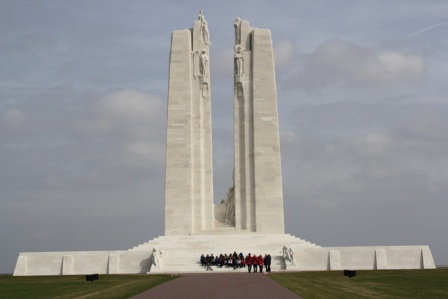
Click thephoto of the Vimy
Memeorialto
see photos on a Google Album,then close the window to return to our website.
Click here to read
Part 2: Ieper (Ypres) Belgium
Tuesday 23 March 2010
It is a chilly, overcast day in Northern France. Ray and I drive into
a forested park and pass a jogger and several people with dogs along the
walking paths next to the road. This looks good. But wait, the woods are
full of strange grassy bumps and there are signs at the edge of the
forest warning not to stray into the woods as there may be unexploded
artillery. This sounds very ominous. This is the Vimy Ridge Memorial
park, 250 acres (107 hectares) of a preserved WWI battlefield,
reforested with over 3,500 trees, one for every Canadian soldier killed
on April 9, 1917. It seems incredible that so many lives were lost in a
single battle. And that was not the only time so many lives were lost.
We were to discover that young lives were ended in record numbers
throught the four years of WWI.
Our friend Dawn Logan attended theVimy Ridge Memorial rededication
ceremony on 9 April 2007, the 90th Anniversary of the battle to take
Hill 145. She spoke in glowing terms of her trip to the ceremony and
visits to the many WWI Memorials and Cemetaries in this area.
Ray suggested we make a trip to Vimy on one our trips to Paris. The time
was right this year so we took a few days away from visiting our
grandchildren in Paris and to drive north to find out more about
Canada’s role in WWI. We learned far more than we expected and came away
impressed by the care and reverence shown for the many commemorative
sites in the area by the Canadian, French, British and Belgian
Governments.
Ray found a very helpful and informative website about visiting Vimy
Ridge, written by John Stephens of Brampton, Ontario with scads of
background info and links to more background information. We followed
his suggestions to visit several sites in France and Belgium as well as
the Vimy Memorial.
See
www.thegreatwar.ca for “A
Canadian’s Visit to Vimy Ridge and WWI Battlefields of Flanders”
Ray suggested that a Memorial to Newfoundland was on the way to Vimy
and would make a good first stop. The memorial near the town of
Beaumont-Hamel, was less than a two hour drive on the A1 expressway NE
of Paris, France. Both Beaumont-Hamel and Vimy Ridge are National
Historic Sites of Canada and cared for by Veterans Affairs Canada.
Canadian University students are chosen as guides for both sites. They
are on four month terms, learning the history of WWI and doing a great
job of imparting that knowledge to the many visitors to the sites. We
had fun talking to them and finding out where they were from. It was
obvious to us that the students felt priveledged to be chosen as guides.
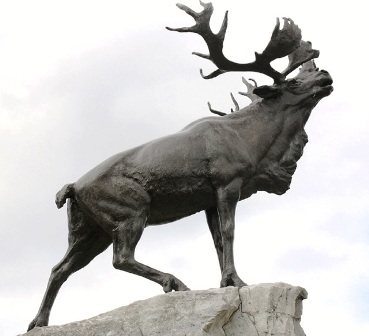 The first thing you see when you reach Beaumont-Hamel is a bronze
cariboo standing atop a rocky mound. Newfoundlanders rallied after WWI
to raise money to create the memorial. A 74 acre (28 hectares) preserved
battlefield park was opened in 1925 marking the spot where
a Newfoundland regiment fought alongside British and French forces to
scrape out a victory on 1 July 1916, the first day of the Battle of the
Somme. It was one of the bloodiest battles of WW1. A total of 57,000
soldiers were killed in a single day. Contrary to what the regiments had
been told, German artillery was not silenced and barbed wire had not
been removed. The Newfoundland regiment was almost wiped out. Of 809
Newfoundlanders, only 68 were able to answer the call the next day.
We followed well kept paths to visit all of the site, which
includes three cemetaries and several other memorials to the combined
forces. The original battlefield has been preserved complete with
original artillery craters and trenches. Grass has grown over the once
muddy field but it cannot disguise the devestation left by the battles.
It wasn’t difficult to image the horrific conditions facing the soldiers
that day.
We spent the night at a very good Bed and Breakfast in Thelus, a
small town outside Arras, where the student guides stay. It was just a
10 minute drive the next day to the Vimy Ridge Memorial, where we took
advantage of an excellent free guided visit to a section of the original
trenches and underground subways and tunnels. We shared part of the tour
with a group of British students, all there to see the battlegrounds
they study as part of their curriculum. On April 9, 1917, all four
Canadians Battalions fought together for the first time, aided by
British troops. The planning by the two Canadian Generals, Currie and
Byng made a difference. This time preparations for the battle were
properly made and weaponry had improved but there was still a huge loss
of life. The victory at Vimy was significant for Canada. It has been
said that Canada went into WWI as a colony of Britain and came out a
nation.
After finished our tour we learned more about WWI in the well run
Visitors Center. Only then were we ready for the Vimy Memorial itself. A
design contest was held in Canada and Toronto architect and sculptor
Walter Allward was chosen to build the memorial. It took 11 years and
6,000 tonnes of limestone from an abandoned quarry in what is now
Croatia to build the monument. It rests on Hill 145, the highest point
of land along the 14 km Vimy Ridge giving a spectacular view of the Doai
Plain. Twin pylons representing the sacrifices of both Canada and France
rests on a wide platform. Twenty human figures, decorating the monument,
were sculpted on site, and collectively make a statement for peace,
rather than the glorification of war. The names of 11,285 Canadian
soldiers who were killed in France and whose graves are unknown were
carved on the walls of the base. It was finished in 1936 and the years
inbetween resulted in massive deterioration. Over several years the
entire monument was disassembled and restored, culminating in a
rededication by Queen Elizabeth on 9 April 2007. The memorial is
magnificent and the resoration is superb.
We asked one of the Canadian guides where the Germans killed in WWI
were buried. Katie, from Cape Breton, a student in Halifax, suggested we
visit both a nearby German and a French cemetary to get a better
perspective of the war. We found the German Cemetary at the village of
Neville St Vaast, near Arras. The remains of German soldiers killed in
the Battles of the Somme were consolidated in this cemetary by France in
1919. Now administered by the German War Graves Commission it contains
43,833 burials, the largest in France. Instead of the white limestone
gravestones of the British and Canadian cemetaries, simple black crosses
mark the graves. The effect of the cemetary was dark and somber, as had
been intended by the architects. Most were inscribed with four names,
two on each side, due to the lack of space accorded the Germans at the
end of the war. Many crosses include at least one “soldier known only to
God”. All the cemetaries we visited on our trip had a great many graves
of unknown soldiers.
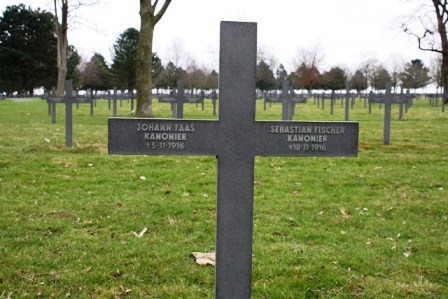
German Cemetary
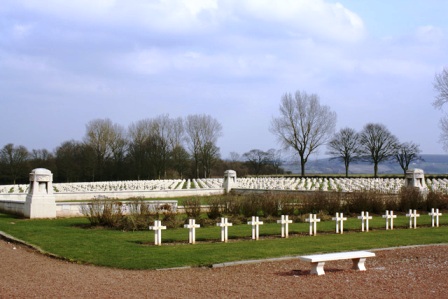
French Cemetary
The large French Cemetary sits on a hiltop at Notre Dame de Lorette,
within sight of the Vimy Memorial. Simple white crosses mark the graves
of French and Colonial soldiers killed in the area in WWI. The bones of
unknown soldiers are contained in an ossuary on the site. A total of
40,000 soldiers lie buried in the cemetary. A large chapel completes the
cemetary. Every day Veterans and other volunteers stand guard at the
cemetary and greet visitors. Once again the extent of the loss of life
was visually brought home to us.
Click here to read
Part 2: Ieper (Ypres) Belgium
Return to
France Intro
Page
Return to
Travels
Return to
Introduction