Episode 1: Riding the Chicken Bus Route

Read the
next episode
Crossing Borders
Page 2 of 2
Saturday 5
February 2005, Antigua, Guatemala
Continued from Page 1
Ray and I said goodbye to our family and took the
chicken bus to Panajachel on Lake Atitlan, a 2-1/2 hour
ride away. After quiet Xela, Panajachel, nicknamed Pana
or Gringotenango, was a busy tourist destination. The 1/2
km street leading down to the lake was lined with stalls
selling textiles, clothing and other souvenirs. There
were so many we wondered how any of them made a living,
especially as each booth is demolished at night and all
merchandise boxed and hauled away until the next morning.
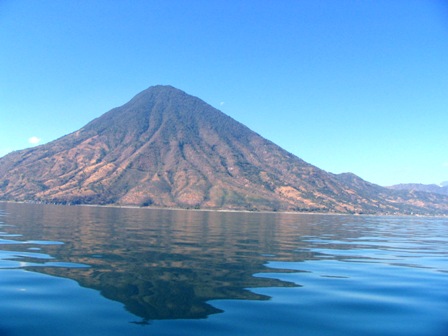 The lake itself
is large and beautiful, the blue waters surrounded by
volcanoes. There is a large beach at Pana but it did not
tempt us. The water was cool and we weren’t sure of the
cleanliness so near town. Beside the handicraft stalls,
the streets in town and along the lake are lined with
good, inexpensive restaurants and there are many hotels
and hostals to choose from. We didn’t like our first
choice so we found a better one, for the same price, with
a nice outside patio with chairs and tables to relax in.
Our first night in Pana we met a trio of middle aged
American who had recently spent up to two years working
with the Peace Corps in El Salvador. They were all
amateur musicians; Lucian Parker played a mean Kentucky
fiddle, Bonnie James also played the violin and her
husband Ed played guitar. They had made a name for
themselves during their work term volunteering their
talents entertainin g locals with traditional American
folk music. They were back together this time just
touring places they missed the first time. They gave us
lots of suggestion of places to visit. They had their
instruments with them and after dinner together and a
visit to a local bar, featuring an Irish Folk band from
Vermont, we were treated to a session of their music. It
was simple and fun.
There are several other small towns surrounding the
lake. We visited several of them on day trips. We walked
to Santa Catarina Palopo, 5 km up and down a hot road. We
had lemonade by the lake and toured the town in short
order, ignoring the sales pitches of the local handicraft
vendors. I didn’t look forward to walking back in the sun
so we elected to take a Colectivo, a pickup truck with
benches running down both sides of the box. The driver
said he would leave when enough people showed up to
constitute a load. He indicated that might be five
minutes or half an hour so we agreed to the charge of Q2
each and waited and waited some more. After 45 minutes
and a total of 5 adults and one child, I asked the driver
how many more he needed before leaving. He told me five
more so I offered to up our payment to get him started.
We agreed on Q10 for the two of us and we finally got on
our way. That is how Colectivos work.
The next day we went down to the docks, really just
rickety wooden structures, to get on a boat for Santiago
Atitlan. There was a choice of small motor boats carrying
about 20 passengers or a slightly larger boat for 50 or
more. We got a return ticket on the larger one that left
at 9:30, we were informed. Once again we waited for more
passengers to appear while other smaller boats took off
fully loaded. Finally we were asked to change to a
smaller boat and 45 minutes late, we took off across the
lake. Once more we learn the reality of public
transportation. At least it was a quick 1/2 hour trip in
the small boat.
 Santiago
Atitlan was a smaller, dustier version of Pana with a
lively market in operation. It was jammed with local
Mayas all in their traditional clothing. We sat in the
town plaza and watched all the locals do their shopping
and lounge in the sun. Next to the town plaza is a huge
church built in the 18th century. Weird wooden figures of
the saints line both sides of the church, each draped in
an assortment of handmade clothes. Each gets a new set of
clothing every year. One looked like Elvis in his outfit
and under the feet of three others could be seen an
object. I am not up on my saints so I cannot really tell
who they were supposed to represent. One woman stood on a
severed head; another had a skull under one foot and a
cannon ball under the other. The third had a demon
peering out from a foot.
When it was time to return to Pana we looked for the
same boat firm that took us over. The larger boat arrived
and we got in wondering how long we would have to wait.
Luckily it was only 20 minutes late and left with only 5
passengers. The larger boat is slower and since the
captain was not busy, he came to chat with us and point
out all features around the lake. He was very patient
with my Spanish and he got to practice his English with
Ray.
 Another day we
took a small boat to San Pedro La Laguna, a quieter more
laid back town. We met a young Winnipeg girl we had first
encountered at Fuentes Georgina outside Xela. She was
staying in San Pedro, taking Spanish at one of the local
schools. Her class was involved in an activity cleaning
up the refuse on the main street. We told them Santiago
really needed their help more than San Pedro. Several of
the students were accompanied by children from a local
home for the disabled. Many of the Spanish schools in
Guatemala try to involve their students in projects that
help the community. Our friend recommended two good
restaurants in town that we finally located by following
twisting back alleys that serve for streets in San Pedro.
We had lemonade in one garden patio then wandered through
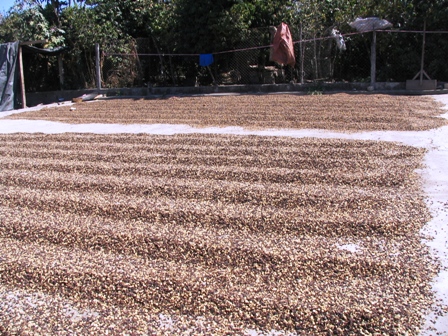
more alleys past a coffee processing plant. The coffee is
grown locally and trucked to these primitive operations
where the soft outside coverings are removed, the beans
are repeatedly washed in concrete sluices and the wet
beans are bagged. The beans are then spread on the ground
in front of neighbouring houses to dry and cure in the
sun. We bought a bag of the roasted beans to send home.
We found the second recommended restaurant, Munchies
and choose a seat on one of the grassy terraces
overlooking the lake. We chatted to our Scottish waiter
who had arrived in San Pedro and like many others,
decided to linger. T hey were advertising for another
waiter so I suggested to Ray that we stay for the week. I
could take more Spanish lessons and he could work at
Munchies. He didn\rquote t take me seriously enough!
We talked to a young American girl having lunch there
and she recommended visiting San Marco, further along the
lake. It sounded like a good detour so after lunch we
grabbed a boat heading for San Marcos La Laguna and
toured the community. Some believe it has a special
spiritual vibe so new age centers abound. Holistic
therapy, yoga, massage, Reiki and meditation centers are
found in lovely garden settings. If peace and quiet is
what you are after, this is the place.
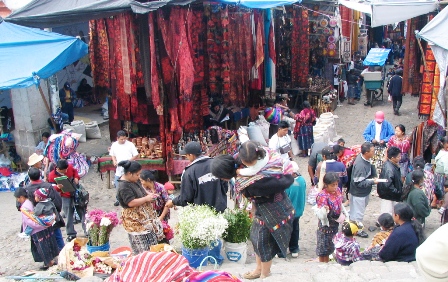 Thursday and
Sunday are market days in Chichicastenango (Chichi) an
hour over the hills from Pana. It is the largest
combination handicraft and local market in the area and
attracts lots of tourists, including us. We opted for a
shuttle bus and arrived at 9 AM while most of the market
was in full swing. As advertised it was huge. A
traditional market and food section was surrounded by
booth after booth of handicrafts. I added to my textile
collection and bought some other souvenirs as well.
Two large, white churches brace the market area, both
fronted by broad, steep steps, in the manner of Mayan
pyramids. These are favourite spots for locals to gather
and say prayers before entering the church. Men outside
have charcoal fires going to load smudge pots which the
locals wave around ceremoniously. Inside flower petal
strewn concrete blocks on the floor hold clumps of
burning candles. The candles are lit in commemoration of
ancestors many of whom are buried beneath the church.
When we got tired of walking around the market we
retired to the elegant Mayan Inn to have a coffee in
their quiet lounge. We were entertained by a local Maya
playing a xylophone with gourds hanging from the sound
boards for resonance. We were surprised others had not
discovered this gem as we were the only people there. The
relatively high price of Q9 (just over $1) was worth it.
As soon as we returned to Pana we arranged to mail
home all our purchases. We found a cardboard box on the
street and packaged up the multitude of textiles and
other purchases and took it to the local post office. We
paid Q2 to have the box covered in brown paper, filled in
the forms, had the box weighed in at just under 6 Kilos
and paid more than $50 to send it off. We were told it
only takes 8 to 10 days so it will be interesting to find
out when it actually arrives. Anyway, we have completed
our souvenir buying for Central America. That is unless
there is something we see that is just begging to be
purchased.
Now we are back in Antigua, after another crowded
chicken bus ride, complete with squealing pig on top.
About a half way to Antigua we were stopped by a roadside
police check. All the men were ordered out of the bus and
everyone, except Ray was frisked. I guessed they were
looking for weapons or drugs. In any case nothing was
found. The men squished back on the bus and we continued
on our way.
That afternoon we
met with the local tourist police to take advantage of a
free guided tour. The police sponsor these tours because
of past problems with robberies in the more remote areas
around town. We had two young people to guide the two of
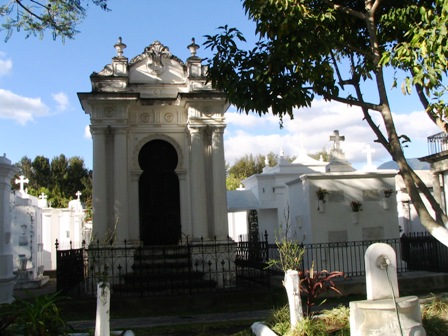
us to the local cemetery. The cemeteries in Guatemala
follow the Spanish tradition of large above ground graves.
There was a combination of expensive family crypts and
walls of more simple graves. In Chichi the graves are
painted all manner of colours but in Antigua all are wh
ite. The cemetery we visited in Buenos Aires was more
ornate, but this was a peaceful and pretty spot.
Family Crypt
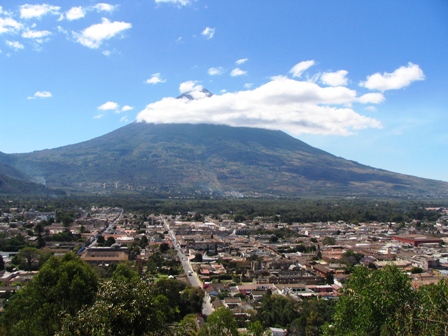
view back to Antigua
While
I was writing this morning, Ray went on another tourist
police guided tour to a cross on a hill above town. A
paved path leads to a perfect viewpoint of Antigua and
Volcan Acatenango to the west. Again two guides led ten
tourists to the cross where additional armed guards keep
the peace. Armed guards are a fact of life in Guatemala.
Every large delivery truck has an armed guard and banks
have two each. It does seem to be keeping the crime rate
down.
We had returned to Antigua to make arrangements to
take a shuttle bus to see Mayan ruins in the UNESCO World
Heritage Site of Copan just over the border in Honduras.
We leave at the ungodly hour of 4 AM Sunday morning and
will stay in Copan two nights before heading back to
Guatemala and northwards to Belize.
So ends the first two weeks of our travels along the
Gringo Trail of Central America. Despite little problems
we are doing well and enjoying ourselv es. We have lots
of suggestion of other places to visit before we fly home
from Panama April 20. We look forward to them all.
Back To: Episode 1: Page 1
Return to
Travels
Return to
Introduction