Click the
photo above to
see an album of photos. To return to our webpage, close the window.
Read
Bangkok Revisited March 2010
Bangkok 30-31 December 2009
Jim Thompson was not only the man who revived the silk industry in
Thailand. He was a man of impeccable taste and an eye for the beautiful.
When we visited Bangkok ten years ago we had seen all the important Wats
but we had missed a visit to the Jim Thompson Teak House. That was first
on our list for our short visit in Bangkok before flying to Myanmar.
We had an easy but long journey from Paris to Bangkok on Egypt Air
via Cairo. This airline was the most economical I found and we were
pleased with the good service. They even supply free ear phones for
watching a movie and a small packet of eyeshade, socks and toothpaste
for the overnight portion. The downside is the flight is overnight and
we had six more hours of jet lag to endure. That is one of the reasons
we scheduled a few days in Bangkok before proceeding on our trip.
We did manage to use our time well. We stayed in a guest house right
in the middle of the backpack area, but in the quieter section. Erawan
House also had the advantage of being just one block from the scenic
Chao Praya River. A good way to orient yourself to Bangkok is to take an
inexpensive ride on the public ferries that ply the Chao Praya and that
is what we did just before sunset the first day. We paid 13 Baht ($0.33)
for a ride upriver, passing several Wats, then repeated the trip the
other way just as the sun was setting.
We got off in the middle of a food market setting up for the evening
meals. It made us very hungry. We satisfied our hungers at several good
restaurants in Bangkok during our short stay, including a meal at the
Hemlock Restaurant for good Thai food to celebrate our 44th anniversary
on 30 December.
The Thompson Teak House is about 5 km from our guest house, too long
a walk even for us. We rejected a taxi or tuk tuk ride in favour of
walking along broad Boulevard Ratchadamneon Klang still decorated with
banners and huge photos of King Bhumibol for his 82nd birthday
celebration the previous December 5th.
At the end of the boulevard is the junction of two canals, one of
which, Khlong Saen Saep has water taxi service passing the Jim Thompson
House. We jumped on board, took our seats and paid 10 B each to an
attendant wearing a hard hat. We soon learned the wisdom of wearing a
hard hat working on the boat. The long boat passes under several
bridges, some of which are too low down to permit passage of the
canopied boat. To solve this problem, the steel poles supporting the
canopy are tilted forward, lowering the roof. The attendants have to be
careful to duck below the canopy to avoid being knocked into the canal.
Houses, most occupied, judging by the lines of laundry hanging from the
windows, but looking very derelict, lined both sides of the canal. One
more prosperous area had pots overflowing with flowers hanging from the
walkway guardrail at the edge of the canal.
The Jim Thompson House is right beside the canal. Originally it had
its own ferry stop but now the stop is just 100 M further on. We were
soon at the entrance where we were given a start time for an English
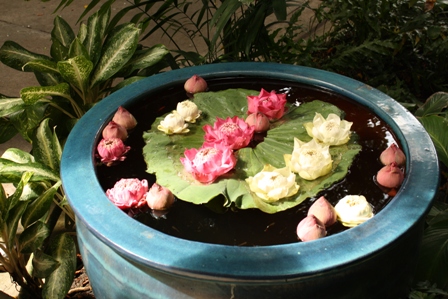
language tour of the complex. We had just enough time to admire the
decorative ponds in the gardens before joining our guide and several
other tourists for our tour. The first lesson you learn in Thailand is
to wear footwear that is easily removed because bare feet are required
inside all houses and Wats. We padded our way through Jim Thompson’s
original teak house admiring his vast and important collection of
antique furnishings and art work. The American architect Jim Thompson
had been posted to Thailand for a short time during WWII. He fell in
love with the country and returned permanently after the war. Besides
reviving the silk industry, he had six traditional teak houses
transported to this site from all over Thailand and assembled into a
large home. Tragically, Jim Thompson disappeared while walking in the
Cameron Highlands of Malaysia in 1967. No trace of him or clues to his
disappearance has ever been found. The Thai Government has taken over
the site and under the protection of one of the Royal Princesses, has
created a beautiful monument to Thai Arts.
Leave time for a visit to this complex if you are in Bangkok. You
won’t be disappointed.
We did manage to visit a few more Wats we hadn’t seen during our
first visit. There are so many in Bangkok it is hard to choose. Wat
Suthat, a 15 min walk from our guesthouse, was reported to be quiet and
peaceful compared to some of the better known Wats. That may have been
true during most of the month but we visited on the last day of the year
during the full moon cycle. This is when all observant Thaïs visit the
Wat of their choice to receive a blessing from the monks and to pray for
prosperity and good fortune for the coming months.
Wat Suthat must be a favourite as it was packed with worshipers, all
lined up at the north entrance waiting to get in. We toured the outer
perimeter of the main Wat first to view the border of
larger-than-life-size Black Buddhas, interspersed with Gold Buddhas,
donated to the Wat by individuals to ensure good favour in their lives.
Only after that did we dare to have a look inside. Rather than join the
crowds entering by the north entrance, we found the much quieter south
entrance. The walls and pillars of the Wat are covered with
floor-to-ceiling murals depicting religious stories. Like the Dutch
paintings of village life, the paintings were full of figures in various
activities. The piece de resistance in the Wat is an 8 M high seated
Buddha. Facing the front entrance, it is the largest surviving
Sukothai-period bronze Buddha. At its feet sat four monks, one of whose
voice we heard amplified over loud speakers as he recited his prayers.
The line of the faithful made their way on their knees to the monks who
conferred blessings to each person and received their gifts of lotus
blossoms, food and money.
Just across from the north entrance of Wat Suthat, in the middle of a
traffic circle, sits the Giant Swing, Sao Ching-Cha. It is used for
death-defying religious ceremonies for the Brahmins, but that was for
another day. There was no swing attached that day.
A short distance away, across a canal is Wat Saket and the Golden
Mount. It seemed a good idea to take in a second Wat on our last day in
Bangkok. The recommended time to visit this Wat, built at the top of a
58 M hill, is sunset when views of the old city are magical. We visited
in the middle of the afternoon when the Wat was even more crowded than
Wat Suthat. We were swept alone with everyone else up winding staircases
to the top of the mount. At each landing rows of bronze bells stood
waiting for worshipers to ring out their best wishes. We rang the bells
along with everyone else. At the top was a landing with a crush of
people all trying to enter a narrow doorway to view the golden pagoda
within. We managed to get in the first window and I took a few photos of
the pagoda and followed along to the next window.
Having enough of the crowds and losing sight of Ray, I retreated to
the landing and waited for Ray to join me. When he didn’t appear after
several minutes, I feared he had already headed down, so I did too. I
made it all the way down to the bottom, stopping several times to wait,
without finding him. I walked to the spot we first entered the compound
and still no husband. I returned to the staircase where people were
still heading up and waited some more. Just when I thought I was going
to be going to Myanmar on my own, two Dutch girls descended and asked me
if I was waiting for my husband. He had asked them to look out for a
grey-haired lady in a pink shirt and there was only one of me. They told
me he was waiting on top! I had no option but to climb up again. There
he was comfortably seated on a wall, wondering what took me so long!
After grumbling some, we descended once more and started on our way
back to the guesthouse. Black clouds that we had seen from the top in
the distance were now right overhead and we felt the first sprinkles. We
stopped under protective awnings along a side street to wait out the
shower. Soon we were joined by many others. It started to rain harder.
We hailed a tuk tuk and asked the fare to take us back to our
guesthouse. True to form he quoted 100 B which was the going gouge rate
for tourists. I countered with 20 B and he immediately came down to 50
B. I still refused and he went on his way. Shortly after, it started to
pour. I was glad we weren’t in the tuk tuk getting soaked two ways. A
while later Ray suggested we try another tuk tuk. The second driver
started at 200B and wouldn’t come lower than 60B. Ray was ready to
concede but I was stubborn. Luckily the rain stopped shortly after,
having cooled the air.
We walked all the way back to our guesthouse, collected our bags from
safekeeping where we had left them and took a taxi to an airport hotel
as we had an early morning flight to Myanmar.
Sometimes language barriers can work to your advantage. We had a 7:20
AM flight from Bangkok to Yangon, Myramar on 1 January 2010. It takes
one hour to drive to the airport and you have to be there two hours
before your flight. That would mean leaving Bangkok at 4:00 AM at the
latest. Surely we could get a bit more sleep at an airport hotel,
especially as we were giving up seeing the New Year in. A friend in
Ottawa gave us the name of an airport hotel they had stayed in. I found
their site on the internet and sent an email requesting a resvation, but
I never got a reply. We did manage to contact them by telephone from our
hotel in Bangkok and they had a room available for us. We would be there
after 4:00 PM on New Years Eve.
You know what they say about the best laid plans. We are living proof
of that adage. The Taxi dispatcher and the Taxi Driver in Bangkok
assured us they knew where the We-Train International Institution on the
airport property was. We showed them both the name and address we had
written down. The flat rate offered by the driver was reasonable and off
we went – right to the airport! We tried to remonstrate with the driver
and tell him we did not want to get off at the airport. We were headed
to the airport hotel but he didn’t understand. He stopped the car,
opened the hood and unloaded our bags. At this point a Thai lady waiting
for a taxi to take her into Bangkok came to our rescue and acted as our
translator. She got the original driver to accept less than the original
price and he left. She also arranged for another driver for us who spoke
English. Next she called the We-Train hotel only to get voice mail. Not
to fear, she said. Her cousin, a policeman, would know where the hotel
was from the address and our driver would take us there. She got the
information for us and we piled into the taxi with our new driver. As we
left the airport he asked where we were going and we told him we had an
Air Asia flight in the morning to Yangon. That is when he stopped the
taxi at a turn off at the first exit and explained the hotel we had
booked was at the old Don Muang airport, 25 km north of Bangkok and we
were currently at the new Suvarnabhumi airport 35 km SE of Bangkok. Just
a few domestic flights leave from Don Muang now. Everything, including
our flight leaves from the new airport. No way did we want to drive 60
km in the wrong direction! No wonder I couldn’t find the We-Train Hotel
in my Lonely Planet for Suvarnabhumi Airport, it was at Don Muang.
The driver told us the Novotel Hotel, closest to the airport was
super expensive but he knew another one close by that was much more
reasonable. True to his word, he drove us to Convenient Resort Hotel
(don’t you love the Asian names), a 10 minute drive from the airport.
They had a room available, a nice outdoor dining room and a shuttle bus
in the morning. The driver didn’t get the huge fare he was expecting to
drive us to the old airport but we gave him a good tip for saving us a
huge headache. Next time we will be aware of the difference between the
old and new airports.
Read
Bangkok Revisited March
2010
Return to
Myanmar Intro
Return to
Indonesia
Intro
Return to Travels
Return to Introduction