Gorgeous Gorges
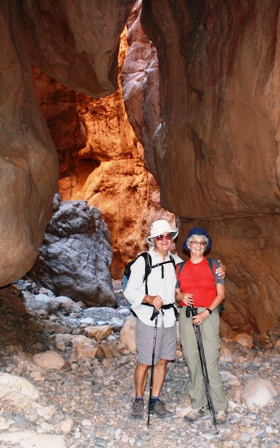
Ray and Jeanne in the Dades Gorge

Read Previous Episode:
Sahara Sand Dunes or Next Episode:
Marakesh
Morocco 13 October 2009
 The gorges of the High Atlas Mountains are gorgeous. We
visited two, Gorges de Todra and Gorges du Dadès. Most
tourists only have the opportunity to drive through in a
tour bus but we had more time. We stayed two nights in each
place and hired a hiking guide to explore their really
beauty.
We hired a Grand Taxi to take us from Erfoud, where I
wrote the last blog, to Tinejdad, which was as far as the
driver was allowed to go. We asked him to stop once to find
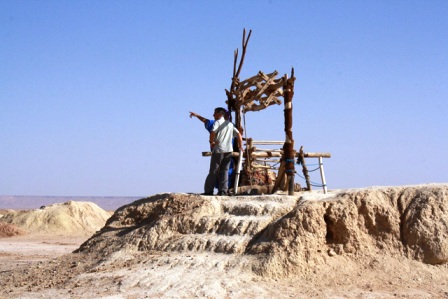
out what the conical mounds of dirt were that littered the
flat desert. This was an irrigation system dating from the
12th C. Each mound had a well head with a winch to lower a
bucket for water from the underground canal and a larger
winch to lower a worker to effect repairs on the canal
system. The underground canals were dry now but the coming
rainy season would fill them with water. Each tribe has
their own parallel canal, consisting of a line of wells
reaching to their garden area. Very ingenious.
We decided to try our luck with sharing a joint taxi from
Tinejdad to the next town, Tinehir. The driver will not
leave until all six seats are purchased. After nearly an
hour we lost patience and paid for one additional seat.
The third leg on our journey was a 15 km ride in a Grand
Taxi just for us. Dh 42 (6 CAD) was not unreasonable. We did
share the ride with a man who spent the entire ride trying
to persuade us to stay at his choice of hotel and to hire
him as a hiking guide. We insisted on going to our choice of
hotel as recommended in the Lonely Planet but we agreed to
have him take us hiking the next day. It was a good
decision. Mahjoub turned out to be a very likeable fellow
and he knew the trails into the mountains.
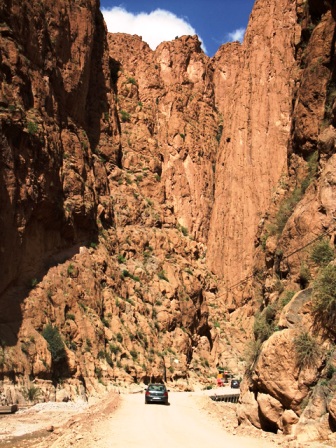 After checking into our hotel, Ray and I went for a short
walk. We had to watch out for the big tour buses that passed
us on the road. This was our first experience in Morocco for
being right on the tour bus trail. Every company worth their
salt brings their group to the Todra Gorge for either a
short visit and lunch or a late afternoon tea break. There
are lots of hotels along the road but the business goes to
two hotels in the best part of the gorge large enough to
serve tour groups. The view of the high red sandstone cliffs
with the Todra River and lush Oasis gardens running at its
base is worth the trip.
Mahjoub arrived right on time the next morning with a
young German couple, Marcus and Effie. We all got along well
and thoroughly enjoyed our 4 ½ hour hike. We climbed to a
vantage point at 1800 M to see the red sandstone cliffs of
the gorge and then down into a valley to have tea with a
nomad family. Mahjoub told us there are now about 12 nomad
families in the area, far fewer than 20 years ago. The men
of the family were away tending their flock of sheep and
goats when we arrived. The flock is their trading power for
needed goods in the village. The young 10 year old daughter
arrived carrying a large sack of dry bushes which they use
for fuel and leading a donkey laden with plastic water jugs.
There is no water source in the mountains so jugs of water
must be filled from a spring beside the road where we
started our hike.
The family of five has a small cave carved into the
hillside where they store grain and also use for sleeping in
rainy weather. A baking oven sits in another depression and
a goatskin of milk hangs in another storage cave. We sat in
the shade of an open sided tent made of camel hair blankets.
The youngest child, a two year old boy, amused us as his
mother prepared tea for us with local herbs. Ray was amazed
at how neat and tidy everything was. Their belongings are
few but they are all well cared for. Mahjoub told us all the
boys go to the village for school at age 7 but the girls
generally stay home to help their mothers.
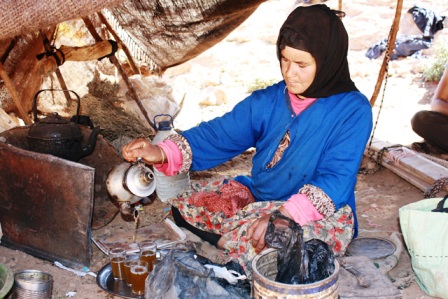
Tea Break
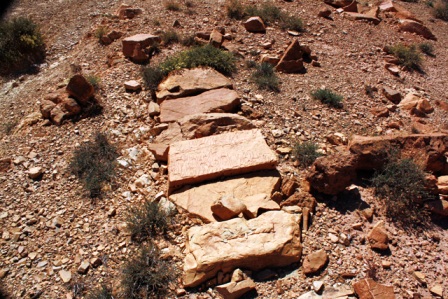
Ancient Cemetary
After our rest and refreshments, we continued across the
rubble strewn hills with only very low bushes for
vegetation. Just above the village of Tizgue, we passed
through the ancient cemetery. It was much simpler than our
cemeteries. Flat sandstone rocks, so much like the
surrounding landscape that it was hard to distinguish them,
were laid across the grave. Two upright slabs marked the
head of the grave. If the rocks were parallel, the person
was a man. If the rocks were perpendicular to each other,
the person was a woman. No names were carved into the
stones.
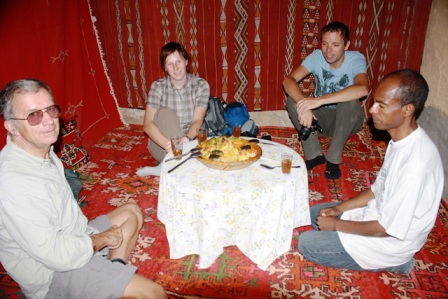 Mahjoub invited Ray and I to join Marcus, Effie and him
in a Cous Cous dinner that had been arranged at his family
home in the village. Cous Cous is not the instant meal we
have at home. In Morocco it is a meal for special occasions
as it takes several hours to prepare. It is made from
scratch, gently steamed and then the vegetables and meat are
added. We were very happy with the opportunity to visit a
local family in their home. Fourteen members of Mahjoub’s
family live together in the house, his parents, sister and
brothers, one of who is married, and three children. The
house, built in several levels on the hillside, was reached
through a series of back alleys. The family hopes to
eventually take in guests and have fixed up many of the
rooms with that view. We first climbed to a roof top terrace
for a view of the town and then were ushered into a room
whose walls and floor were covered in rugs. A huge dish of
steaming Cous Cous with chicken and vegetables was placed on
a low table in the center of the room. We were given large
spoons to eat with and to ladle our food onto plates. We ate
our fill and complimented his sister, the chief cook, on the
meal.
It is possible to hike through the mountains for three
days or to take a 4WD vehicle over very rough roads to reach
the Dadès Gorges but we went by the far less expensive and
quicker Grand Taxi. One taxi, filled to the gills, took us
down the mountain to Tinerhir and another taxi with just the
two of us for passengers, took us the rest of the way. It
was obvious our driver, who spoke no English and very little
French, was unfamiliar with the very steep and winding road.
He drove very slowly, allowing us to admire the ruined
fortress Kasbahs, pinnacle rocks and in one area, piles of
giant round boulders.
We had picked out a hotel 27 km from Boumalne at the base
of the road. It had been expanded since the Lonely Planet
report and now was large enough to accommodate a small tour
group, which had filled the hotel. The manager recommended
another hotel just down the road and even phoned for us.
Auberge Argane was a good choice. We were the only guests
and had our choice of four large, nicely decorated rooms. A
roof top terrace gave good views of the hills and the
extensive village gardens on either side of the Dadès River.
Another terrace at ground level looked over the hotel’s
private garden where the manager, Mohammed, told us most of
their fresh produce was grown.
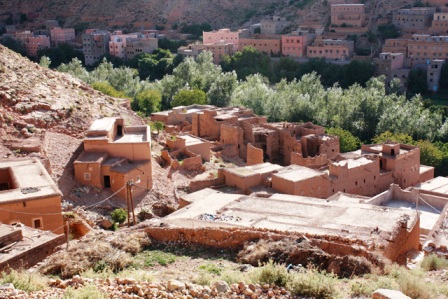 The next morning, the guide, also named Mohammed, arrived
to take us on our hike. He had to be assured that the
altitude of 2000 M was not a problem and that were were fit
enough for 3 – 4 hours of hiking. Of course we were fine.
Mohammed has been guiding since 1975. He must have been
close to 50 and smoked continually but aside from the
occasional cough, was still fit. Our walk started through
the gardens, proceeded through an abandoned village and up
an almost barren hillside. Thyme, camomile and some other
very hardy plants were the only vegetation. We quickly
reached our high point and were a little disappointed when
Mohammed told us the rest of the way was downhill. We need
not have worried. The best part was to come. We passed a
nomad farm but the family was elsewhere for the day.
Mohammed told us that the families would soon be leaving for
lands farther south. Snow does fall in this area, several
inches at a time, but it does not stay. Nevertheless it gets
too cold for families who live outdoors most of the time.
A little further on Mohammed pointed out the Gorge. We
could see a few flocks of goats climbing the rocks on either
side of the gorge. We made our way down a path to the dry
river bed running between the sheer red rock sides of the
gorge. This path becomes impassable during the rainy season
as there is always the danger of flash floods but it was
fine now. I kept stopping to take photos and Mohammed kept
urging me on. He was concerned that the goats would dislodge
rocks that would tumble down and injure us. One small stone
did roll down but we were sheltered under a rocky ledge at
the time. We continued walking down the river bed between
cliffs that were sometimes no more than an arm’s breadth
apart. Mohammed helped us descend two areas where the
alternative would be to slither down on our bellies. Soon we
reached the junction with the shallow Dadès River, crossed
on a row of rocks and scrambled up the embankment to the
road. We were pleased with the walk as we would have never
seen the best part of the gorge from the road.
Later that afternoon we set out again, intending to see
the view from a hotel built at the summit of a series of
long switchbacks, a distance of about 3 to 4 km from our
hotel. We thought it would be easier to get a ride to the
top and walk back to the hotel but when we inquired about a
local collective taxi, we were told there were none of this
Friday Holy day. We started out anyway and lucked out. Part
way up we spied a car with Dutch license plates who, when
asked, were only too happy to take along two passengers. At
the top we enjoyed the view, had tea but decided it didn’t
match the views on our walk.
It was time to move on. We had a condo reserved for a
week starting Saturday in Marrakesh. Early Saturday morning
we shared a fast, this time, taxi ride to Boumalne, with our
manager Mohammed. From there we took the bus to Marrakesh.
It was a long 7 hour journey through dramatic countryside.
We started the trip with the High Atlas Mountains in the
distance but were soon in the midst of the mountains.
Saturday must be laundry day for women were busy doing the
weekly wash in every river we crossed. Carpets, piled high
with mounds of laundry, were spread on the ground beside one
river. Railings of a footbridge over the river were hung
with more carpets and blankets that were drying after their
washing.
There were no straight roads with bridges spanning the
gaps. The narrow, paved road followed the contours of the
mountains over what must have been the original goat paths.
Up to over 2300 m and down the other side we went. At one
point there was a loud bang and the bus rattled to a stop
beside the road. I feared we had a flat tire but luckily it
was a rock that was trapped behind the wheel. The rock was
dislodged and we were on our way again. We did have a few
breaks to stretch and buy food but it was a long trip. We
were glad to finally reach the city and our condo hotel.
Return to
Morocco Intro
Return to
Travels
Return to
Introduction