Sahara Sand Dunes
Read Previous
Episode: Fez
or Next Episode:
Gorgeous Gorges
Morocco 5 October 2009 Merzouga
 We changed our transportation mode leaving Fez. We
planned to take a bus to Azrou, a small town in the
mountains farther south but the first class bus only ran at
night. The alternative was a Grand taxi. These are old
Mercedes cars imported from Germany when their useful German
life has ended. In Morocco these become shared taxis. Two
passengers sit in front with the driver and four more
passengers squeeze into the backseat. You hire a Grand taxi
at a Grand Taxi stand in one of many official locations or
you hail one from the street. It is cheap but not very
comfortable for a longer trip. We splurged and reserved the
whole taxi for ourselves. That way we could direct the
driver to stop in Ifrane, a Swiss style vacation town
popular with Moroccans. There is not very much to do there
except relax so we just took the requisite tourist photo of
a large rock in a small square. The rock was carved with the
head of a lion by a German prisoner of war while he was
interned there during WWII. Now it is the symbol of the
town.
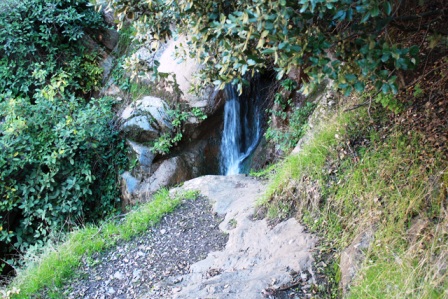
Our plan was to take advantage of the hiking trails into
the Middle Atlas Mountains next to Azrou. We did take a
small walk beside a mountain stream the afternoon we arrived
but decided to move on the next day. We planned to take the
bus to either Er Rachidia and if we made good time, continue
on to Erfoud, stay overnight, then complete the trip to
Merzouga, on the Sahara, the next day.
We got on a second class bus right after breakfast the
next morning and climbed up and over mountain ranges. The
temperature dropped enough for us to put on our fleeces on
the way to the high point of over 1700 M. The rain last week
dropped snow on the high Jebel Arachi range visible from the
bus. We started talking to a young Moroccan man, Mohammed,
the most popular name in Morocco, who was going to Merzouga.
He recommended we go all the way rather than break the trip
in a less interesting town. We decided to take his advice
and got off the bus with him in Er Rachidia. We shared a
Grand Taxi with him the rest of the way. In fact we took two
Grand taxis as each town has limits as to how far one taxi
can take passengers. Luckily there is a system to connect
with a taxi from the next town if you want to go farther
than usual. Once again we hired the entire taxi which
allowed us to stop for photos along the way. The Ziz Valley
is a must see. It has gorges, red rocks like Sedona Arizona,
and lush Palmaraie (a palm grove oasis).
Mohammed took us to the hotel owned by his friends in
Merzouga and it turned out to be a winner. Auberge Vallée
des Dunes is run for just one year by Moha (short for
Mohammed) and his Spanish girlfriend Maria. There are just
five rooms around a small courtyard, and a large sitting
room. We had a pleasant, simple room with attached toilet
and shower. Most of the hotels in Merzouga offer half-board,
which includes breakfast and dinner. The food was plentiful
and excellent.
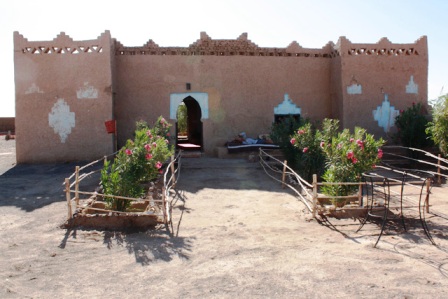
Auberge Vallée des Dunes
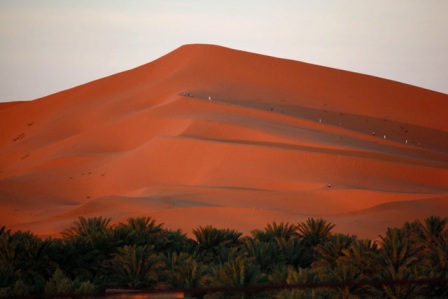
Erg Chebi
Out
the front door of the auberge was a picture postcard
view of Erg Chebbi, 190 M at its peak, the highest sand
dune in Morocco. The erg sits in the middle of a sand
dune area 35 km across and 50 km wide. The Sahara is not
just one big sand dune. The sand dune areas are like
lakes scattered over a flat base of hard packed sand
covered with a blanket of black volcanic pebbles.
Algeria has the 300 km long dune areas but Merzouga is
on the edge of the largest in Morocco. That is what we
and all the other tourists come to see.
We were not in a rush so we took the next day off to
explore the area and relax. Merzouga is on the Southeast
edge of the Sahara desert in Morocco, with the Algerian
border on the other side of Erg Chebbi. The village of
50 families is merely a collection of mud and straw
adobe style houses and hotels. Up until five years ago
the only way to get to Merzouga from Rissani, the
nearest town 25 km away, was by 4WD. Finally the paved
road was extended but it ends right at the village of
Merzouga. There are no paved roads in the village. 4WD
vehicles, motor scooters, bicycles and donkeys are the
mode of transportation in this sleepy village. Hilary
Clinton visited the village with her daughter Chelsea
when Bill Clinton was president. A local told me there
was military presence every 100 M but the positive
outcome of this visit was that electricity and running
water was installed for the village.
Between Erg Chebbi and the village is a lush
palmaraie full of date palms and small vegetable plots.
It is date harvest time in September and October. A
family harvesting their trees offered us a taste and
they were delicious. Merzouga has one of the largest
water supplies in the desert. It has been channelled
along concrete aquaducts to provide water for the
palmaraie.
There are several Riads, the luxury level of hotel,
in Merzouga. We asked if we could visit one that is just
being built. It was very nice with a large restaurant
next to a shallow swimming pool and nicely decorated
rooms. Since they are just being finished, the rates
were only Dh 300 (Dh 7 = 1 CAD) per person per day. Our
simpler auberge cost Dh 200 each so I suspect rates will
rise if it is a success.
Having rested for one day, it was time to explore
more of the area. A 4 hour circular tour of the Erg
Chebbi sand dune area in a 4WD vehicle is the way to go.
Our first stop was a shallow lake outside the town where
pink flamingos gather. There was a flock of long-haired
goat, an egret and a few ducks but no flamingos. Noone
told them we were coming.
 A
A
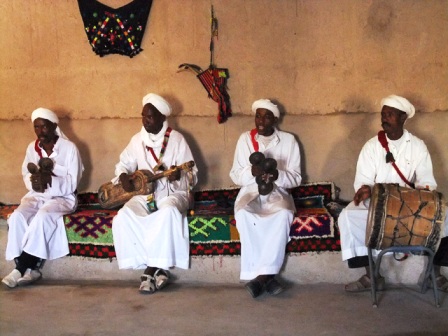
few km away is what the locals call a Black Village
populated by people from sub-Sahara countries such
as Senegal, Mali, Sudan and other countries. Some
were brought as slaves years ago and others came
north to as agricultural workers. There are no
longer many jobs in agriculture so the village has
been transformed into a musical performance stop for
tour groups. We were ushered into a small house
where one of the best known groups, the Gnawa were
performing. They play drums, a Moroccan lute and
brass hand symbols and sing in a language that is a
combination of Berber, Arabic and other native
languages. Their songs are both mystical and
ceremonial and sometimes accompanied by dancing. It
was an unusual and entertaining performance.
We drove to the back side of the Erg area to
climb a small hill with an abandoned coal mine. It
is no longer a commercial operation but locals
search the area for fossils, found all over the
area. The fossils are turned into souvenirs for
tourists. From the top of the hill we could see the
Algerian border with border posts scattered
throughout the desert. The Algerian border has been
closed for many years. We were told no one attempts
the crossing if they value their life.
We passed the tents of several nomad families who
support themselves with herds of sheep and goats.
Our picnic lunch was under a shelter made of berber
carpets next to a small farm house. I think our
driver Omar, likes the last section of the circuit
best. He gets to put his 4WD through its paces
surfing up and over small dunes. I thought we might
get stuck in the sand at one point but we made it
safely out.
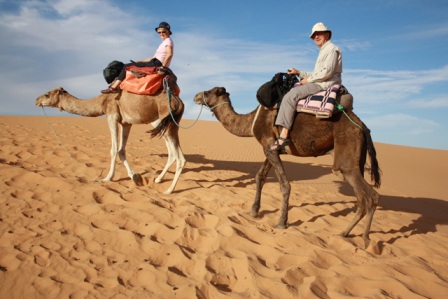
 That
That
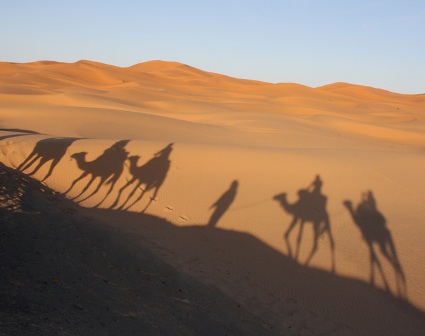
evening we got to explore some of the center of the
dunes, this time riding a camel. Ray and I took a
sunset to sunrise camel trek riding Jimmy and Asou
following behing our guide, Mohammed (another one).
We left before 5 PM and joined several other groups
all heading for the same spot. We stopped about 6 PM
to see the colours of the sand change as the sun
sank below the dunes. It took about 1 ½ hours to
reach our bed for the night. Tents made of the same
Berber blankets that created our lunch shelter were
set up permanently in a square in the dunes. There
were just the two of us at this location. Other
groups were on the other side of a dune. Mohammed
set out rugs and a small low table in the center of
the tents and made a bed for us in a tent with
mattresses, sheets and blankets. It was very
comfortable. We enjoyed a tasty chicken tagine
prepared by Mohammed in the small attached kitchen.
The moon has been full or almost full for the last
three nights so we almost didn’t need a flashlight
to see.
We looked out our tent before 6 AM to see other
camel trekkers climbing the tallest dune around to
see the sun rise over the desert. It was already
light but we quickly dressed and started climbing.
It was hard work and neither of us bothered reaching
the peak but we got far enough up to see several
small nomadic tents in nearby valleys and to see the
sun before it got over the dune peaks. There was
nothing left to do but pack up, mount our camels
again and amble back to Merzouga. Breakfast was
waiting for us at the auberge.
We left after breakfast, once again in our own
Grand Taxi (this is becoming a habit) and are
over-nighting in Erfoud where we have time to relax
again and write this blog.
Return to
Morocco Intro
Return to
Travels
Return to
Introduction