Lost in the Fez Medina
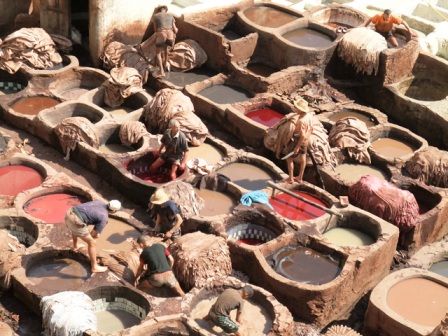
Workers in Fez Tannery
Read
Previous Episode:
Medinas or Next Episode:
Sahara Sand
Dunes
Morocco Saturday 30 September 2009
It took us three tries but we finally found our way to the
famous tanneries in Fez. The Fez Medina has a reputation for
causing visitors to get lost and we were no exception. We
started out well. We followed the directions in our Lonely
Planet and made our way along one of the main shopping roads
down a hill and up the other side, keeping our of the way of
workers leading donkeys laden with crates of soft drinks, bags
of cement or boxes of produce. The roads are so narrow that
motorized vehicles cannot negotiate the inner medina. Each time
out we managed to reach the small plaza Place ai-Seffarine, but
the route from the Place to the tanneries remained a mystery
until our third foray.
 It didn´t really matter as we discovered many other areas
almost as interesting. One of the first areas we passed through
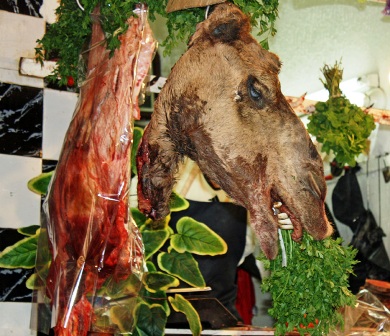
was the butchers´ market. Small stalls sold beef, mutton, goat
and camel meat cut to order. The camel butcher advertised his
product with a camel head chewing a bunch of leaves hanging to
the side of his stall. Cats were everywhere, poised expectantly
below the counter of the butcher waiting for whatever scraps of
meat the butcher wanted to throw to them.
There were the usual shops selling carpets and crafts, such
as wooden inlaid articles, tin lamps, mirrors in silver frames,
herbs, fruit and vegetables and of course leather goods, a
specialty in Fez. There were arrays of purses, belts, shoes,
poofs, jackets and many other items waiting for prospective
buyers. The medina is a shopper´s heaven.
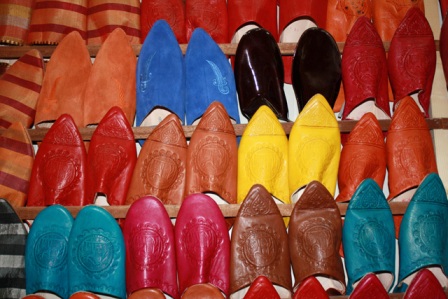
Leather shoes in market
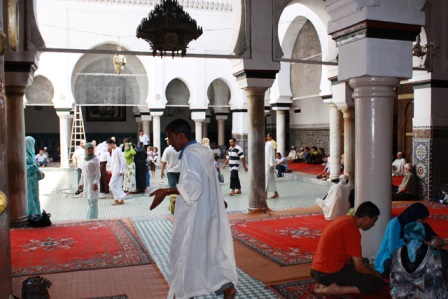
Medersa Bou Inania theological
college
We stopped to visit the recently restored Medersa Bou Inania,
the finest theological college in Fez and Morocco. It was built
from 1350-1357 and boasts some of the best examples of
decorative tilework and carved concrete. A women´s room and
separate men´s room both had acoustically correct cedar ceilings
so that no students would miss the reading of the Koran. These
rooms flank an anteroom centered with a pool in which Muslims
wash before visiting the mosque on the side facing Mecca.
The Kairaouine Mosque and University was farther into the
medina, near the Place ai-Seffarine. First built in 859 by
Tunisian refugees and expanded in the 12th C the mosque is the
largest in Arica and the adjacent building houses the oldest
university in the world. Non-Muslims not allowed in but there
are excellent views through open doors on several sides. The
interior of the mosques was crowded with Muslims come to say
their prayers and pay their respects at the mausaleum of Moulay
Idriss II, the son of ruler buried near Volubilis.
If we had obtained the services of one of the many unofficial
guides, men who offer to show you the way with a side visit to
their shop, we would have reached the tannery area on our first
attempt. We did succumb to the services of a few unofficial
guides. We visited a small sheep skin processing room where the
skins were scraped and washed. The visit was free but we had to
pay the guard. Another time we followed a shop owner through the
shoe and fabric district to his shop to climb stairs for a
roof-top view of the Mosques. We gave him a small amount for his
efforts as we didn´t succomb to his sales pitch to bring home a
camel hair blanket or two. After climbing several sets of stairs
in the median I can safely say that the stair builders have
never heard of a standard width or height for the stair treads.
We finally found the right path to the tanneries by listening
to the advice of a market worker lolling on his hand cart
waiting for his next job and following a tour group. Speaking of
tour groups, Wednesday must be the most popular day for groups
to tour the Fez Medina. We had to jockey for position with
several overly large groups following a leader holding aloft a
flag or umbrella. Our advice would be to travel only with a very
small group in Morocco. The streets are too narrow to
accommodate large groups.
The tanneries follow the same practices developed in medieval
times. Workers are organized in guilds and membership is handed
down from generation to generation. It is extremely dirty work
but the workers are proud of their skills and the end products
are world class.
The best viewing spot for the tanneries is from a roof top
terrace above one of the many shops surrounding the tanneries.
We accepted the assurances of a shop owner that there would be
no charge to view from his terrace and he was true to his word,
although he did hope we would buy some of his wares. We were
offered a sprig of mint to hold up to our nose to combat the
powerful smell of vats full of a combination of pigeon poo and
cow urine used to process the hides. We didn´t need the mint as
we both had minor colds and couldn´t smell a thing.
We looked down on a large area pockmarked with tile lined
concrete vats, just large enough for one worker. Men worked
busily first washing and curing the hides of cows, goats, sheep
and camels, then dying them in an array of colours. Only natural
dyes are used in the process ; walnuts for brown, roses for
pink, poppies for red, indigo for blue, mint for green and
saffron for yellow. We watched fascinated, snapping pictures
while men filled the vats with skins, stomped on them to
incorporate the dyes then piled them on the narrow separations
between the vats for the next step. Some men wore rubber boots
and gloves for the most caustic operations but most worked in
shots and either bare feet or sandals.
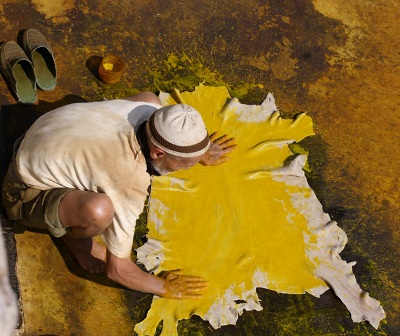
We watched one man on the roof top directly below us spread
yellow dye with his hands on hides and spread them on straw to
dry in the sun. I have to think there is a fair incidence of
illnesses due to the chemicals the men are exposed to day after
day. The tanneries are the most popular tourist draw in the
medina and we would have been sorry to miss seeing them in
action.
Fez is divided into three main sections, the Medina, the
Mellah, just a short distance from the Medina, and the Ville
Nouvelle, the modern commercial and suburban district, farther
south. The Mellah, a district established as a refuge for Jews
in the 14th C. About 200 families still live in Fez. Their homes
remain but they have moved to better housing in the Ville
Nouvelle.
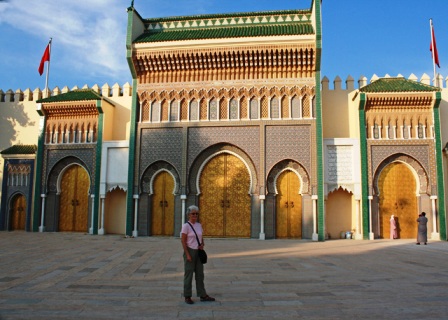
We found our way to the Mellah and saw a few of the homes but
never did manage to find the old synagogues. It didn´t matter.
We were content with the huge ornate gates of the Royal Palace,
which occupies a large area adjacent to the Mellah.
Return to
Morocco Intro
Return to
Travels
Return to
Introduction