Java Episode 5: Temples, Birds and Puppets
Click
the photo above
to see an album of photos. Close the window to return to this page.
Read previous
Jogja Treats or
next Solo
Monday 1 February 2010 Yogyakarta Indonesia
Europe has its churches, Asia has its temples. It had better be good to get
me up before 5 AM, and it was. Six tourists piled into a comfortable AC minvan
to drive to Borobudur, less than an hour to the west of Yogya.
Angkor is the largest complex of temples in Asia but Borobudur is the largest
single temple.It was built between 750 AD and 850 AD to depict the Buddhist
vision of the cosmos. The site was buried for centuries beneath ash from the
eruption of nearby Gunung Merapa, which is still active. It was not uncovered
until 1815 when Sir Thomas Stamford Raffles, goveror of Java, discovered the
ruins, probably at the suggestion of locals. The Dutch started restoration in
the early 20th C but the real work wasn’t done until a UNESCO coordinated effort
proceeded from 1973 to 1983. The resration had to begin again when Soeharto
opponents exploded bombs planted at the top of the temple in 1985.
We hired a guide to take us around and explain the significance of the site
and the many intricately carved relief panels decorating the sides of the
temple. Six square terraces topped by three circular terraces surroung the main
stupa, which is wrapped around a small hill. There are niches containing 432
Buddha statues on the middle levels and another 72 Buddha statues each in its
own lattice stupa on the top level. Some of the carved relief panels tell the
consequences of good and bad behaviour while others depict the life of Buddha
from his birth to his death.
Our guide said the complex resembled the sacred lotus flower. Lonely Planet
said that the terraces were arranged like a 3-D tantric mandala. A mandala
unites the forces of opposites, of darkness and light. Mandalas may be employed
for focusing attention of aspirants and adepts, as a spiritual teaching tool,
for establishing a sacred space. The tantric aspect refers to the union of inner
masculine (method) and feminine (wisdom) forces. The builders were probably
early Vajrayana or Tantric Buddhists who used the site as a walk-through
mandala. A large procession of tourists and locals, led by two monks, made their
way to the stairs of the temple complex just ahead of us. Our guide said that
the monks come periodically to Borobudur to lead groups around the temple. We
kept meeting up with the group during our visit as they chanted their way around
each of the terraces, stopping periodically for prayers. It must have been that
mandala trip!
There was a small museum on the site explaining how the restoration process
worked and a room full of photographs of each of the carved relief panels. None
of our group spent too much time in the museum. We were all anxious to haveour
promised breakfast at an on-site restaurant at 8:30 AM.
We piled into the minivan after breakfast and drove a short distance to a
small temple in the village. I guess we should have paid the 3000 RP admission
to go inside Mendut Temple to see the reputedly splendid statues inside but we
didn’t. We just admired the outside of the temple. We were anxious to get to our
next destination.
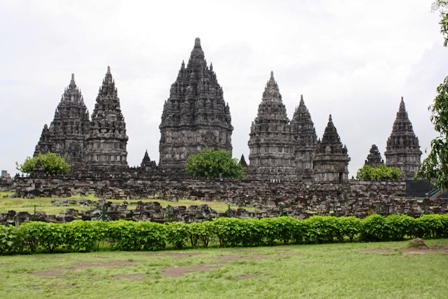
Prambanan, built about 50 years after Borobudun, was about a one hour drive
to the east. It was built in 856 AD to commemorate the marriage of a Hindu
prince and a Buddhist princess. The main complex consists of three large temples
dedicated to the Hindu gods Shiva, Vishnu and Brahma. The Buddhist temple Sewa
was about 850 M away but we didn’t get the chance to visit it. Once again we
hired a guide to show us around as there is no helpful explanatory information
at the site. The complex was abandoned one century after it was built and
further destroyed by a 16th C earthquake. Some efforts were made to restore it
in 1885 but it was not until 1937 that restoration really began. Then the
epicenter of an earthquake in 2006 was near the site. Restoration is still
ongoing and some of the temples are still damaged and off limits to visitors. We
were able to go into some to see their huge sculptures, including a four-headed
Shiva and in a smaller temple, his vehicle, Nandi the Bull. Our guide described
how the sculpted panels told the story of the Ramayana through the complicated
legends of Vishnu’s earthly journey as Prince Rama. He also pointed out a
flower-like design that he said was a depiction of female ovaries, a recurring
fertility theme. There were also a few panels with Kama Sutra characters in the
throes of sexual games. Oh how our Christianized sensibilities are tested!
After our visit we followed the sound of gamelan music to a courtyard in
front of a small museum. A group of amateur musicians were practising. When they
finished their number they suggested we view a film on the complex. It was quite
interesting, exploring the difference between how the current civilization is
polluting the earth compared with the harmony between man and nature that was
achieved by the Prambalan civilization. The film went on to tell the story of
the Ramayana using photos of the sculpted panels to illustrate the story.
We didn’t hear the end of the tale. We had to return to our van and our
driver who was waiting to drive us back to Yogyakarta, with a brief lunch stop
on the way. It was an entertaining a worthwhile trip. I still find the temples
fascinating, even after all the ones we saw in Myanmar. Each site is different
and has its own charms.
Birds do sing in their cages, even in the rain. It had started to rain
lightly but steadily just as we left our guesthouse back in Yogyakarta to walk
to the Bird Market in Yogya. After bargaining with a few rickshaw drivers, we
settled on a price and hopped in. We had to open our newly purchased umbrella to
shelter our knees from the rain but the rain had stopped by the time we reached
the market and the birds were in full song. The birds in their bamboo cages were
sweet but their food, live maggots, crickets and ants were repulsive and
fascinating. I am sure the birds find them tasty but I don’t care to join them.
A bonus was a fruit and vegetable market right next to the bird market. There
are always different products for sale that we can try. Rambutans and Snake
fruit are in season and both are delicious.
We wandered into a restoration site that is the Taman Sari, the Water Castle.
Built as a pleasure garden in 1758 it had been reduced to a few ruined walls
until recent restoration efforts began. It is far from complete and will be
interesting to see if its former water gardens are restored.
Wherever we walked in Yogya, as in other Indonesian towns, we were approached
and asked if we would like to see something special. We had already seen the
Batik production. This time we accepted an invitation to see traditional leather
shadow puppet making. We followed our guide to a small workshop near the Palace.
Two men were sitting on benches making these famous puppets made from buffalo
skin. There are 350 different traditional puppets. The men were working on
variations of a man. The shape of a standing man with a crown on his head had
been cut from the hide. Long skinny arms with joints at the shoulder, elbow and
wrist were attached to the body. One man was cutting tiny shapes out of the body
with tools made from motorcycle spokes. Our guide explained the meaning of each
small part of the design. Nothing is left to chance. A second man was using
natural colour oil paints to complete the puppet. He covered both sides of the
one dimensional puppet with yellow paint then applied pink and white to the
design. The finished puppet will be painted on both sides in many more colours.
It takes about one week or more to cut the design and at least another week to
complete the painting of the puppet. There were many finished puppets to admire
and of course they were all for sale. If you were a collector you would have
bought several, but we are not. We left empty handed.
Stretching back from the main street, Jalan Malioboro, named for the Duke of
Marlborough, is the huge central market complex. Consisting mainly of clothing
and household goods, there is an interesting spice section in the back. Anything
you would need for a curry or an Indonesian chilli or peanut sauce is available
here. We were handed pieces of spice to smell and guess what they were.
Now that we had seen how the puppets were made, we had to attend a
performance to see how they are used. There is a performance of Wayang Kulit
(Leather shadow puppets) every night in the Sono-Budoyo Museum, next to the
Palace compound. We were given a small brochure as part of our ticket pointing
out what portion of the Ramayana story was to be presented that night. The whole
story would take several days to portray so just one episode is portrayed each
night. We saw the story of Rama’s Dam, but to tell you the truth we couldn’t
tell what was going on as we don’t know the story and it was all in Javanese. It
didn’t matter.
We walked into a room with a few rows of folding chairs in front of a full
gamelan orchestra, including three women singers. The screen against which the
puppets would play was a large white sheet lit from above and decorated with a
fringed curtain along the top. Puppets of all shapes and sizes were arrayed on
each side of the screen The puppeteer sat on the ground behind the orchestra in
front of the screen. Each puppet is supported by a long stick attached to its
feet. The puppeteer worked one or two of the puppets at a time by holding them
up against the screen and manipulated their long, skinny jointed arms. He took
the speaking parts of the characters and told the story to the accompaniment of
the gamelan orchestra and singers. We could see all the different colours of the
puppets but couldn’t see their silhouettes. We walked around to take seats at
the back of the screen to see that aspect. We were able to change seats at will
and take photos whenever we wanted. Even though we didn’t understand the story
and didn’t stay until the end, it was a great show.